
Quick Answer: What Toilet Paper Is Septic Safe?
For septic systems, septic safe toilet paper is not simply the softest roll or the most familiar brand. It is the paper that breaks down after flushing without staying as a dense wet sheet. A safer choice usually has a simple sheet structure, suitable ply, controlled wet strength, and no unnecessary fragrance, dye, lotion, or coating.
A brand name can help users start the search, but it should not be the only reason to trust a septic-safe claim. Two toilet paper products from the same brand may use different ply, thickness, embossing, additives, or wet strength. What matters most is how the finished sheet behaves after flushing.
A product marketed as septic safe toilet tissue still needs a structure check. For homeowners, that means choosing paper that disperses well and avoiding products that stay strong when wet. For retailers, distributors, and private label buyers, it means reviewing the specification before using septic-safe wording on packaging, product listings, or sales materials.
What Actually Makes Toilet Paper Septic Safe?
What makes toilet paper septic safe is not one feature alone. A toilet paper product is generally more suitable for septic systems when it can separate into smaller fibers after flushing instead of staying in dense clumps. The faster the sheet disperses, the less stress it may place on plumbing lines, septic tanks, and downstream treatment areas.
This is also what is septic safe toilet paper really means in practical product terms. Ply count matters, but so do toilet paper GSM, wet strength, embossing, sheet size, fiber mix, and additives. A thin product that is heavily bonded may still break down slowly. A softer product may feel premium, but it needs closer review if it uses lotion, fragrance, heavy surface treatment, or dense quilting.
A common issue appears when a toilet paper looks safe on the package but behaves differently in water. A thick, comfort-focused roll may feel premium, but if the sheet stays bonded after flushing, the problem usually comes from GSM, wet strength, bonding, embossing, or surface treatment rather than ply count alone. That is why septic-safe claims need to be checked against the finished product, not just the front label.
Septic safe toilet paper meaning should be tied to the finished product, not only to the wording on the package. For sourcing or product development, the useful checks are practical: how the paper breaks down, how strong it stays when wet, and whether the product structure matches the claim.
| Check Point | قد تبدو اللفة الأوسع أفضل للمستخدم النهائي، ولكنها يمكن أن تقلل من عدد اللفائف في الكرتون. قد يؤدي القطر الخارجي الأكبر إلى تحسين التواجد على الرف، ولكنه يمكن أن يزيد أيضًا من حجم الكرتون. قد يقلل القلب الأكبر من الورق القابل للاستخدام مع الاستمرار في شغل مساحة داخل الكرتون. |
|---|---|
| Breaks down quickly | Helps reduce clogging and sludge buildup risk |
| Suitable ply | 1-ply often disperses faster, while 2-ply, 3-ply, and 4-ply need closer structure checks |
| Moderate wet strength | Paper should hold during use but still disperse after flushing |
| Simple sheet structure | Thickness, embossing, bonding, and GSM can affect breakdown |
| No heavy fragrance, dye, or lotion | Additives may add unnecessary variables for septic use |
| Clear claim support | Septic-safe wording should match product design and sample review |
Septic Tank Safe and Septic System Safe Mean the Same Buying Question
People may search for septic tank safe toilet paper, septic system safe toilet paper, toilet paper safe for septic tanks, or bathroom tissue safe for septic systems. The wording is different, but the buying question is almost the same: will this toilet paper break down well enough after flushing?
A septic tank is only one part of the system. The full septic system also includes pipes, wastewater movement, drainage, soil treatment, and regular maintenance. Toilet paper is not the only factor in septic performance, but slow-dispersing paper can add avoidable stress, especially in older systems, low-flow conditions, or poorly maintained tanks.
Septic tank safe toilet paper and septic system safe toilet paper should both be judged by product behavior, not by label wording alone. The same basic support is needed: suitable sheet structure, manageable thickness, controlled wet strength, and clear breakdown performance.
Ply Matters, But It Does Not Decide Everything
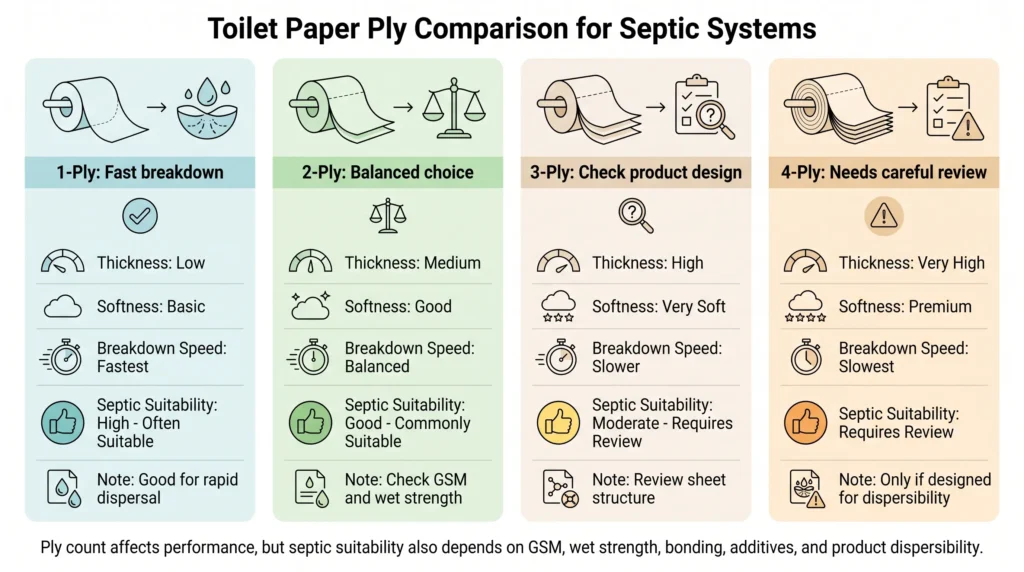
Ply count is one of the easiest toilet paper features to compare, so it often appears in septic-safe searches. Many users assume 1-ply is always safe and thicker paper is always risky. That shortcut misses the real product question.
Searches such as 1-ply septic safe toilet paper, 2-ply septic safe toilet paper, 3-ply toilet paper septic safe, 4-ply toilet paper septic safe, and septic-safe toilet roll all point to the same issue. how quickly the finished sheet breaks apart after flushing. A thinner paper often disperses faster, but ply count does not work alone. GSM, fiber bonding, wet strength, embossing, and additives can change how the sheet behaves in water.
A well-designed 2-ply or 3-ply product may be more suitable than a poorly dispersing 1-ply product. A 4-ply product needs the closest review because comfort-focused thickness can slow breakdown if the paper is not engineered for dispersibility.
| Toilet Paper Type | Septic-Safe Potential | Buyer Check |
|---|---|---|
| 1-ply toilet paper | Usually easier to disperse because it is thinner | Good for quick breakdown, but may not match all comfort or retail positioning needs |
| 2-ply toilet paper | Often a practical balance between comfort and breakdown | Check GSM, wet strength, embossing, and dispersibility |
| 3-ply toilet paper | Can still be suitable, but thickness matters more | Review sheet structure, additives, and breakdown behavior |
| 4-ply toilet paper | Needs the most careful septic-use review because it is thicker | Best positioned carefully unless dispersibility and septic-safe claims are supported |
| Ultra-soft or heavily quilted multi-ply toilet paper | Higher risk if it breaks down slowly | Avoid broad septic-safe claims unless performance support is clear |
For Newland Bamboo buyers, this distinction matters because bamboo toilet paper is commonly developed in 2-ply, 3-ply, and 4-ply toilet paper options. The right choice depends on the target market: household septic use, retail comfort positioning, hospitality supply, RV-sensitive use, or private label packaging claims. Ply is the starting point, not the final answer.
How to Tell If Toilet Paper Is Septic Safe Before You Trust the Label
How to tell if toilet paper is septic safe starts with the finished sheet, not the front label. The same rule applies when a product is described as toilet tissue safe for septic systems. The same rule applies when a product is described as toilet tissue safe for septic systems. A septic-safe label is useful, but it should not replace product review. If the sheet is dense, heavily quilted, lotion-coated, or designed to stay strong when wet, it deserves closer review before being positioned for septic systems.
The second check is the specification. For sourcing or private label projects, review ply, GSM, sheet count, إذا كنت تحتاج فقط إلى إجابة "ما عرض لفة ورق التواليت"، فإن النطاق العملي يبلغ حوالي, wet strength, embossing, additives, and material composition together. These details help determine whether the product can support a septic-safe claim in the intended market.
How to test if toilet paper is septic safe is usually discussed through a simple water jar test. Some users place several sheets in water, shake gently, and check whether the paper separates into smaller fibers instead of staying as a dense wet sheet. This can help compare products quickly, but it is only a basic screening method. It is not laboratory testing, certification, or a guarantee that the product will perform the same way in every septic system.
Does septic safe toilet paper dissolve? In practical terms, it should break apart or disperse more readily than products designed for wet strength, such as paper towels or wipes. For packaging and product listings, the safer approach is to connect any “septic safe” claim to the finished product design, not just the material name, ply count, or brand identity. If the buyer’s main concern is breakdown behavior, it may also help to compare this topic with soluble toilet paper, because solubility and septic-safe positioning are related but not identical.
Toilet Paper and Products to Avoid with Septic Tanks
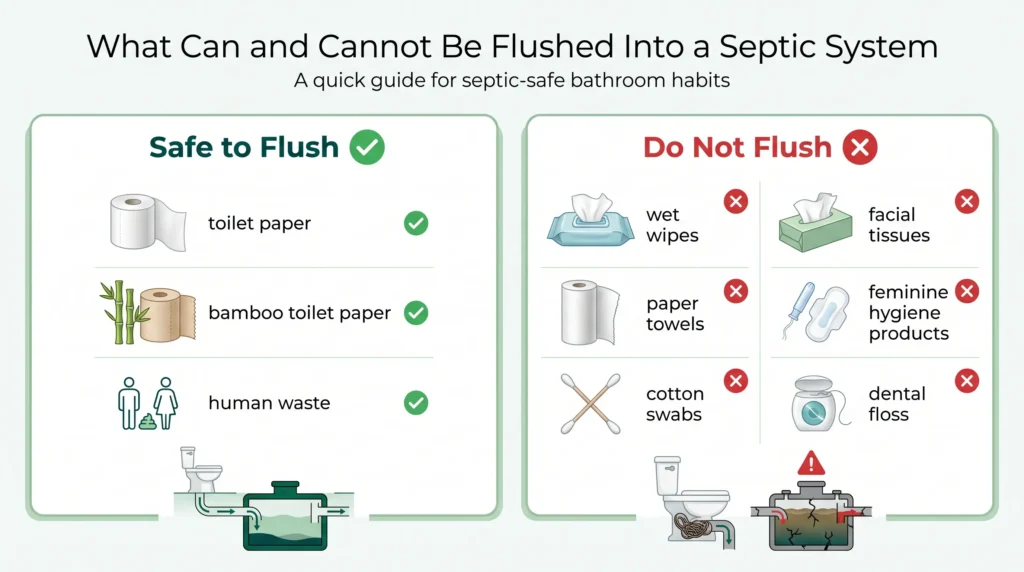
Toilet paper to avoid with septic tanks is usually paper that stays thick, strong, or coated after it becomes wet. In a septic context, that can be a problem because the product may not disperse like ordinary toilet paper.
| نوع المنتج | Why It Can Be a Problem |
|---|---|
| Ultra-thick multi-ply toilet paper | May break down more slowly and increase buildup risk |
| Heavily quilted toilet paper | Extra texture and thickness can slow dispersal |
| Lotion-coated toilet paper | Added surface treatment may affect how the sheet breaks apart |
| Scented or heavily dyed toilet paper | Fragrance and dye add unnecessary variables for septic use |
| Wet wipes or “flushable” wipes | Often do not break down like toilet paper and may create blockage risk |
| Paper towels | Designed for wet strength, not toilet flushing |
| Facial tissue | Made for softness and facial use, not septic dispersibility |
Paper towels, wet wipes, and facial tissues should not be treated as toilet paper substitutes. They are designed for different use cases, often with stronger wet performance. That strength is useful for cleaning, wiping, or facial use, but it is not ideal for flushing into septic systems. The EPA advises users to only flush toilet paper, and Michigan State University Extension notes that facial tissues, baby wipes, and paper towels can damage septic systems.
For toilet paper, toilet tissue, or bath tissue products designed for flushing, the issue is usually not one single feature. A soft paper can still be suitable if it disperses well. A thick paper can be risky if it stays bonded too long. A premium product can be attractive for retail, but septic-safe wording should be reviewed separately from softness, comfort, and luxury claims.
Brand Names Help, But Specifications Decide the Claim
Many users search for septic safe toilet paper brands because brands are easy to recognize. This is why search results often mention well-known products or best septic safe toilet paper lists. Those lists can help homeowners start comparing options, but they do not answer the full product question.
For a homeowner, brand names make comparison easier. For a buyer developing a private label line, brand logic is not enough. The real question is whether the approved sample, ply, GSM, wet strength, embossing, and packaging claim can stay consistent when the order moves into bulk production. Two products under the same brand can perform very differently if one is designed for quick breakdown and the other is built for luxury comfort.
A stronger buyer conversation starts with product details: ply, GSM, wet strength, sheet count, embossing, roll size, wrapping style, carton packing, material composition, and claim wording. For private label projects, the approved sample should also match what will be repeated in bulk production. That helps buyers avoid a common problem: the packaging claim sounds clear, but the final product structure has not been reviewed closely enough to support it.
A Short Note on RV Use
Septic safe toilet paper for RV use needs a separate check. RV holding tanks are smaller, use less water, and can be more sensitive to slow-dispersing paper.
RV toilet paper vs septic safe toilet paper is not always a one-to-one comparison. A general septic-safe claim does not automatically mean the product is ideal for RV, camper, or marine use. For buyers planning RV-oriented packaging or listings, the product should be reviewed under that use case instead of treating RV-safe and septic-safe as the same claim.
A Short Note on Bamboo Toilet Paper
Is bamboo toilet paper septic safe? It can be, when the finished product is designed to break down quickly, uses a suitable ply and GSM, and avoids unnecessary fragrance, dye, lotion, or heavy coating. Bamboo material alone does not automatically make a product septic safe.
Bamboo toilet paper septic safe performance depends on the finished specification. A bamboo toilet paper product may be 2-ply, 3-ply, or 4-ply. Each version can have different sheet thickness, wet strength, embossing, and breakdown behavior. The finished specification matters more than the material name alone.
For a deeper review of septic safe bamboo toilet paper and bamboo-specific product checks, see our dedicated guide: Is Bamboo Toilet Paper Septic Safe?
Buyer Takeaways
Septic-safe toilet paper should be chosen by structure, not only by label. The strongest signs are quick breakdown, suitable ply, controlled wet strength, simple sheet construction, and limited unnecessary additives.
For consumer-facing brands, this helps reduce confusion around claims such as soft, strong, biodegradable, bamboo, recycled, or septic safe. These claims can support a product story, but they do not replace product performance.
For wholesale and private label buyers developing toilet paper, toilet tissue, or bath tissue products, the useful review starts before packaging is finalized. Confirm ply, GSM, wet strength, embossing, sheet count, material, sample behavior, packaging wording, and target market expectations. A 2-ply, 3-ply, or 4-ply bamboo toilet paper can be positioned differently depending on whether the priority is household septic use, premium comfort, retail shelf appeal, or downstream customer claim review.
For bamboo toilet paper sourcing, the review usually starts before the artwork is finalized. A buyer may need one product for household septic use, another for premium comfort, and another for retail shelf differentiation. In that process, ply, GSM, wet strength, embossing, sheet count, wrapping style, carton packing, sample approval, and claim wording should be checked together.
Newland Bamboo supports bamboo toilet paper wholesale projects with 2-ply to 4-ply options, bleached and unbleached choices, embossing options, and packaging development for buyers preparing يساعد في مطابقة التوقعات المحلية ومعايير الموزع. Custom tissue packaging and لفات ورق تواليت من الخيزران support can help keep the product plan easier to present, list, and repeat across markets.
For buyers comparing bamboo toilet paper specifically for septic systems, the next step is to review the dedicated bamboo guide: Is Bamboo Toilet Paper Septic Safe?
Septic Safe Toilet Paper FAQ
Does septic safe toilet paper dissolve?
Septic safe toilet paper should break apart or disperse more easily in water than products designed for wet strength, such as paper towels or wipes. It does not need to disappear instantly, but it should not remain in dense clumps after flushing.
How can you test if toilet paper is septic safe?
A simple screening method is to place several sheets of toilet paper in a jar of water, shake it gently, and check whether the paper separates into smaller pieces. This can help compare products, but it should not be treated as formal certification or a guarantee of septic system performance.
Can 4-ply toilet paper be septic safe?
Yes, but it needs closer review. A 4-ply product is thicker, so septic-safe wording should only be used when GSM, wet strength, embossing, additives, and breakdown behavior support that claim.
Can septic safe toilet paper be used in an RV?
Some septic safe toilet paper may work in RV systems, but RV use is usually more sensitive because holding tanks are smaller and use less water. RV-safe claims should be reviewed separately from general septic-safe claims.
Is recycled toilet paper safe for septic systems?
Recycled toilet paper can be suitable for septic systems if it is designed to break down well and avoids heavy additives or coatings. As with bamboo, wood pulp, or blended paper, the final sheet structure matters more than the material name alone.
Is bamboo toilet paper septic safe?
Bamboo toilet paper can be septic safe when the finished product is designed for quick breakdown and avoids unnecessary additives. For more detail, read our dedicated guide on whether bamboo toilet paper is septic safe.