
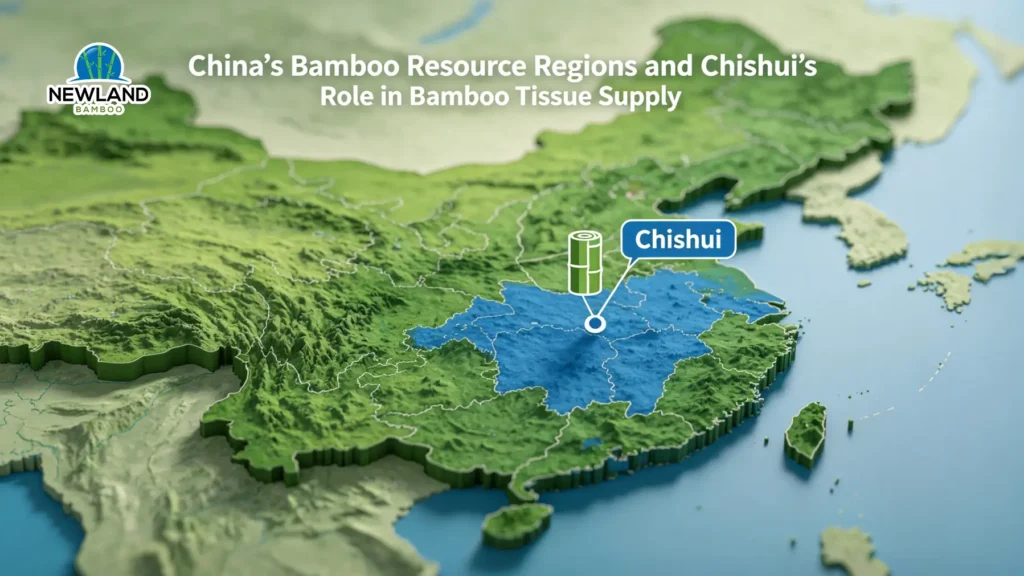
Why Raw Material Origin Matters in Bamboo Tissue Supply
When several bamboo tissue suppliers all describe their products as “eco-friendly,” a buyer still has one practical question:
What is behind that claim?
The answer often starts with raw material origin and how matériau à base de pulpe de bambou is connected to finished tissue products.
For bamboo tissue buyers, raw material origin is not just a background story. It is one of the first signals that helps buyers understand whether a bamboo tissue product is supported by a real material base or only by a marketing claim.
A bamboo tissue buyer is not simply buying finished papier hygiénique en bambou, mouchoir en bambou, or essuie-tout en bambou. In B2B sourcing, the product sits inside a longer chain:
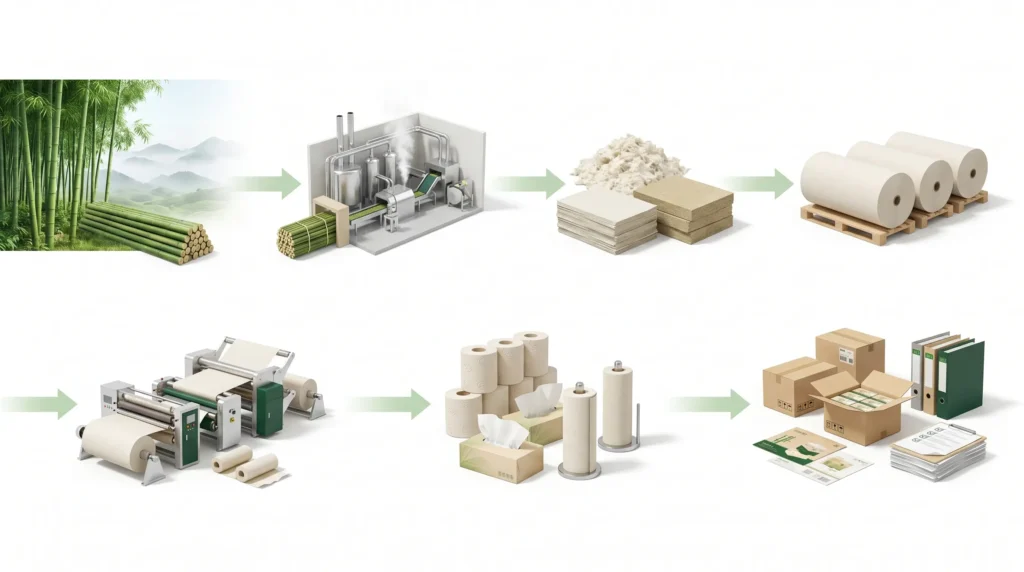
bamboo resource → bamboo pulp → household paper base material → parent roll → tissue converting → finished product → packaging and market claims
If this chain is weak, the finished product may still exist, but the buyer has less confidence when discussing supply stability, product differentiation, packaging copy, retail listing content, or long-term private label planning.
This is why bamboo resource regions matter.
A bamboo forest is not automatically a bamboo tissue supply advantage. It becomes an advantage only when raw bamboo can be harvested, organized, processed into pulp, converted into household paper base material, and supported by downstream tissue production.
That distinction is important.
For buyers, bamboo origin affects five practical questions:
- Can the material story be explained clearly?
- Is there a stable upstream resource base behind the product?
- Can bamboo pulp and parent roll supply support long-term orders?
- Can private label packaging and product pages explain the material responsibly?
- Can the buyer’s own customers understand why bamboo is being used?
This is the deeper reason Chishui matters in a discussion about bamboo tissue supply. Its value is not simply that it has bamboo. Its value lies in how bamboo resources are connected with pulp, household paper base material, local downstream converting, and bamboo-based material applications.
China Bamboo Resource Regions Map Is Broad, Not Single-Region
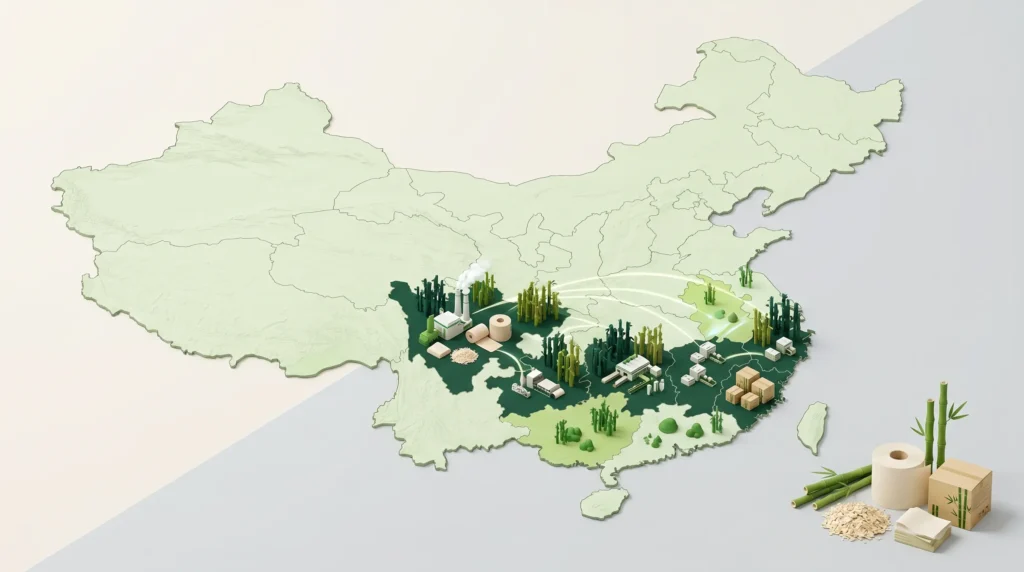
China’s bamboo resources should not be understood through one city or one province alone. The country has a broad bamboo resource base distributed across multiple regions.
China’s national bamboo resource data describes China’s bamboo forest area as spread across 20 provinces. The largest bamboo-resource provinces include Fujian, Jiangxi, Hunan, Zhejiang, Sichuan, Guangdong, Guangxi, and Anhui, which together account for most of the country’s bamboo forest area.
This matters because it prevents a simple misunderstanding: Chishui is not important because China has no other bamboo regions. China has many bamboo regions, and some of them are stronger than Chishui in certain categories.
Some regions have larger overall bamboo industry scale.
Some have longer processing histories.
Some are better known for bamboo lifestyle products, furniture, flooring, or export products.
Some have strong papermaking associations.
For bamboo tissue buyers, the question is not which region is the biggest in every category. The better question is:
Which region helps explain how bamboo resources can become bamboo pulp, household paper base material, downstream tissue products, and buyer-facing product value?
This is where Chishui’s role becomes clearer.
Different Bamboo Regions Solve Different Industry Problems
Different bamboo regions in China have different industrial roles. They should not be treated as simple competitors in one ranking table.
| Region / Area | Main Bamboo Industry Role | Relevance to Bamboo Tissue Supply |
|---|---|---|
| Fujian and nearby southeastern bamboo regions | Large-scale bamboo industry, mature processing, export-oriented bamboo products | Shows China’s mature bamboo processing and industrial capacity |
| Zhejiang Anji and similar bamboo branding regions | Bamboo culture, lifestyle products, bamboo product branding, green innovation | Useful for bamboo storytelling and sustainability positioning |
| Sichuan and other pulp-related bamboo regions | Bamboo pulp, bamboo paper, bamboo-based industrial applications | Directly relevant to pulp and papermaking discussions |
| Guizhou Chishui | Bamboo resource density, pulp conversion, household paper base material, local downstream converting | A representative case for raw-material-to-tissue supply-chain integration |
| Jiangxi, Hunan, Guangxi, Guangdong, Anhui and other bamboo provinces | Important bamboo resource areas | Support China’s wider bamboo resource landscape |
This table is not meant to prove that one region is better than all others. It explains why different regions matter for different buyer questions.
For example, Fujian’s bamboo industry development shows how a mature bamboo region can build scale, processing capacity, and export-oriented product systems. Zhejiang Anji is more useful as a reference for bamboo lifestyle products, bamboo branding, green innovation, and carbon-related storytelling. Pulp-related regions are more relevant when the buyer’s question is connected with bamboo paper and tissue supply.
If a buyer wants to understand bamboo flooring, furniture, or export bamboo products, one region may be more relevant. If a buyer wants to understand bamboo branding and lifestyle positioning, another region may be more useful. If a buyer wants to understand bamboo pulp and tissue supply, the relevant question becomes more specific.
The question is no longer:
Where is bamboo famous?
It becomes:
Where does bamboo enter the tissue supply chain?
Chishui’s answer to that question is not based only on a title or a forest area number. It is based on a conversion chain.
Chishui Is Not “the Best” in Every Bamboo Category
Chishui should not be described as the best bamboo region in China in every sense.
That would be too simple.
It is not necessarily the largest bamboo industry base by overall provincial scale. It is not mainly known as a bamboo lifestyle branding region. It is not the only area connected with bamboo papermaking. Other bamboo regions have their own industrial strengths.
But Chishui is not an ordinary bamboo-growing area either.
Chishui was officially granted the title “China Bamboo Capital” in 2023. Chishui’s China Bamboo Capital recognition is useful as regional bamboo industry recognition, especially when explaining Chishui’s bamboo resource density and bamboo industry identity. However, it is not a product certification and should not be treated like FSC, BPI, compostability testing, or any other product-level compliance document.
Its real value for bamboo tissue buyers is more practical:
Chishui shows how a bamboo-rich region can turn raw bamboo resources into pulp, household paper base material, downstream converting, and broader bamboo-based product development.
That is a more useful point than saying it is simply “the best.”
In bamboo tissue supply, the strongest region is not always the one with the loudest cultural identity or the largest general bamboo industry. It is the region that helps explain how raw material becomes usable paper products.
Chishui’s niche is exactly here.
Chishui’s Niche: From Bamboo Forest to Household Paper Base Material
Chishui’s bamboo resource base is the starting point, but not the end of the story.
Public reports describe Chishui as having about 1.33 million mu of bamboo forest. That scale gives the region a strong raw material foundation. But for bamboo tissue buyers, the forest itself is only the first layer.
A buyer cannot import a bamboo forest.
A retailer cannot list a bamboo forest as a finished SKU.
A private label brand cannot sell “resource potential” to its customers.
The resource has to be converted.
This is where Chishui’s supply-chain meaning becomes stronger. The region is not only associated with bamboo growing. It is connected with the industrial use of bamboo for pulp, paperboard, household paper base material, and downstream products.
This is the key difference between a bamboo resource region and a bamboo tissue supply node.
A bamboo resource region can say:
There is bamboo here.
A bamboo tissue supply node can say:
Bamboo here can move into pulp, paper base material, converting, and product development.
That is why Chishui is worth studying.
Raw Material Advantage Only Matters When It Can Be Converted
A common mistake in bamboo product storytelling is to stop at the raw material.
“Bamboo grows fast.”
“Bamboo is renewable.”
“Bamboo is an alternative fiber.”
“Bamboo forests are abundant.”
These points may be useful, but they are not enough for B2B procurement.
For a tissue buyer, raw material advantage only becomes commercial value when it can be converted into the materials and products the buyer needs.
In bamboo tissue, that means several steps:
- bamboo can be harvested and supplied at scale;
- bamboo can be processed into pulp;
- pulp can become household paper base material or parent roll;
- base material can be converted into tissue formats;
- finished products can be packaged, documented, and explained to the market.
Chishui’s significance is that public reports describe this chain moving beyond raw resource ownership. According to public reporting on Chishui bamboo pulp and household paper conversion, bamboo resources are being processed into bamboo pulp board and household paper-related materials. Household paper base material is also being locally converted through downstream enterprises.
This changes the meaning of “raw material advantage.”
If a region has bamboo but weak processing capacity, its value remains mostly resource-based. If a region links bamboo resources with pulp and downstream paper-related production, it becomes more relevant to product buyers.
For bamboo tissue buyers, that difference is critical.
They need stable material support, specification discussions, samples, packaging options, and market-facing explanations. A connected supply chain makes those conversations more credible.
Local Downstream Converting Makes the Supply Chain More Valuable
The next important point is local conversion.
If bamboo pulp or household paper base material has to leave the region before any meaningful downstream processing happens, the region still has value, but its supply-chain role is less complete.
When household paper base material can be locally converted at a high rate, the region begins to show a stronger industrial ecosystem.
This matters because tissue products are specification-driven.
A buyer may need:
- 2-ply, 3-ply, or 4-ply toilet paper;
- bleached or unbleached bamboo tissue;
- facial tissue in boxes or soft packs;
- kitchen paper towels with specific absorbency;
- parent roll for local converting;
- private label packaging;
- mixed SKU supply;
- carton planning and shipment support.
These requirements cannot be answered by raw bamboo alone. They require coordination between material supply, paper base material, converting, packaging, and documentation.
That is why Chishui’s local downstream conversion is important. It shows that bamboo resource advantage is not staying at the forest or pulp level. It is moving closer to product formats that buyers can actually purchase, test, package, and sell.
This is also why Chishui’s wider bamboo industry chain matters: the region is not only discussing bamboo resources, but also processing, downstream converting, bamboo products, and material applications.
For B2B buyers, this is where raw material origin becomes business value.
Chishui’s Role in the Wider “Bamboo Instead of Plastic” Direction
Chishui’s supply-chain role is also connected with a broader material substitution direction.
In China, bamboo is increasingly discussed not only as a forestry resource, but also as a material platform, especially under the national bamboo-as-a-substitute-for-plastic action plan. Bamboo can support paper products, molded pulp, packaging, disposable items, household goods, and other bamboo-based applications.
This wider direction matters for bamboo tissue buyers because many buyers are not only comparing softness and price. They are also looking at product positioning.
They want to know whether bamboo tissue can support:
- alternative fiber positioning;
- tree-free or reduced wood-pulp storytelling;
- private label sustainability narratives;
- plastic-reduction packaging discussions;
- responsible product education for downstream customers.
Chishui is relevant because its bamboo industry is not only tied to paper. It is also connected with bamboo-based material extension, including “bamboo instead of plastic,” bamboo products, and new material directions.
This does not mean buyers should overclaim.
Bamboo origin does not automatically make a tissue product biodegradable, compostable, plastic-free, FSC certified, BPI certified, or compliant in every market. Those claims require separate evidence.
But it does mean bamboo tissue products can be placed inside a clearer material story: bamboo is not just a decorative claim; it is part of a real resource and processing system.
Why This Matters for Bamboo Tissue Buyers
The value of Chishui for bamboo tissue buyers is not emotional. It is practical.
1. Supply Confidence
A buyer is more confident when the product is connected to a real raw material and processing background. Bamboo tissue is easier to explain when the buyer understands the path from bamboo resource to pulp, paper base material, and finished tissue.
2. Product Differentiation
Bamboo tissue needs a clear reason to exist in the market, and buyers often need to explain pourquoi le tissu de bambou is different before comparing price, packaging, or certifications. If the product is only described as “eco-friendly,” it may sound generic. If the buyer can explain bamboo as an alternative fiber supported by a resource and processing system, the product becomes easier to position.
3. Private Label Packaging
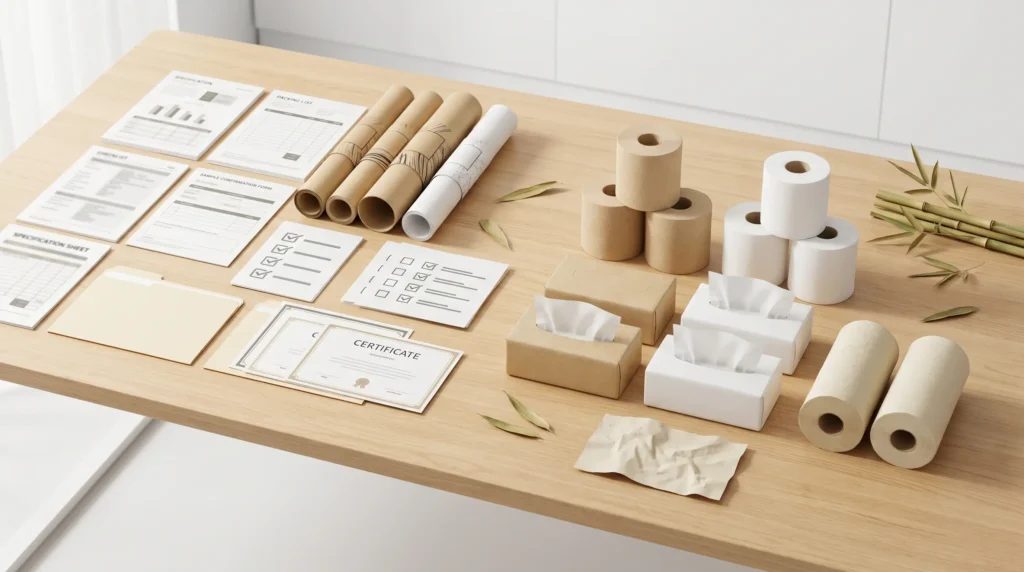
Private label buyers often need more than a finished product; they also need custom bamboo tissue packaging, product page wording, FAQ support, and claims that can be reviewed. A stronger material background helps the buyer build clearer packaging and listing content.
4. Downstream Customer Education
B2B buyers have their own customers. A distributor, importer, retailer, or hospitality supplier must explain why bamboo tissue is different. A clear resource-to-product story helps that downstream communication.
5. Claim Discipline
A strong raw material story can make marketing stronger, but it also requires discipline. Buyers need to separate resource background from certifications, testing, packaging claims, and destination-market compliance.
This is why Chishui matters. It helps buyers understand bamboo tissue as a supply-chain product, not just a green label.
How Buyers Should Use Bamboo Origin Without Overclaiming
Bamboo origin should be used carefully.
A regional title such as “China Bamboo Capital” can support resource background and industry storytelling. But it is not a product certification.
It should not be used as a replacement for:
- FSC documentation;
- BPI certification;
- compostability testing;
- biodegradability testing;
- food-contact review;
- packaging material documentation;
- destination-market compliance.
A buyer can say that bamboo tissue is connected with bamboo-based raw material and a bamboo resource story. But claims such as “compostable,” “biodegradable,” “plastic-free,” “chemical-free,” “tree-free,” or “zero impact” need to be reviewed separately.
Bamboo origin does not automatically make a tissue product biodegradable, compostable, plastic-free, FSC certified, BPI certified, or compliant in every market, so buyers should separate material storytelling from certification and claim review.
This is especially important for private label products.
The stronger the raw material story, the more carefully it should be used. Good product communication does not exaggerate the origin. It connects origin, material, product specification, packaging, and documentation in a responsible way.
What Buyers Should Ask When Evaluating Bamboo Tissue Supply
For buyers comparing bamboo toilet paper, facial tissue, kitchen paper towels, parent rolls, or private label bamboo tissue products, raw material background should lead to better questions.
Buyers should ask:
- What bamboo pulp is used?
- Is the product bleached or unbleached?
- What parent roll or finished product formats are available?
- What ply, sheet count, GSM, embossing, and roll size options can be supported?
- Can packaging be customized for retail, wholesale, hospitality, or e-commerce?
- What documents can support market-facing claims?
- Which claims should be avoided or reviewed more carefully?
- Can the supplier support product samples and specification comparison?
These are the questions that turn a bamboo resource story into a procurement discussion.
This is also where Chishui’s role becomes useful. It gives buyers a concrete example of how raw bamboo resources can move toward pulp, household paper base material, local downstream converting, and market-ready product communication.
For buyers developing bamboo toilet paper, facial tissue, kitchen paper towels, or private label tissue products, this is the kind of raw-material-to-product logic worth checking before comparing price alone.
Conclusion: Chishui Is a Raw-Material-to-Tissue Supply Chain Case
Chishui should not be described as the best bamboo region in China in every category.
That is not the point.
Its real value lies in a more specific supply-chain role. Chishui shows how bamboo resource advantage can be converted into bamboo pulp, household paper base material, downstream paper-related production, and bamboo-based material applications.
For bamboo tissue buyers, this is more useful than a simple regional ranking.
A bamboo forest becomes commercially meaningful only when it supports the next steps: pulp, parent roll, converting, packaging, documentation, and downstream customer communication.
Chishui is relevant because it helps explain that full path.
That is why it deserves attention in the bamboo tissue supply discussion.
From Chishui Resource Background to Newland Bamboo’s Supply Capability
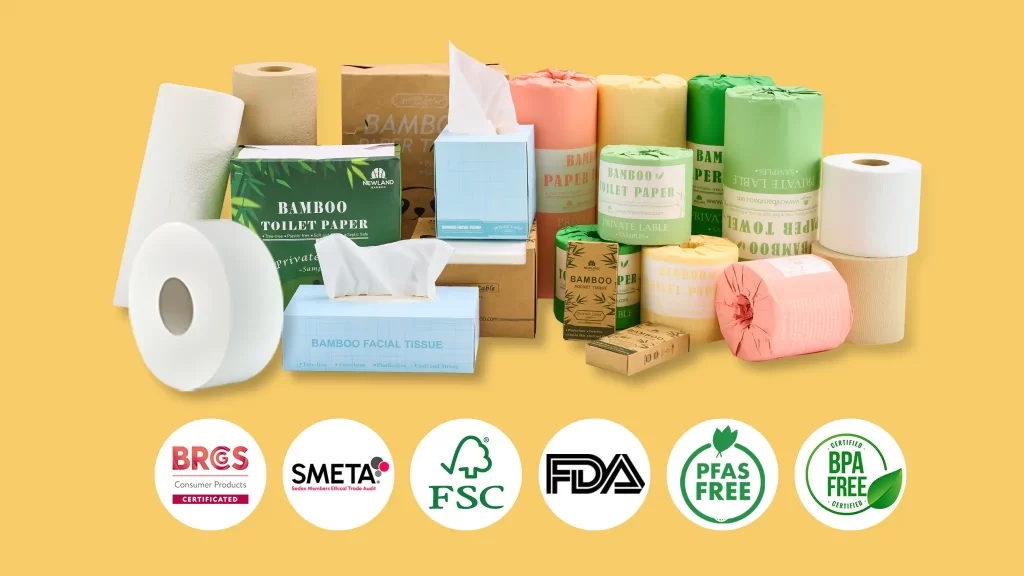
Chishui helps explain the raw material side of bamboo tissue supply, but buyers still need to know whether that material background can be turned into stable products, repeat orders, and export-ready tissue projects.
This is where Newland Bamboo’s factory capability becomes important.
Bambou Newland is based in Chishui, Guizhou, and works with overseas buyers who need bamboo toilet paper, facial tissue, kitchen paper towels, parent rolls, and private label bamboo tissue products. With a 30,000+ square meter factory, 20+ years of tissue production experience, 400+ containers per month, 7+ years of global export experience, 215+ customized tissue brands, and service to 50+ countries, Newland Bamboo connects Chishui’s bamboo resource background with practical B2B supply support.
For buyers, this means the discussion does not stop at “bamboo is eco-friendly.” It can move into real project details: product specifications, bleached or unbleached options, embossing, sheet count, roll size, parent roll or finished product format, packaging design, carton planning, sample review, certification documents, and claim wording.
This is where the Chishui resource story becomes commercially useful. It gives buyers a clearer material background to explain to their own customers, while Newland Bamboo helps turn that background into reviewable samples, practical specifications, custom packaging, export order planning, and repeat supply support.
For a buyer, the goal is not only to source bamboo tissue. The goal is to build a bamboo tissue product line that can be supplied consistently, explained clearly, reviewed responsibly, and sold with confidence.
FAQs About Bamboo Resource Regions and Bamboo Tissue Supply
Why does raw material origin matter for bamboo tissue buyers?
Raw material origin matters because bamboo tissue is a material-based product. Buyers need to understand whether the bamboo story is supported by real resources, pulp processing, paper base material, and downstream production. This affects sourcing confidence, product positioning, packaging copy, and downstream customer education.
Is Chishui the largest or best bamboo region in China?
Not in every category. Chishui should not be described as the best bamboo region for all bamboo industries. Its stronger value is that it is a representative case of how bamboo resources can be connected with pulp, household paper base material, downstream converting, and bamboo-based material applications.
What does “China Bamboo Capital” mean for tissue buyers?
“China Bamboo Capital” is a regional bamboo industry recognition. It can support resource background and industry storytelling, but it is not a product certification. It should not be treated as a substitute for testing, certification, or market compliance documents.
How does bamboo resource advantage become a tissue supply advantage?
Bamboo resource advantage becomes a tissue supply advantage only when raw bamboo can be harvested, processed into pulp, converted into household paper base material or parent roll, and supported by downstream tissue converting. Without this conversion chain, bamboo resources remain only a raw material advantage.
Can bamboo origin help private label tissue brands?
Yes. Bamboo origin can help private label buyers explain the material background of bamboo toilet paper, facial tissue, kitchen paper towels, or parent roll products. It can support packaging language, product pages, FAQ content, sales decks, and downstream customer education. However, product claims still need proper documentation and review