From Kitchen Paper to Paper Towels: How Bamboo Products Redefine Sourcing
What Is Kitchen Paper? (Beyond the Name)
At its simplest, kitchen paper refers to disposable absorbent paper designed for use in cooking and cleaning. In the UK, Europe, and parts of Asia, “kitchen paper” or “kitchen roll” is the standard term. Consumers rely on it to:
- Absorb spills on countertops and tables.
- Wipe cooking utensils and surfaces.
- Dry hands quickly and conveniently.
But for bulk buyers, the definition must go further than the everyday use. You need to evaluate the technical specifications that determine product performance and customer satisfaction.
Key Specifications for Bulk Buyers
When sourcing kitchen paper in wholesale quantities, pay attention to:
- Ply Count : Most kitchen rolls are 2-ply, but premium products can be 3-ply for extra absorbency and strength.
- GSM : The weight of the paper directly affects durability and feel. Typical ranges are 15–22 GSM per ply.
- Absorbency Rate: A critical metric for household use. Stronger kitchen paper absorbs liquid faster and holds more without disintegrating.
- Wet Strength: Unlike tissue paper, kitchen rolls must maintain integrity even when wet. Buyers should request lab test data.
- Packaging Formats:
- Individual rolls for retail sale.
- Multi-packs (2/4/6/12 rolls) for supermarkets and convenience stores.
- Bulk cartons for B2B and Horeca (hotel/restaurant/catering) buyers.
- White-label options for retailers seeking private brands.
👉 Pro Tip for Buyers: Always request a full specification sheet with ply, GSM, absorbency, and packaging details before confirming an order. This ensures you’re comparing like-for-like products across suppliers.
What Are Paper Towels? (A North American Perspective)
In the United States and Canada, the term “paper towels” is universally recognized. While the product is functionally identical to kitchen paper, regional terminology creates a distinct set of market expectations. For bulk buyers, understanding these expectations is crucial to successfully entering and competing in North America.
Market Expectations in the US & Canada
- Standard Roll Sizes
- Common retail rolls contain between 60–120 sheets, with each sheet typically sized around 11 × 9 inches (27.9 × 22.8 cm).
- Jumbo or “mega” rolls are increasingly popular, offering consumers better value-per-sheet and reducing packaging waste.
- Select-A-Size Format
- One of the most notable preferences in North America is the “Select-A-Size” feature, where perforated sheets are cut into half-sizes.
- This allows consumers to use smaller portions, which is marketed as cost-saving and eco-friendly.
- For buyers, this means suppliers must have precise cutting and perforation machinery to meet these requirements.
- Embossing and Design Patterns
- Consumers often associate embossing with absorbency and softness.
- Popular options include dot, wave, or quilted patterns, which not only improve performance but also enhance visual appeal.
- Consumer Preferences
- North American shoppers are brand-conscious, with major players like Bounty, Viva, and Scott dominating the shelves.
- However, private label brands are rapidly growing, especially those offering eco-friendly positioning or value-oriented bulk packs.
- Retail Channels
- Paper towels are sold across multiple channels: supermarkets, warehouse clubs (Costco, Sam’s Club), e-commerce (Amazon), and dollar stores.
- Each channel demands different packaging strategies and MOQ (minimum order quantity) expectations.
👉 Pro Tip for Buyers:
Pro Tip for Buyers: If you’re targeting the North American market, competing on price alone against giants like Bounty is challenging. Differentiation is key. Bamboo paper towels offer a compelling story:
- Eco-Premium Positioning: Bamboo’s natural sustainability allows you to tap into the growing green consumer segment.
- Performance Meets Conscience: Our bamboo pulp is engineered for high absorbency and wet strength, debunking the myth that eco-friendly means less effective.
→ The First Step to Differentiation: Success here starts with the right material and the right specifications. We recommend requesting a comparative sample kit to feel the strength and absorbency of bamboo versus traditional products. This hands-on test is the best way to validate your branding strategy.
👉 Conversion Point: Looking to launch a private-label paper towel brand in the US or Canada? Our factory provides OEM solutions with Select-A-Size technology, multiple embossing options, and FSC-certified pulp. Contact us today for a customized quotation.
Key Differences: Terminology, Markets, and Consumer Habits
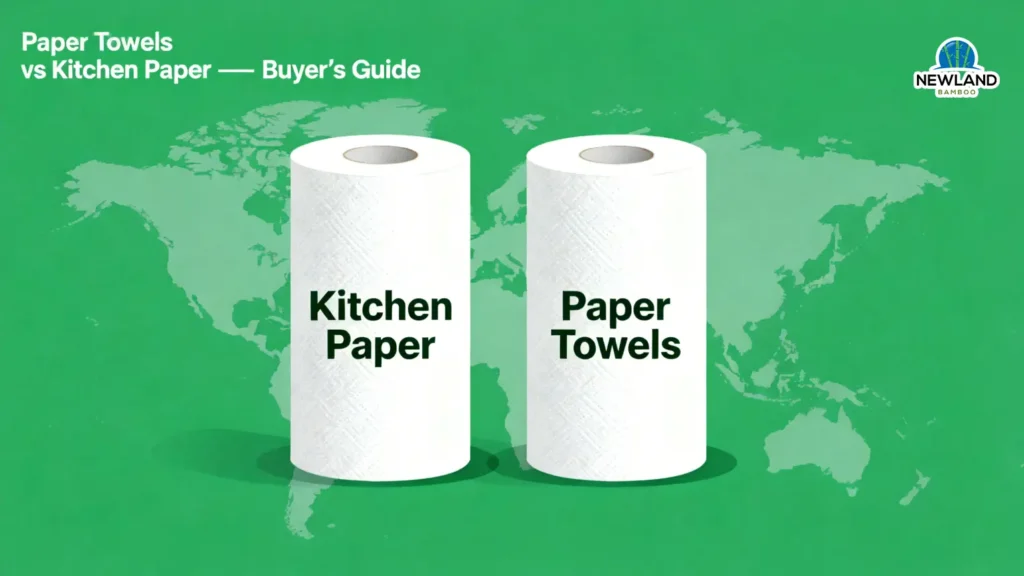
At first glance, paper towels and kitchen paper seem like interchangeable terms. In reality, the difference lies not in the product itself but in regional language, consumer habits, and sourcing implications.
Here’s how the two compare:
| Feature | Kitchen Paper (UK/EU) | Paper Towels (US/Canada) | Sourcing Implication |
|---|---|---|---|
| Terminology | “Kitchen Paper” or “Kitchen Roll” | “Paper Towels” | Packaging and labeling must be localized. Using the wrong term may confuse consumers and affect sales. |
| Standard Roll Sizes | Often larger rolls (up to 200 sheets per roll) | Smaller rolls (60–120 sheets), plus “Mega” rolls | Ensure roll sizes match local consumer expectations and shelf dimensions. |
| Popular Features | Focus on absorbency and ply strength | Select-A-Size perforation, embossed designs | Verify supplier has the right converting equipment to meet local demand. |
| Consumer Behavior | Treated as a household essential, less brand-sensitive | Highly brand-driven, dominated by major players but open to private labels | Entry into North America requires stronger differentiation strategy (eco-friendly, premium, or value packs). |
| Perceived Value | Functional necessity, price-sensitive in some regions | Premium perception possible, tied to convenience and branding | Align product positioning (premium eco, budget bulk, etc.) with channel strategy. |
👉 Pro Tip for Buyers: When sourcing, always align product specifications with target market norms. For example, a 200-sheet kitchen roll may succeed in the UK but be considered oversized and less attractive in the US.
👉 Conversion Point: Avoid costly mismatches between your product and your market. Partner with a supplier who understands these regional differences and can tailor specifications for your target audience.
The Strategic Relationship for Global Sourcing
For global buyers, knowing the terminology difference is only the beginning. The real challenge is finding a manufacturing partner who can translate those differences into practical, market-ready solutions.
Choosing the right supplier means more than securing a competitive price. It’s about ensuring that your products:
- Meet regional expectations (Select-A-Size in North America, larger roll formats in Europe).
- Comply with packaging standards (barcode placement, retail-ready cartons, eco-label certifications).
- Align with consumer positioning (premium, value, or eco-friendly).
- Scale with your business (whether you need one container per month or fifty).
In short, the supplier you work with is not just a vendor—they become your strategic partner in global growth.
Why This Matters for Buyers
- Entering a new market with the wrong format or labeling can lead to stock sitting unsold on shelves.
- A knowledgeable supplier reduces your risk by guiding you on MOQ, certifications, and logistics compliance.
- Strategic sourcing is about minimizing mistakes while maximizing opportunities.
👉 Conversion Point: By working with a supplier experienced in both European and North American markets, you gain more than a product—you gain a competitive edge. Our team provides market-specific guidance, ensuring that every shipment is tailored to your buyers’ needs. [Request a consultation today].
Why the Right Terminology is Your First Step in Quality Sourcing
In global trade, small details can reveal big truths. If a supplier clearly understands the difference between “kitchen paper” and “paper towels”, it’s not just about language—it shows they have real experience working with international clients.
What Terminology Tells You About a Supplier
- Market Familiarity: A supplier who asks whether your rolls are for the UK or US market is already thinking about packaging, roll sizes, and consumer expectations.
- Localization Ability: Correct use of terms means they know how to prepare labels, barcodes, and certifications that comply with different regions.
- Communication Efficiency: Clear terminology reduces errors in contracts, product listings, and shipping documents—saving time and preventing disputes.
For buyers, this simple “terminology check” can serve as a screening tool. If a supplier is confused about basic naming conventions, chances are they may struggle with larger issues like compliance, certifications, or logistics.
👉 Pro Tip for Buyers: When shortlisting suppliers, ask how they differentiate between kitchen paper and paper towels. The quality of their answer often reflects their ability to serve international markets.
👉 Conversion Point: Looking for a supplier who speaks the language of global trade—both literally and professionally? Work with our team to ensure your products meet the exact standards of your target market.
Beyond Terminology: 5 Key Considerations When Buying Bamboo Paper Products in Bulk
For professional buyers, success comes from choosing the right sourcing strategy. When your differentiator is a premium material like bamboo, due diligence is even more critical. Here are five key factors to evaluate:
1. Supply Chain Reliability & Sustainable Sourcing
A reliable supplier must guarantee a truly sustainable and transparent source. For bamboo, this is your product’s core credibility.
- Bamboo Origin & Certifications: Prioritize suppliers with FSC or PEFC certification for their bamboo plantations, ensuring sustainable harvesting.
- Traceability: Can the supplier provide documentation tracing the pulp back to its origin? This is a key asset for your marketing.
- 👉 Our Commitment: Our bamboo is sourced from FSC-certified, sustainably managed forests. We provide full traceability documentation to support your brand’s green claims.
2. Customization for a Premium Brand Story
Bamboo isn’t just a material; it’s a narrative. Your packaging should tell that story.
- Material Highlight: Customize packaging to emphasize “100% Bamboo Pulp,” “Rapidly Renewable,” and “Naturally Biodegradable.”
- Aesthetic Choices: Use natural, minimalist designs that reflect the eco-premium quality.
- 👉 Our Capability: We help turn the benefits of bamboo into a powerful shelf presence, from unbleached rolls to fully branded designs.
3. Quality Control Tailored for Bamboo
The performance of bamboo paper must exceed customer expectations to justify its premium positioning.
- Performance Metrics: Request test data for absorbency rate, wet strength, and softness specific to bamboo products.
- Consistency: Ensure the supplier has robust QC processes (e.g., ISO standards) to maintain consistency across batches.
- 👉 Our Standard: Our bamboo pulp is engineered for superior performance. We provide third-party lab test reports to verify that our products meet or exceed traditional paper towel benchmarks.
4. Competitive Pricing & MOQ for Market Entry
Balance cost with value. Bamboo may have a higher entry cost, but it commands a higher retail price.
- Value Analysis: Evaluate cost per sheet in the context of your target premium price point.
- MOQ Flexibility: Inquire about mixed container loading to reduce risk when launching a new product line.
- 👉 Our Offer: We work with buyers to find competitive pricing that reflects the premium quality of bamboo. Our MOQ starts at one 40HQ container, with flexible mixed-loading options.
5. Logistics and Green Compliance
The journey of your eco-friendly product should be efficient and compliant.
- Green Logistics: Discuss options for reducing the carbon footprint of shipping.
- Certification Compliance: Ensure all necessary eco-certifications are correctly documented for smooth customs clearance.
- 👉 Our Support: Our logistics team ensures efficient shipping worldwide and assists with all documentation for a seamless import process.
Buyer’s Takeaway
By evaluating these five areas—capacity, customization, quality, pricing, and logistics—you’ll secure a supplier who isn’t just producing rolls of paper, but actively supporting your business growth.
Conclusion: Partner with Knowledge, Source with Confidence
The difference between paper towels and kitchen paper may seem like a small detail, but for global buyers it can have a big impact. Using the correct terminology ensures your packaging resonates with local consumers, your listings comply with retail standards, and your shipments avoid costly misunderstandings.
But terminology is just the beginning. Success in today’s market means offering products that are not only functionally superior but also environmentally responsible. Bamboo paper products represent this perfect synergy.
Choosing to partner with us means more than securing a supply of kitchen paper; it means aligning your brand with a sustainable future, backed by a partner with deep expertise in bamboo pulp technology and global market logistics.
Ready to lead with bamboo?
Take the next step with confidence. Request your free bamboo sample kit to experience the difference firsthand.
📩 [Contact Us to Request Your Free Bambua Sample Kit & Consultation]
In your free consultation, we’ll discuss:
- Which product specifications (ply, GSM, size) best suit your market.
- Customization and packaging options for your brand.
- Volume pricing and logistics solutions.
FAQ: Common Buyer Questions About Paper Towels and Kitchen Paper
-
Is kitchen paper the same as paper towels?
Yes. The terms refer to the same product, but usage differs by region. “Kitchen paper” or “kitchen roll” is more common in the UK and Europe, while “paper towels” dominate in North America.
-
What certifications should I look for when sourcing paper towels in bulk?
Buyers should look for FSC or PEFC certification (for sustainable pulp sourcing), ISO quality management systems, and, in some markets, compostability certifications like EN13432. These add credibility and open doors to eco-conscious retailers.
-
What is the typical MOQ for wholesale orders?
Most suppliers require at least one 40HQ container as the minimum order. However, flexible factories may allow mixed loading (combining different SKUs in one container) to reduce your risk and increase variety.
-
Can paper towels or kitchen paper be composted?
Standard paper towels are biodegradable. Compostability depends on the pulp source and whether the rolls are free from synthetic additives or coatings. If eco-positioning is part of your brand, confirm with your supplier that products are compostable and unbleached.
-
How do shipping and lead times vary across regions?
To North America: Typically 25–35 days by sea.
To Europe: 20–30 days depending on the port.
To Asia-Pacific: 7–15 days for nearby countries.
Lead times may extend during peak seasons, so advance planning is crucial. -
Can I customize packaging for different markets?
Yes. Most professional suppliers offer OEM/ODM services, including private-label branding, customized pack sizes, and multilingual packaging design. This is essential for meeting retailer requirements in different regions.