Quick Answer: What Do You Need to Start a Toilet Paper Business?
Starting a toilet paper business requires more than a logo and a supplier quotation. Before placing a first private label order, you should confirm:
- who will buy the product;
- where it will be sold;
- what the first SKU should offer;
- which roll specifications affect the packaging;
- how samples will be evaluated;
- whether the first order fits your budget and inventory capacity;
- which packaging claims need supporting documents;
- what information the manufacturer needs before sampling or quotation.
A private label toilet paper business is more likely to become a workable project when the sales channel, product direction, packaging, order quantity and repeat-order plan are considered together.
The first goal is not to design a complete product line. It is to prepare one product direction that can be sampled, reviewed, quoted, sold and reordered. Buyers who already have a target market or product concept can review the full private label toilet paper program after completing the preparation steps below.
Is a Toilet Paper Business Profitable?
A toilet paper business can be viable, but profitability does not come from the product category alone. It depends on whether the selling price, landed cost, sales channel, inventory level and repeat-order timing work together.
A low factory price does not automatically create a profitable product. Packaging, international freight, import costs, warehouse handling, marketplace fees, retail margins and local delivery can change the final cost substantially.
Use the following questions before building a financial forecast:
| Profitability Factor | What to Confirm |
|---|---|
| Target customer | Who will buy the product and why they would choose it |
| Sales channel | Retail, ecommerce, subscription, distributor or institutional supply |
| Target selling price | The realistic price after retailer or marketplace deductions |
| Landed cost | Product, packaging, freight, import costs and destination charges |
| SKU count | Whether the first order will support one SKU or several |
| Inventory exposure | How much cash will remain tied up in unsold stock |
| Storage | Carton volume, warehouse space and local handling cost |
| Customer acquisition | Advertising, listing, samples, distributor commissions or retail support |
| Repeat-order timing | Whether the next order can arrive before stock runs out |
| Product claim value | Whether bamboo, paper packaging or other positioning supports the intended price |
A project may look profitable when only the factory price is considered but become difficult once slow inventory, multiple SKUs and local fulfillment are included.
For this reason, a new brand should calculate profitability at the sellable-pack level, not only at the roll or container level.
Who Is Ready to Start a Private Label Toilet Paper Business?
A buyer is generally ready to start when there is a defined market, a realistic first product and enough commercial preparation to evaluate samples and inventory.
| Readiness Level | Typical Situation | Recommended Action |
|---|---|---|
| Ready to prepare samples | Target market, channel and first product direction are clear | Prepare a sample brief and packaging direction |
| Needs validation | Product idea is clear, but the sales channel or target price is uncertain | Test the channel and compare competing products first |
| Not ready yet | No target customer, no inventory plan and no defined product position | Delay supplier quotations and clarify the business model |
A brand idea is not the same as a purchase-ready project.
For example, “eco-friendly toilet paper” is still too broad. A supplier cannot reliably prepare the right sample until the buyer explains whether the product is intended for a premium retail shelf, an ecommerce subscription, a distributor catalog or a value-oriented family pack.
The same preparation logic applies to a private label toilet tissue business, a private label bath tissue brand or a private label toilet roll line. The market name may change, but the buyer still needs to define the sales situation before selecting the product.
Which Sales Channel Should Your First Toilet Paper Product Serve?

Choose the sales channel before finalizing the first SKU. Each channel creates different requirements for roll size, packaging, carton configuration, product photography and reorder planning.
| Sales Channel | Product Priority | Packaging Priority | Main Order Risk |
|---|---|---|---|
| Retail stores | Shelf appearance, clear value and recognizable pack size | Barcode, front-panel information, pack count and shelf fit | Product may not match retailer expectations |
| Ecommerce | Shipping efficiency, product photos and customer review performance | Carton protection, compact packs and clear online claims | Bulky packaging may raise fulfillment cost |
| Subscription | Consistent consumption value and repeatable supply | Predictable pack quantity and recognizable branding | Reorder timing may not match subscriber demand |
| Distributors | Broad customer fit and stable specifications | Carton count, labeling and warehouse handling | Too many customized SKUs may reduce flexibility |
| Hospitality or institutional supply | Practical use, storage and cost control | Bulk cartons, clear product identification and case handling | Retail-style packaging may add unnecessary cost |
A retail brand may prioritize pack presentation and shelf communication. An ecommerce brand may care more about dimensional shipping, product photography and damage prevention. A distributor may prefer a simpler specification that can serve several customer types.
These differences should be settled before the product sample is approved. Otherwise, a technically acceptable roll may still be unsuitable for the intended channel.
How Should You Choose the First Private Label Toilet Paper SKU?
The first SKU should represent one clear product promise. Avoid trying to combine every possible feature into the first order.
A useful starting question is:
What should the customer notice first: value, softness, material, pack format or convenience?
| First-SKU Direction | Likely Buyer Expectation | Product Decisions to Review |
|---|---|---|
| Cost-balanced product | Practical daily-use value | Ply, sheet count, GSM and pack quantity |
| Soft retail product | Better hand feel and shelf appeal | Ply, embossing, roll appearance and packaging |
| Bamboo-positioned product | Clear material and sustainability story | Material, color, claim wording and pack structure |
| Family value pack | More perceived use per purchase | Sheet count, pack count, carton volume and unit economics |
| Compact ecommerce product | Easier shipping and product photography | Roll diameter, pack dimensions and carton protection |
| Distributor product | Stable specifications for several customers | Standardized SKU, carton quantity and reorder control |
The full product specification may include ply, GSM, sheet count, sheet size, roll height, roll width, outer diameter, core diameter, core type, embossing, color and pack count. You can review available bamboo toilet paper product options when preparing the first sample direction.
You do not need to finalize every number before contacting a manufacturer. You do need to explain the intended product direction so the supplier can show relevant options instead of sending unrelated samples.
Starting with one SKU often makes the first review easier. It reduces artwork work, sample combinations, carton variations and inventory fragmentation.
Multiple SKUs may make sense when a retailer has already requested specific formats or when a distributor has confirmed demand for different price levels. They should not be added only to make the initial product line look larger.
Should You Choose the Toilet Paper Roll Before Designing the Packaging?
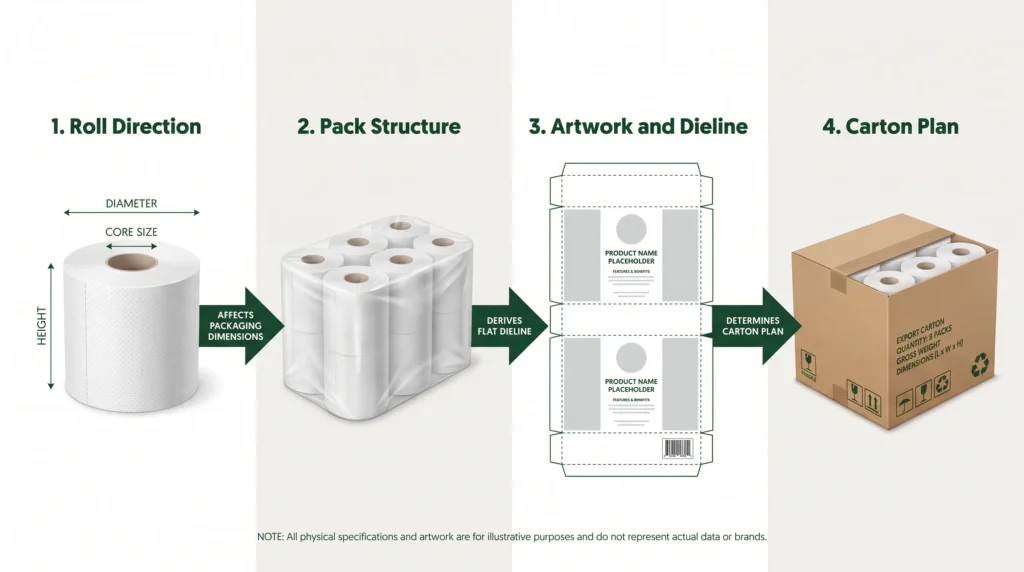
Yes. The roll direction should be clear before the final packaging artwork and dieline are approved.
Roll height, outer diameter, sheet count, ply and pack count can change the package dimensions. Those dimensions can then affect the carton plan, product photos, unit cost and loading arrangement.
The practical sequence is:
| Step | Decision | Output |
|---|---|---|
| 1 | Confirm channel and product position | First-SKU direction |
| 2 | Select the roll direction | Approximate roll specification |
| 3 | Choose the pack format and count | Packaging structure |
| 4 | Prepare or adjust the dieline | Reviewable artwork file |
| 5 | Check barcode, claims and carton marks | Packaging review record |
| 6 | Approve product and packaging direction | Sample or production reference |
Designing the packaging too early can create avoidable rework.
For example, increasing the sheet count may enlarge the roll diameter. A larger roll may require a wider wrapper, a different multipack layout and a revised carton count. The original barcode position or front-panel design may no longer fit properly.
This is why packaging development should follow the physical product direction, not run separately from it.
Do You Need Finished Artwork Before Contacting a Manufacturer?
No. A private label manufacturer can often begin reviewing a project from an idea, a reference product or an existing artwork file.
| Starting Point | What You May Already Have | What Should Be Reviewed Next |
|---|---|---|
| Idea only | Brand concept, market and target customer | Product direction, pack format and sample options |
| Reference product | Photos, physical sample or competitor specification | Which features should be matched, changed or avoided |
| Existing artwork | Logo, dieline, barcode and packaging copy | Pack dimensions, claim wording, print direction and carton marks |
When the artwork is not ready, prepare a simple project description:
- intended sales channel;
- target customer;
- preferred product position;
- approximate pack count;
- target market;
- material preference;
- expected first-order scale;
- claims you may want to use.
When artwork already exists, the review becomes more technical. The manufacturer may need to check the dieline, pack count display, barcode area, product wording, claim wording and carton mark before printing.
A finished visual design is useful, but it cannot replace a confirmed product and packaging structure.
What Should You Check in Private Label Toilet Paper Samples?
A sample should help you decide whether the product is suitable for the target channel. It should not be judged on softness alone.
Use a simple scorecard so the buying team, sales team and downstream customer are reviewing the same criteria.
| Sample Check | What to Review | Why It Matters |
|---|---|---|
| Hand feel | Softness, texture and perceived thickness | Affects customer experience and product position |
| Strength | Dry strength and normal-use performance | Weak paper can create complaints |
| Lint | Visible paper dust during handling | May affect buyer perception and product photography |
| Ply bonding | Whether layers remain aligned | Affects appearance and use |
| Sheet dimensions | Sheet width and length | Changes value perception and total usable paper |
| Roll dimensions | Height, width and outer diameter | Affects packaging and holder fit |
| Sheet count | Count direction and roll size | Affects pack claims and unit economics |
| Embossing | Pattern, clarity and visual effect | Supports appearance and product differentiation |
| Color | White or natural direction | Must match product positioning and photographs |
| Core | Core diameter, material or coreless direction | Affects appearance, use and packaging |
| Pack fit | Whether the roll fits the selected packaging format | Prevents packaging rework |
| Channel fit | Whether the SKU works for retail, ecommerce or distribution | Connects the sample to the actual business model |
Sample approval should produce a record, not only a verbal response such as “the roll feels good.”
Record which roll direction was approved, which changes were requested and whether the packaging must be adjusted. This makes later quotation, pre-production checks and repeat orders more consistent.
What Affects the First Order, MOQ and Inventory Risk?
MOQ is only one part of first-order planning. The more important question is whether the entire order structure fits the brand’s selling capacity.
The first order can be affected by:
- the product specification;
- quantity per SKU;
- packaging format;
- number of printed designs;
- carton configuration;
- material and color;
- destination;
- loading plan;
- document requirements;
- production setup.
One large order with one SKU may be simpler than the same total quantity divided across several products and packaging designs.
| Order Decision | Lower-Risk Direction | Higher-Risk Direction |
|---|---|---|
| SKU count | One clearly positioned SKU | Several untested SKUs |
| Packaging | One approved pack format | Multiple formats and print files |
| Demand | Confirmed retailer, distributor or channel test | General expectation without sales validation |
| Inventory | Stock level linked to expected sell-through | Order based only on lower unit price |
| Reorder plan | Lead time and stock coverage reviewed | Reorder discussed only after stock is nearly gone |
| Product changes | Approved specification kept in a record | Frequent changes between sample and production |
Do not increase the first order only because the unit price appears lower at a higher volume.
A lower unit price can be offset by slower sell-through, additional warehouse cost, cash tied up in inventory or obsolete packaging.
Before approving the order, estimate:
- how many sellable packs the order creates;
- how quickly the channel can sell them;
- how long production and transportation may take;
- when the next order must be confirmed;
- how much stock should remain when the reorder starts.
This turns MOQ from a supplier number into an inventory decision.
What Claims and Documents Should Be Reviewed Before Printing?
Every packaging claim should be connected to the actual product, packaging structure and available evidence.
Do not select claims only because they sound attractive. Some words may require supporting documents, market-specific review or more precise wording.
| Proposed Claim | What Must Be Confirmed |
|---|---|
| Bamboo | Actual material composition and approved product wording |
| FSC-related wording | Applicable certificate scope, product scope and any required logo-use approval |
| Plastic-free | Whether the complete relevant packaging structure supports the statement |
| PFAS-free | Available testing or supplier documentation and claim scope |
| BPA-free | Available supporting information and product relevance |
| Formaldehyde-free | Testing or documentation and exact wording |
| Heavy metals not detected | Test method, report scope and wording |
| Biodegradable | Product or packaging component, conditions and supporting evidence |
| Compostable | Applicable component, test standard and disposal conditions |
| Eco-friendly | Specific, supportable reason rather than a broad unsupported statement |
Buyers can review Newland Bamboo’s available certification and testing documents before deciding which wording may be suitable for a specific product and market.
A practical approval path is:
Proposed claim → product or packaging condition → available evidence → buyer or market review → final artwork approval.
The supplier can provide available product and document information, but the buyer should still confirm that the final wording is suitable for the destination market, retailer or platform.
This review should happen before mass printing, not after the packaging has already been produced.
What Information Should You Send a Private Label Toilet Paper Manufacturer?
A useful supplier inquiry should explain the intended product and business situation. It does not need to be a finished technical specification.
Prepare the following project brief:
| Project Field | Information to Provide |
|---|---|
| Buyer type | Brand owner, retailer, ecommerce seller, importer or distributor |
| Target market | Country or region |
| Sales channel | Retail, ecommerce, subscription, distribution or institutional |
| Product direction | Value, soft retail, bamboo-positioned, family pack or another concept |
| Product name | Toilet paper, toilet tissue, bath tissue or toilet rolls |
| Material direction | Bamboo or another requested material direction |
| Known roll details | Ply, sheet count, size, color, embossing or core information |
| Packaging format | Individual wrap, paper pack, plastic pack, multipack or bulk carton |
| Pack count | Expected rolls per sellable pack |
| Artwork status | Idea only, reference product, logo, artwork or dieline |
| Quantity | Expected first-order quantity or range |
| Destination | Country, port or delivery location |
| Sample needs | Roll samples, packaging direction or pre-production review |
| Proposed claims | Bamboo, FSC-related, plastic-free or other wording |
| Document needs | Buyer, retailer or market review requirements |
| Attachments | Photos, product references, artwork or packaging files |
This information allows a manufacturer to identify what is already clear, what still needs confirmation and whether the next step should be specification review, sampling, packaging review or quotation.
When Should You Delay the Launch?
Delay the first private label order when the project still has one or more of these problems:
- there is no defined sales channel;
- the target customer is unclear;
- the target selling price has not been tested;
- the first order includes too many untested SKUs;
- the packaging was designed before the product direction;
- the project compares only unit prices;
- proposed claims cannot be supported;
- there is no storage or inventory plan;
- the team has no sample approval criteria;
- the reorder timeline has not been considered.
Delaying an order does not mean abandoning the business. It means resolving the highest-risk decision before committing to printed packaging and bulk inventory.
Prepare Your First Private Label Project Review
If you are preparing a private label bamboo toilet paper brand, send the information you already have rather than waiting for a perfect specification.
Include your target market, sales channel, first-SKU direction, preferred packaging format, artwork status, expected quantity, destination, proposed claims and sample needs.
Newland Bamboo can review which product, packaging and document details should be confirmed before the project moves to sampling, packaging preparation or quotation.
FAQ About Starting a Private Label Toilet Paper Business
What is the difference between private label and white label toilet paper?
Private label toilet paper is developed for a specific buyer or brand and may include customized specifications, packaging and artwork. White label toilet paper normally uses a more standardized product that different sellers can brand with fewer product changes.
The exact use of these terms varies between suppliers, so buyers should confirm which product, packaging and customization elements are included.
Can I start a toilet paper business with one SKU?
Yes. One SKU can simplify sample approval, artwork preparation, carton planning and inventory management. Additional SKUs can be added after the first product and sales channel have been validated.
Can I request samples before confirming the first order?
Yes. Samples should be reviewed before bulk production whenever possible. Use them to confirm paper feel, strength, dimensions, sheet count, embossing, color, packaging fit and channel suitability.
Should a new toilet paper brand use paper or plastic packaging?
There is no universal best option. The choice depends on the target channel, selling price, pack count, shipping conditions, product positioning and the claims the brand plans to use. Confirm the roll dimensions and pack structure before approving either format.