
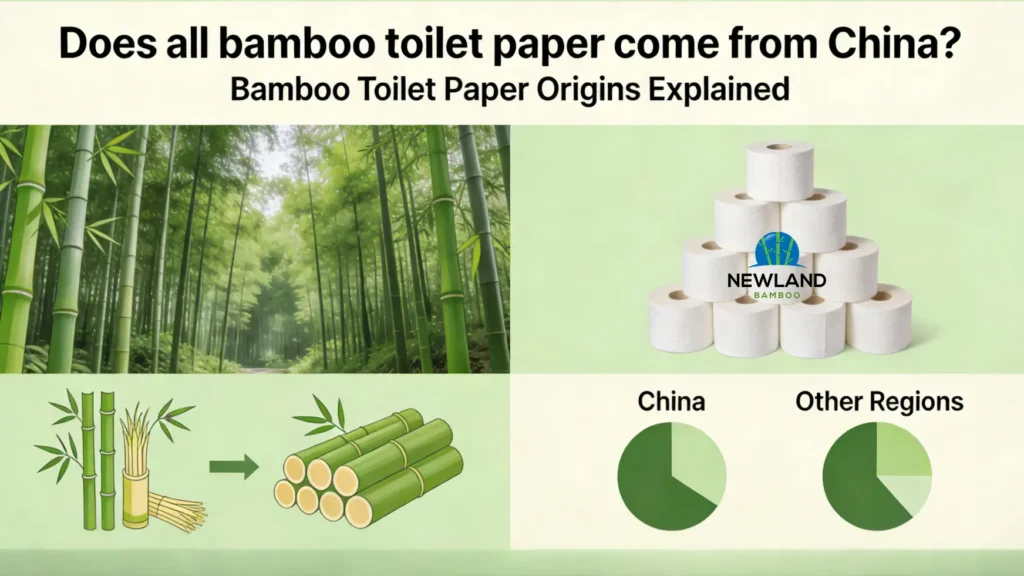
Is All Bamboo Toilet Paper Made in China? Unveiling the Industrial Realities Behind the Global Supply Chain
Why Has the Global Bamboo Pulp Industry Chosen China? Three Pillars That Build the Industry Center
China’s position as the core of the global bamboo pulp paper supply chain is not accidental; it is built on three solid pillars.
The Pillar of Resources and Raw Materials: Nature’s Endowment
China, especially the hilly areas south of the Yangtze River, boasts the ideal climate and geographical conditions for the growth of the best bamboo species for paper production (e.g., Moso bamboo, **Cizhu Bamboo (Neosinocalamus affinis)**). In Sichuan alone, the bamboo forest area spans millions of hectares, providing a sustainable and large-scale raw material base for the industry. This concentrated and rich resource endowment is the fundamental foundation for any industrial layout.
The Pillar of Technology and the Industry Chain: Decades of Accumulation and Clusters
After decades of development, China has formed the world’s most complete and mature “bamboo-pulp-paper” integrated industry cluster. From bamboo chopping and bleaching to pulp making and processing, each link in the industry chain has mature technology, well-developed equipment, and a large number of skilled workers. This deep industry cluster brings unparalleled efficiency, stable quality control, and enormous production capacity flexibility, capable of meeting global market demand fluctuations.
The Pillar of Cost and Market: Scale Effects and Internal Growth
These two points have jointly generated significant economies of scale, making “Made in China” highly competitive globally in terms of overall cost. Additionally, China itself is a massive consumer market, driving constant technological upgrades and product iteration within the industry, creating a strong internal growth momentum that further consolidates its industrial position.
The Global Value of Chinese Bamboo Toilet Paper: Not Just Production, But Standards
As the global industry center, China exports not only products but also widely accepted quality standards and environmental practices to international markets.
Meeting International Quality and Safety Standards
Leading Chinese bamboo pulp paper factories have already aligned their product standards with international benchmarks. Through certifications like FSC (Forest Stewardship Council), they ensure the sustainability of raw material sources; they also comply with safety regulations through standards such as FDA (U.S. Food and Drug Administration) for food-contact materials and EU AP (2002)1 testing. These authoritative certifications are the passport for “Made in China” bamboo pulp paper to thrive in high-end markets such as Europe, the U.S., and Japan.
Measurable Environmental Practices
“Using bamboo instead of wood” is not just a slogan. The rapid growth of bamboo (3-5 years to maturity) and its once-planted, perpetual utilization model make it an ideal renewable resource. China’s bamboo pulp paper industry is systematically replacing wood with bamboo resources worldwide, contributing to reducing deforestation and increasing carbon sequestration.
The Social Value of Driving Rural Development
The value chain of this industry extends into the mountains. It connects millions of bamboo farmers in the upstream, transforming “green mountains and clear waters” into “golden mountains and silver mountains” through contract farming, price guarantee buying, etc. This creates a virtuous cycle of “industrial revitalization of rural areas,” giving the product a richer social connotation.
A Rational Perspective: Transport Carbon Footprint and True Selection Standards
A common concern is: does shipping products from China to the global market offset their environmental benefits? This needs to be viewed objectively.
Firstly, modern maritime transport is a low-carbon pillar of global trade, with carbon emissions per unit of goods transported much lower than air or road transport. Secondly, according to lifecycle assessment studies, the majority of carbon footprint (typically over 80%) of paper products occurs during the raw material planting and manufacturing processes, not during final transportation. Therefore, choosing bamboo as a raw material, which grows without the need for chemical fertilizers or pesticides and acts as a carbon sink, brings significant environmental benefits at the front end.
For truly conscious consumers and buyers, obsessing over the “origin label” is less important than focusing on more core, verifiable metrics:
- Does the product have certifications such as FSC, PEFC, or other sustainable forest certifications?
- Is the brand willing to disclose its safety testing reports?
- Does the supply chain offer a certain level of transparency?
These are the true standards for evaluating the real value of bamboo toilet paper.
Looking Ahead: Building Greater Trust in the Established Reality
China’s role as the global bamboo pulp paper industry center is a result of market and historical choices. For brand owners and consumers, the key is how to find partners who are committed not only to industry scale but also to excellence, transparency, and trustworthiness within this mature industry system.
Future competitiveness will not lie in unrealistically shifting production locations but in leveraging the advantages of this industry center to continually drive:
- Energy efficiency improvements and cleaner production processes.
- Digitization and traceability of supply chain information.
- Rigorous and transparent product certifications and environmental claims.
The conclusion is clear: at present, global bamboo pulp paper depends on “Made in China.” This is the industry’s objective reality. The more important insight is that we should move beyond simple geographic labels and focus on the true sustainability evidence behind the product, verifiable quality standards, and the comprehensive value brought by the industry chain. Choosing a bamboo toilet paper product is not just about selecting a product but supporting a proven, efficient, and continuously improving industrial system.
Ready to Optimize Your Procurement Strategy?
In global bamboo pulp paper procurement, understanding how to balance cost, compliance, brand growth, and supply chain risks is critical for every decision-maker. By mastering the “Impossible Triangle” and the “Power Triangle”, you can make more informed decisions for future market expansion and ensure a resilient supply chain.
Choose Newland Bamboo, and you’re not just selecting an eco-friendly bamboo paper product; you’re partnering with a proven and transparent supplier. Our expert team will help you:
- Provide custom bamboo pulp paper solutions to meet your cost, quality, and supply stability needs.
- Ensure compliance and sustainability certifications, making sure your brand meets international standards.
- Offer full supply chain transparency, giving you confidence in every step of the process.
Take the Next Step:
Together, we can drive your sustainable procurement strategy and build a greener future!
Conclusion: Beyond the “Made in China” Label—Focusing on Sustainability and Transparency
China has become the global center of the bamboo pulp tissue industry, but this is a result of natural resources, mature industry clusters, and market dynamics, not an inherent limitation. The focus should now be on choosing partners who prioritize excellence, transparency, and sustainability.
Future success won’t lie in shifting production locations but in leveraging existing industry strengths. By embracing energy-efficient production, digital supply chain transparency, and rigorous environmental certifications, businesses can better meet growing demand and enhance brand value.
Choosing bamboo toilet paper is more than selecting an eco-friendly product; it’s about supporting a proven, efficient, and sustainable industry system. By partnering with Newland Bamboo, you ensure your procurement meets international standards for compliance, sustainability, and environmental responsibility.
FAQ (Frequently Asked Questions)
-
Is bamboo’s natural antimicrobial (Bamboo Kun) effect the same as medical disinfection?
Bamboo Kun’s antibacterial effect is primarily about inhibiting bacterial growth through natural properties, which provides daily hygiene protection. However, bamboo pulp paper does not have disinfection properties and cannot replace medical-grade disinfectants. Bamboo pulp paper offers a cleaner, safer wiping experience for everyday use but should not substitute specialized disinfection products for health concerns.
-
Is bamboo pulp paper more eco-friendly than traditional wood pulp paper?
Yes, bamboo pulp paper has significant environmental advantages over traditional wood pulp paper. Bamboo is a fast-growing herbaceous plant that matures in just 3-5 years, much faster than traditional wood (which takes decades). Additionally, bamboo requires minimal use of fertilizers and pesticides during growth, and the production of bamboo pulp paper uses chlorine-free bleaching processes, reducing environmental pollution.
-
How do I ensure the bamboo pulp paper I purchase meets sustainability standards?
We recommend focusing on the following points to ensure bamboo pulp paper’s sustainability:
1.FSC Certification: Ensure the raw material comes from sustainable bamboo forests.
2.Third-party Testing Reports: Look for FDA or EU testing reports to ensure safety.
3.Supply Chain Transparency: Choose brands with transparent supply chains that ensure compliance at every stage of production.Newland Bamboo provides full compliance reports and FSC certification, ensuring every batch of bamboo pulp paper meets stringent sustainability standards.
-
What are the long-term cost benefits of bamboo pulp paper?
Although bamboo pulp paper may have a slightly higher unit price compared to traditional wood pulp paper, considering its strength, absorbency, and efficiency, it can reduce paper waste in the long run and contribute to lowering carbon emissions. With carbon taxes and increasingly stringent environmental regulations, bamboo pulp paper can offer significant long-term value by helping brands mitigate compliance risks.
-
Can our company customize bamboo pulp paper products according to our needs?
Yes, we offer flexible customization services for our clients, including:
Custom sizes, weights, and embossing.
Custom packaging, including eco-friendly packaging options.
Regional production needs, ensuring compliance with different market requirements.
We are committed to providing personalized bamboo pulp paper solutions to help your business grow and meet global procurement goals. -
Is bamboo pulp paper suitable for sensitive skin?
Yes, bamboo pulp paper is naturally soft and hypoallergenic, making it especially suitable for sensitive skin. Since bamboo pulp paper does not contain harmful chemical additives, it is gentler than many traditional papers, reducing irritation. For users with allergy history, we recommend choosing unscented and dye-free bamboo pulp paper products.