
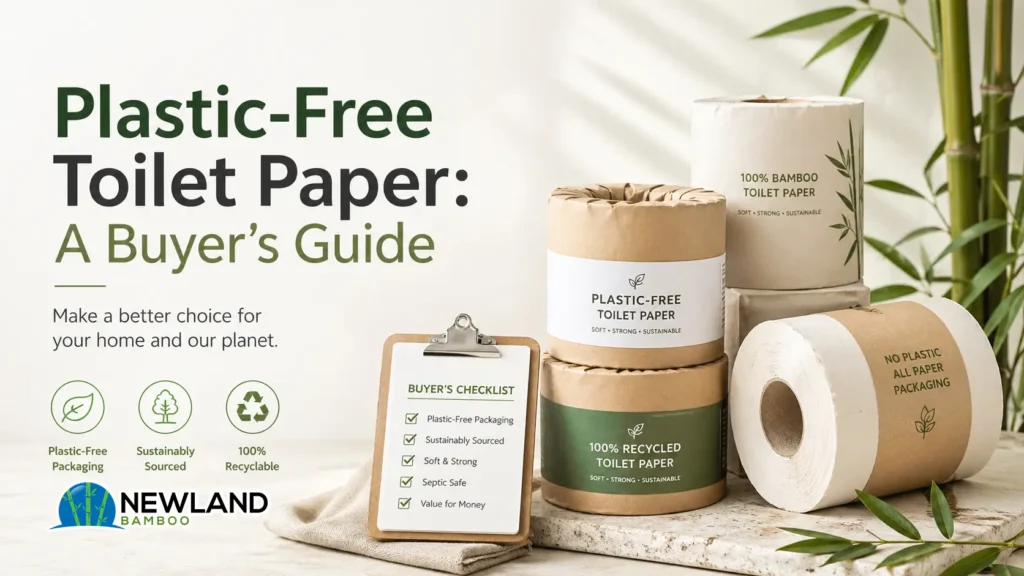
Plastic-Free Toilet Paper: A Buyer’s Guide
Plastic-Free Toilet Paper: A Buyer’s Guide
A DTC founder emailed us last month. Her brand was built on “zero waste,” and every product was plastic-free. Then, a customer sent her a photo: her toilet paper rolls, individually wrapped in clear PE film. The customer asked, “Is this really zero waste?”
She switched to paper wrapping within two months. Her unboxing videos got shared more, and her subscription retention went up. The paper itself hadn’t changed, but the packaging finally matched her brand’s promise.
This guide breaks down what plastic-free actually means in wholesale bamboo toilet paper manufacturing, your packaging options, real factory costs, and how to choose. No greenwashing—just proven configurations that work.
The Spectrum of “Plastic-Free”: What Are You Promising?
The term “plastic-free” gets thrown around loosely. Before choosing a packaging style, clarify what your specific market demands.
| Certification Level | What It Means | Real-World Example |
| Fully Plastic-Free | Zero plastic anywhere (wrap, pack, case seal, tape). | Individually paper-wrapped rolls in a paper-taped kraft box. |
| Consumer-Facing | No plastic visible to the end user (plastic may exist in bulk pallet wrap). | Paper multi-packs shipped with PE pallet wrap. |
| Reduced Plastic | Plastic is reduced but not entirely eliminated. | Recyclable PE film replacing conventional plastic. |
💡 Pro Tip: Buyers in Europe and eco-focused DTC segments expect “Fully Plastic-Free.” Retail supermarket chains often accept “Consumer-Facing.” Know your audience before over-investing.
Why the Shift is Structural, Not Just a Trend
Forget the moral argument for a moment. Plastic-free toilet paper is growing rapidly due to three distinct business pressures:
- Strict Legislation: The EU’s Single-Use Plastics Directive, the UK’s Plastic Packaging Tax, and new North American laws are making plastic packaging more expensive and legally complex.
- Retailer Mandates: Major chains like Whole Foods and Carrefour now have strict plastic-reduction targets baked into their buying requirements.
- Consumer ROI: Products making concrete sustainability claims grow 1.7x faster, according to a McKinsey consumer survey. Packaging is the most visible claim you can make.
The Material Advantage: Why Bamboo Fits Best
When positioning a plastic-free product, the paper material must match the eco-friendly narrative. Here is why bamboo holds a natural advantage over wood and recycled paper:
| Material | Performance in Plastic-Free Positioning |
| 100% Virgin Bamboo | Naturally retains a warm tone without bleaching. It allows your brand to claim hypoallergenic, and free of dyes, inks, and BPA—the exact traits today’s consumers search for. |
| Recycled Paper | Requires heavy bleaching and chemical input. Plastic-free is possible, but “chemical-free” is not. |
| Virgin Wood Pulp | Relies on tree harvesting. Packaging works, but the tree-free sustainability narrative is missing. |
(Note: Want to see the exact fiber specifications? Check our [100% Virgin Bamboo Toilet Paper] details here.)
Four Factory-Proven Packaging Configurations
Here are the realistic packaging options available at the factory level, along with their honest trade-offs.
Option A: Individual Paper-Wrapped Rolls
Each roll is wrapped in custom-printed kraft or white paper. Aligned with the Sustainable Packaging Coalition‘s design guidelines, it offers maximum branding real estate.
- Best For: DTC subscriptions, zero-waste stores, premium eco-brands.
- The Trade-off: Paper wrapping costs 2–3x more than PE film and slows down packing speed. (See Section 5 on how to offset this).
Option B: Kraft Paper Multi-Packs
A single curbside recyclable kraft bag holds 4 to 12 rolls, featuring a die-cut handle for retail convenience.
- Best For: Supermarkets, natural food stores, and club retailers.
- The Trade-off: Takes up more shelf space than shrink-wrapped PE and is more vulnerable to moisture in highly humid environments.
Option C: Paper Belly Bands
A minimal printed paper band wraps around 2–4 rolls. This is the most material-efficient option, strictly adhering to circular economy packaging principles.
- Best For: Brands emphasizing extreme minimalism.
- The Trade-off: Rolls are exposed to dust. Only recommended for supply chains with pristine handling.
Option D: Fully Plastic-Free Outer Cartons
The master shipping box uses paper-based tape and corner protectors instead of plastic inserts.
- Best For: Brands requiring 100% supply chain compliance.
- The Trade-off: Paper tape can weaken during multiple transits across highly humid climate zones.
The Economics: How to Offset the Packaging Cost
Nobody publishes this clearly, but here is the factory reality: Plastic-free packaging costs more. However, smart brands use a specific formula to neutralize this cost.
The Strategy: Coreless Rolls + Paper Wrap
| Configuration | Rolls per 40HQ Container | Packaging Cost | Freight Cost per Roll |
| Cored + PE Wrap | Baseline (Standard) | 1x (Baseline) | Baseline |
| Cored + Paper Wrap | Standard | 2–3x Higher | Baseline |
| Coreless + Paper Wrap | +8% to 12% More Rolls | 2–3x Higher | Drops Significantly |
By removing the cardboard core, you can fit 8-12% more rolls into the same shipping container. The freight savings generated across an entire 40HQ container help bridge the gap between expensive paper wrap and cheap plastic film. This is the exact math successful DTC brands use.
How to Choose Your Configuration (Decision Framework)
Use this quick framework to make your sourcing decision:
- Who buys your product?
- Unboxing/DTC Customers → Individual Paper Wrap.
- Aisle-Scanning Retail Shoppers → Kraft Multi-Pack (with handle).
- What is your target retail price?
- Under $8/pack → Paper Belly Band.
- $10–$15/pack → Kraft Multi-Pack.
- $18+/pack → Individual Paper Wrap.
- How clean is your supply chain?
- Climate-controlled, direct-to-warehouse → Belly Bands work well.
- Multi-step transit, rough handling → Stick to fully enclosed Kraft bags or Individual Wraps.
Frequently Asked Questions
-
Are there higher Minimum Order Quantities (MOQs) for plastic-free packaging?
No. It follows the standard MOQ of one 40HQ container. We can even mix standard and plastic-free SKUs in the same container for market testing.
-
Is the paper packaging itself certified?
Yes. We supply FSC-certified kraft paper for both wraps and multi-packs.
-
Do paper-wrapped rolls survive ocean freight?
Yes. The outer master carton takes the structural load. For humid routes, we add high-capacity desiccants inside the container to prevent moisture damage.
Conclusion: Aligning Sustainability with Profitability
Transitioning to plastic-free packaging is a strategic business decision, not just an environmental one. The right configuration must balance unit economics, transit durability, and retail expectations. Success lies in identifying the exact level of plastic-free presentation your target market demands—without over-engineering your costs.
Validate Your Packaging Strategy Before Sourcing.
[CTA: Request a Custom Plastic-Free Sample Kit from Newland Bamboo →]
As a leading bamboo toilet paper manufacturer, we provide factory-direct samples of our individual paper wraps, kraft multi-packs, and paper belly bands. Evaluate the material strength, print quality, and structural integrity in your own hands before committing to a container order.