
There is no single toilet paper wholesale price that applies to every product or order.
A published case price may refer to standard household rolls, jumbo commercial tissue, coreless rolls, branded stock, or a premium product with a different sheet count and packaging format. Two quotations can show similar prices while covering different amounts of paper, different packaging, and different delivery responsibilities.
Before comparing the numbers, identify what each one represents: an online case price, a factory product quote, or a landed cost. Then align the specification, packaging, quantity, delivery basis, and destination.
| Price type | What it usually represents | Best used for |
|---|---|---|
| Online case price | A finished stock product sold by a distributor or commercial retailer | Immediate domestic purchasing |
| Factory product quote | Production based on an agreed specification, packaging format, and quantity | OEM, private label, importing, and recurring orders |
| Landed cost | The cost of delivering the order to the agreed destination | Final commercial comparison |
Why Is There No Single Toilet Paper Wholesale Price?
A wholesale price only becomes meaningful when it is attached to a defined product and transaction.
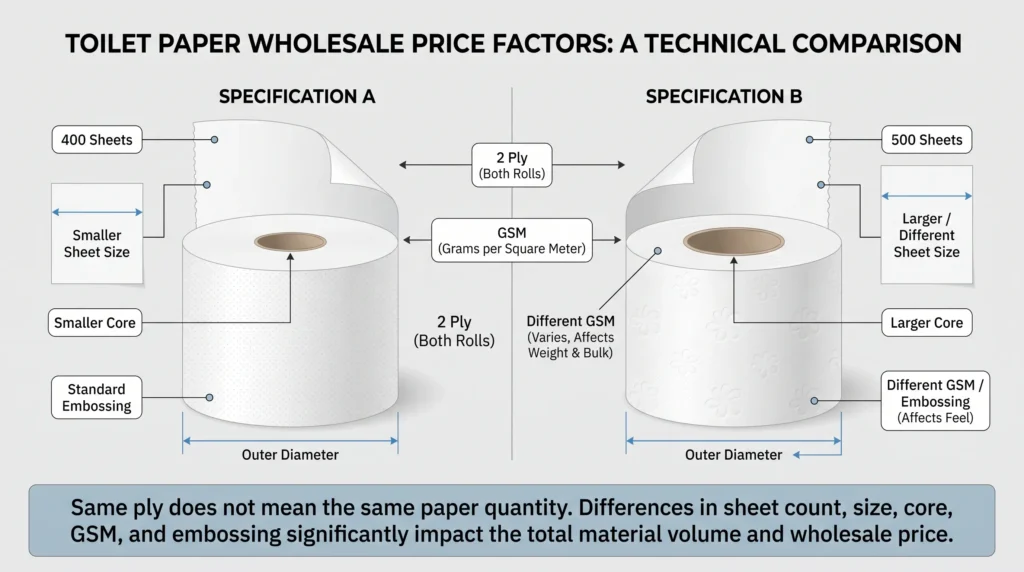
A case of standard household rolls cannot be compared directly with jumbo restroom rolls or coreless tissue. Even two products labeled as 2-ply may differ in:
- GSM;
- sheet count;
- sheet dimensions;
- core diameter;
- packaging;
- rolls per case.
The commercial model also matters. An online listing may cover a finished product already stored in a domestic warehouse. A factory quotation may cover production only and exclude international freight, customs-related charges, and final delivery.
That is why an average figure often creates more confusion than clarity. It does not tell the buyer how much paper, packaging, or delivery service is included.
How to Read a Wholesale Toilet Paper Price List
A wholesale toilet paper price list can help with initial screening. It should not be used to shortlist a supplier until the price unit, case configuration, quantity tier, delivery basis, and validity period are visible.
Check the Price Unit
Confirm whether the listed price applies to:
- one roll;
- one sellable pack;
- one case or carton;
- one pallet;
- one container;
- a specified production quantity.
A lower case price may simply mean fewer rolls or fewer retail packs. A lower price per roll may come from smaller sheets, a lower GSM, or fewer sheets per roll.
Check the Case Configuration
The listing or quotation should identify:
- product format;
- ply and GSM;
- sheets per roll;
- sheet dimensions;
- roll and core dimensions;
- rolls per pack;
- packs or rolls per case;
- packaging format.
Consider these three configurations:
96 rolls per case × 400 sheets per roll
80 rolls per case × 500 sheets per roll
48 rolls per case × 500 sheets per roll
The first two contain 38,400 and 40,000 sheets respectively, but their roll count and carton structure differ. The third contains only 24,000 sheets, even though each roll has the same 500-sheet count as the second option.
The case price alone does not reveal these differences.
Check the Commercial Conditions
A usable price list should also state:
- stock product or made-to-order production;
- quantity tier;
- standard or customized packaging;
- currency;
- delivery basis;
- included and excluded costs;
- price validity period.
Request any missing fields before treating the listed price as comparable.
Online Case Price vs Factory Quote vs Landed Cost
These three figures answer different commercial questions.
Online Distributor Case Price
An online case price usually applies to an existing SKU with fixed specifications and packaging. It may include domestic warehousing, distributor margin, order handling, and local delivery.
Check whether delivery is included in the displayed price or becomes available only after the order reaches a minimum threshold.
This price is useful for quick local replenishment. It does not usually offer much control over the roll specification, retail pack, or carton format.
Factory Product Quote
A factory quote is built around an agreed product specification, packaging format, quantity per SKU, and delivery basis.
It gives the buyer more control over the product and packaging. However, the quoted price may stop at the factory, an origin port, or another agreed delivery point rather than the buyer’s warehouse.
A factory quotation should therefore be read together with its trade term, named destination, assumptions, and exclusions.
Landed Cost
Landed cost connects the product quotation with the agreed destination. Depending on the transaction, it may include freight, insurance, customs-related expenses, destination handling, and local delivery.
A lower factory unit price can produce a higher final cost once these expenses are added. For commercial comparison, the buyer needs to know what it will cost to receive the same usable or sellable product at the same location.
How Product Specifications Affect Toilet Paper Roll Wholesale Price
The toilet paper roll wholesale price is closely tied to the amount of paper used and the way the finished roll is constructed.
Fiber, Ply, and GSM
Fiber selection can affect raw-material cost, product positioning, appearance, and performance. Common options include virgin wood pulp, bamboo pulp, recycled fiber, and declared blends.
Ply tells the buyer how many layers the sheet has. It does not define the total paper weight.
Two 2-ply products may use different GSM values. One supplier may also state GSM per ply, while another reports the combined weight of the finished sheet. Those two figures cannot be compared without clarifying the basis.
Wholesale toilet tissue pricing can therefore differ even when both offers are described simply as “2-ply.”
Sheet Count and Sheet Size
Sheet count must be reviewed with sheet dimensions.
A 500-sheet roll made with smaller sheets may contain less total paper area than a 450-sheet roll with larger sheets. A lower roll price may reflect a smaller sheet rather than a more efficient production offer.
Confirm:
- sheet length;
- sheet width;
- sheets per roll;
- total sheets per case.
For closer comparisons, also check whether the quoted sheet dimensions are nominal or the actual finished cut size.
Roll Diameter, Core, and Embossing
A larger-looking roll does not always contain more usable paper.
Outer diameter can be affected by:
- paper quantity;
- GSM;
- winding tightness;
- embossing depth;
- core diameter.
A wider core uses more space inside the roll. Deep embossing can increase visible bulk. Loose winding may also make the roll look larger without increasing the number of sheets.
| Specification variable | How it may change the quote | What the buyer should confirm |
|---|---|---|
| Fiber material | Changes the raw-material basis | Declared composition |
| Ply | Changes sheet construction | Number of layers |
| GSM | Changes paper weight and fiber use | Per-ply or combined GSM |
| Sheet count | Changes paper per roll | Usable sheets per roll |
| Sheet size | Changes total paper area | Finished length and width |
| Core diameter | Changes usable space inside the roll | Actual core measurement |
| Embossing | Changes bulk and converting setup | Approved pattern |
| Roll dimensions | Affect pack and carton efficiency | Height and outer diameter |
A buyer reviewing samples should compare the roll against the written specification rather than relying only on photographs or apparent roll size.
How Packaging and SKU Setup Change the Quote
Packaging affects material consumption, printing, production setup, carton packing, and shipping volume.
Packaging Format
Common formats include:
- naked rolls;
- individually wrapped rolls;
- plain multipacks;
- printed retail packs;
- paper wrap;
- plastic film;
- private label packaging.
Naked rolls usually require less packaging material than individually wrapped or retail-ready products. Custom packaging may also involve artwork preparation, print setup, approval samples, and packaging-material minimums.
A quote based on plain stock packaging should not be compared directly with a quote for custom printed retail packs.
Carton Configuration
The quotation should define:
- rolls or packs per carton;
- carton dimensions;
- gross weight;
- carton material;
- labeling requirements;
- sellable packs per carton.
A larger carton may reduce packaging cost per roll, but it can also change handling and storage requirements. Carton dimensions affect pallet and container utilization, so a lower carton price does not always produce a lower delivered cost.
For ecommerce or retail distribution, the buyer should also check whether the carton protects the sellable packs from compression and presentation damage.
One SKU vs Multiple SKUs
A large total order does not automatically receive the same unit price as a large single-SKU order.
An order divided across several specifications, pack sizes, packaging designs, or carton formats may require separate materials and production preparation. The supplier may also need to stop, adjust, and restart converting or packing equipment between SKUs.
The quotation should state whether its quantity tier is based on:
- the total order quantity; or
- the quantity of each individual SKU.
A 40,000-roll order split across four SKUs is not commercially identical to a 40,000-roll run of one specification and one pack design.
One-Time and Recurring Costs
Some costs appear mainly at the beginning of a project. Others apply to every order.
| Cost type | Typical examples | How to compare it |
|---|---|---|
| Setup-related | Artwork setup, print preparation, sample development | Separate from the long-term recurring unit cost |
| Recurring product cost | Paper, converting, packaging material, cartons | Compare on every order |
| Delivery-related | Freight, clearance, destination handling, delivery | Compare using the same destination and delivery basis |
Separating these categories is particularly useful when comparing a first private label order with future repeat orders. A supplier that lists setup fees separately may appear more expensive on the first order but provide a clearer recurring cost.
How Order Quantity and MOQ Affect Toilet Paper Wholesale Prices
Order quantity can reduce some unit costs because production and setup expenses are spread across more rolls. The reduction is rarely uniform across every cost item.
Why Unit Price May Fall With Volume
A higher quantity may improve:
- production-run efficiency;
- packaging-material utilization;
- setup cost per unit;
- carton or container loading;
- order-handling cost per roll.
Suppliers may therefore use separate price tiers for trial quantities, commercial runs, and recurring orders.
Why a Larger Order Does Not Reduce Every Cost
Some costs remain fixed or change independently of the roll quantity. Examples include:
- artwork and print preparation;
- separate packaging for each SKU;
- special testing or documents;
- destination charges;
- local delivery.
Ask the supplier which cost components decrease at the higher quantity. Do not assume that a lower product price will reduce freight, customs-related expenses, or local handling at the same rate.
MOQ Is Not the Same as the Best Buying Quantity
MOQ is the minimum quantity required for a particular production or packaging setup. It is not necessarily the quantity that creates the best commercial result for the buyer.
Separate the following figures:
- production MOQ;
- packaging-material MOQ;
- MOQ per SKU;
- total order quantity;
- quantity used for the quoted price.
This distinction becomes especially important when comparing standard stock products with customized orders.
How Delivery Terms and Destination Change the Quoted Price
A quotation should always be recorded with its delivery basis and named destination.
The same product may be priced for:
- collection from the factory;
- delivery to an origin port;
- international freight;
- destination-port delivery;
- delivery to the buyer’s warehouse.
Each option includes a different set of tasks, costs, and risks. The ICC’s Incoterms® rules provide the standard framework used to define those delivery responsibilities.
Ask every supplier to quote against the same named port, warehouse, or delivery location. Record:
- trade term;
- named destination;
- currency;
- freight status;
- included costs;
- excluded costs;
- quote validity.
Freight should be identified as:
Fixed
Estimated
Excluded
An estimated freight figure can change before shipment and should not be treated as a guaranteed delivered cost. The product price and the freight estimate may also have different validity periods, so both need to be confirmed before order approval.
How to Compare Wholesale Toilet Paper Prices on the Same Basis
The same logic should be used whether a buyer is comparing public case listings, factory quotations, wholesale toilet roll prices, or repeat-order offers.
Start by converting the quotations into units that reflect the same product and commercial outcome.
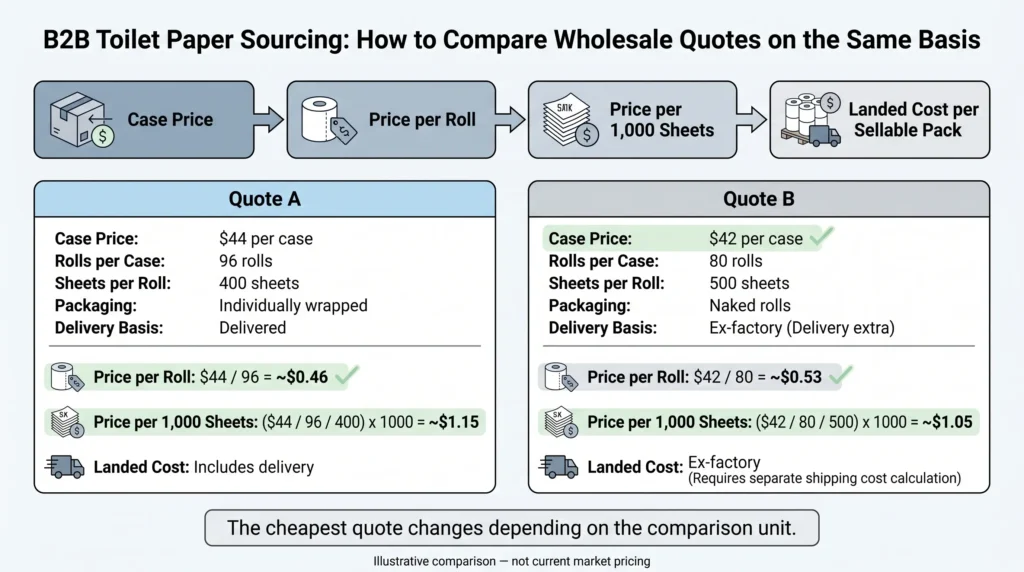
Price per Roll
Price per Roll
=
Case Price ÷ Rolls per Case
This is a useful first calculation, but only when the rolls have comparable:
- sheet counts;
- sheet dimensions;
- GSM;
- cores;
- packaging.
When those fields differ, the cheaper roll may simply contain less paper.
Price per 1,000 Sheets
Price per 1,000 Sheets
=
Case Price ÷ Total Sheets in the Case × 1,000
This calculation normalizes differences in rolls per case and sheets per roll. It still needs to be reviewed with sheet dimensions, GSM, and paper construction.
A supplier using smaller sheets can show an attractive cost per 1,000 sheets while providing less total paper area.
Landed Cost per Sellable Pack
Landed Cost per Sellable Pack
=
Total Delivered Order Cost ÷ Number of Sellable Packs
This is often the most useful unit for retailers, ecommerce sellers, distributors, and private label brands because it connects the full delivered order cost with the pack that will actually be sold.
For example, if an order has a total delivered cost of $12,600 and contains 2,000 sellable packs:
$12,600 ÷ 2,000 = $6.30 per sellable pack
This is an illustrative calculation, not a current supplier quotation.
Illustrative Quote Comparison
The following figures demonstrate the comparison method only. They are not current market prices.
| Quote field | Quote A | Quote B |
|---|---|---|
| Case price | $44 | $42 |
| Rolls per case | 96 | 80 |
| Sheets per roll | 400 | 500 |
| Total sheets per case | 38,400 | 40,000 |
| Price per roll | $0.46 | $0.53 |
| Price per 1,000 sheets | $1.15 | $1.05 |
| Packaging | Individually wrapped | Naked rolls |
| Delivery basis | Delivered | Ex-factory |
Quote B has the lower case price and lower cost per 1,000 sheets. Quote A has the lower price per roll.
Neither result settles the decision.
Quote B does not include the same packaging or delivery scope. Quote A contains fewer sheets per roll. The buyer still needs to align the product specification, packaging, delivery basis, and destination-related costs.
The cheapest option changes depending on what is being measured.
Which Comparison Unit Is Most Useful?
| Buyer scenario | More useful comparison unit |
|---|---|
| Commercial facility supply | Cost per 1,000 sheets or per comparable case |
| Retail resale | Landed cost per sellable pack |
| Ecommerce | Landed cost per sellable pack plus shipping dimensions |
| Distributor | Delivered cost per comparable case |
| Private label importer | Factory quote plus setup and landed costs |
What a Lower Quote May Actually Mean
| A lower quote may reflect | What the buyer should check |
|---|---|
| Lower GSM | Whether paper weight or performance changed |
| Fewer sheets | Whether the roll contains less usable paper |
| Smaller sheets | Whether each sheet has less area |
| Larger core | Whether the roll looks larger without more paper |
| Simpler packaging | Whether it still fits the sales channel |
| Fewer packs per carton | Whether the case contains less sellable product |
| Freight excluded | Whether the quote stops at the factory or port |
| Earlier payment | Whether cash is committed sooner |
The lowest quoted unit price is not automatically the lowest comparable cost.
What Information Is Needed for an Accurate B2B Quote?

An accurate quote requires a defined product, packaging format, quantity, and commercial basis.
| Quote field | Information to provide or confirm |
|---|---|
| Product format | Standard, jumbo, coreless, or another defined format |
| Paper specification | Fiber, ply, GSM, sheets, sheet size, and color |
| Roll specification | Height, diameter, core, and embossing |
| Packaging | Rolls per pack, material, standard or customized |
| Carton | Packs or rolls per carton |
| Quantity | Per SKU and total order |
| Requested specification | Original RFQ requirement |
| Quoted specification | Specification used in the quotation |
| Deviation | Any difference from the RFQ |
| Setup fees | Included, separate, or not applicable |
| Delivery basis | Requested trade term and named destination |
| Freight | Fixed, estimated, or excluded |
| Payment | Currency and payment schedule |
| Quote validity | Period available for commercial review |
Any deviation from the RFQ should be listed separately. It should not be hidden inside a lower quoted price.
Buyers preparing to compare toilet paper wholesale quotes can review our wholesale toilet paper supply options and send the intended specification, packaging format, quantity per SKU, destination, and delivery basis for a feasibility and quotation review. This gives the supplier enough information to price the roll, sellable pack, carton, and delivery conditions on a consistent basis.
Projects involving several roll specifications, retail packs, or carton formats can also review our specification and packaging customization process before requesting a final quote.
FAQ About Toilet Paper Wholesale Prices
Why do toilet paper wholesale prices vary so much?
Prices vary because quotations may cover different roll formats, materials, GSM, sheet counts, sheet sizes, packaging, carton quantities, order volumes, and delivery conditions. Public case prices, factory quotes, and landed costs also include different products and services.
Can suppliers provide a wholesale toilet paper price list?
Yes, but the list should identify the product specification, price unit, case configuration, quantity tier, currency, delivery basis, and validity period. Without these details, it is only a preliminary reference.
Is price per roll enough to compare wholesale toilet paper?
No. Review the price per roll with the sheet count, sheet size, GSM, core dimensions, and packaging. Two rolls with the same price may contain different amounts of paper.
Does a larger order always reduce the wholesale price?
No. Higher volume may improve production efficiency and reduce some unit costs, but custom packaging, multiple SKUs, special documents, and destination expenses may not decrease at the same rate.
What information is needed for an accurate toilet paper quote?
Send the supplier a defined product specification, packaging format, quantity per SKU, delivery basis, destination, and required quote validity. Ask the supplier to list any difference from the RFQ separately.
Related Guides
- How to Buy Toilet Paper Wholesale for Resale: A complete buying process for retailers, importers, distributors, and ecommerce sellers.
- Bamboo Toilet Paper: Bamboo pulp roll specifications and customization options.
- Private Label Toilet Paper: Branding, packaging, and custom product development.
- Toilet Paper Roll Dimensions: How roll height, diameter, sheet size, and core affect product planning.