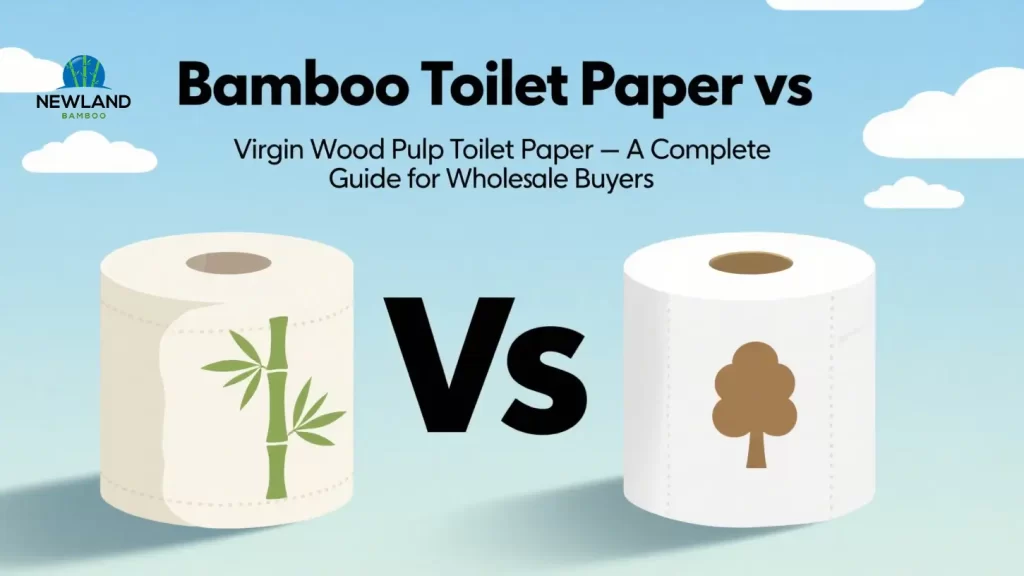
Bamboo Toilet Paper vs Virgin Wood Pulp Toilet Paper — A Complete Guide for Wholesale Buyers
Introduction
At Newland Bamboo, we have seen a growing shift in the global tissue market. Businesses and consumers alike are searching for sustainable alternatives to conventional toilet paper. Two popular choices are bamboo toilet paper and virgin wood pulp toilet paper.
In this guide, we compare both options from a wholesale and manufacturing perspective, so you can make the right decision for your brand, target market, and budget.
What Is Bamboo Toilet Paper?
Bamboo toilet paper is made from fast-growing bamboo — a grass that matures in 3–5 years and regenerates without pesticides or fertilizers.
Advantages of bamboo toilet paper:
- Renewable source: FSC-certified bamboo from stable supply chains.
- Performance: Naturally strong fibers create high tensile strength and a silky-soft feel.
- Eco-friendly production: Lower carbon footprint and water consumption compared to wood pulp.
- Customization: At Newland Bamboo, we offer a wide range of GSM, ply counts, embossing patterns, core types, and private label packaging.
Best suited for: Premium eco-conscious brands, luxury hotels, boutique retailers.
What Is Virgin Wood Pulp Toilet Paper?
Virgin wood pulp toilet paper is made from newly harvested trees, often a blend of hardwood and softwood species.
Advantages of virgin wood pulp toilet paper:
- Performance: Very soft, smooth texture, often with a bright white appearance.
- Market familiarity: Recognized and trusted by mainstream consumers worldwide.
- Scalability: Widely available from large-scale pulp mills.
Limitations:
- Requires significant logging, contributing to deforestation.
- Production often involves chemical bleaching, impacting sustainability ratings.
- Price may fluctuate with global timber supply and demand.
Bamboo vs Virgin Wood Pulp — Key Differences
| Feature | Bamboo Toilet Paper | Virgin Wood Pulp Toilet Paper |
|---|---|---|
| Raw Material | FSC-certified bamboo | Newly harvested trees |
| Softness | Very soft, silky feel | Very soft, smooth |
| Strength | High tensile strength | Moderate to high |
| Color | Natural beige/off-white | Bright white |
| Price | Slightly higher than virgin pulp | Generally lower |
| Sustainability | Very high (WWF supported) | Low to moderate |
| Best For (B2B) | Premium eco brands, luxury hospitality | Mainstream cost-driven markets |
Factory Insight: Newland Bamboo helps wholesale clients analyze whether bamboo or virgin pulp better fits their market positioning, cost targets, and brand image.
Environmental Impact
Bamboo is a rapidly renewable resource that can be harvested without killing the plant, making it a long-term sustainable option.
Virgin wood pulp production, on the other hand, requires tree harvesting, which can contribute to habitat loss and higher carbon emissions.
At Newland Bamboo, our sustainability measures include:
- Using renewable raw materials like bamboo.
- Recycling water in a closed-loop system.
- Meeting environmental certifications such as FSC, BPI Compostable, and ISO 14001.
Which Should You Choose?
Choose Bamboo Toilet Paper if:
- You target eco-conscious consumers or luxury hospitality clients.
- You want a strong brand identity linked to sustainability.
- You are willing to invest slightly more for higher environmental value.
Choose Virgin Wood Pulp Toilet Paper if:
- You focus on mass-market retail where bright white and low price dominate.
- Your buyers are less focused on eco credentials.
Consider a Blend:
At Newland Bamboo, we can produce bamboo–wood pulp blends that balance performance, aesthetics, and cost — ideal for brands seeking a mid-range solution.
Buying Guide for Businesses
When sourcing either bamboo or virgin pulp toilet paper:
- Check certifications — FSC, BPI, ISO standards.
- Define specifications — GSM, ply, embossing, sheet count, packaging.
- Request samples — Test softness, strength, and flushability.
- Understand lead times — Our standard is 30–45 days after order confirmation.
- Leverage OEM/ODM services — Newland Bamboo offers complete private label solutions.
Conclusion
Both bamboo and virgin wood pulp toilet paper have their advantages, but bamboo clearly leads in sustainability and brand differentiation.
Whether you need premium bamboo, cost-effective virgin pulp, or a custom blend, Newland Bamboo delivers certified quality, customization, and reliable global supply.
[Get a Quote] | [Request Samples] | [Explore Our Products]
FAQ — Bamboo vs Virgin Wood Pulp Toilet Paper
-
Is bamboo toilet paper softer than virgin wood pulp toilet paper?
Both can be very soft, but bamboo offers a silky feel with strong fibers, while virgin pulp provides a smoother, more uniform texture.
-
Which is more eco-friendly: bamboo or virgin pulp?
A: Bamboo is significantly more sustainable due to its rapid renewability and lower carbon footprint.
-
Does bamboo toilet paper cost more?
Bamboo is usually slightly more expensive, but offers higher environmental value and brand differentiation.
-
Can bamboo and virgin pulp be blended?
Yes, Newland Bamboo can create blends to balance performance and cost.
-
What certifications are available for bamboo toilet paper?
FSC, BPI Compostable, ISO 14001, and others upon request.