
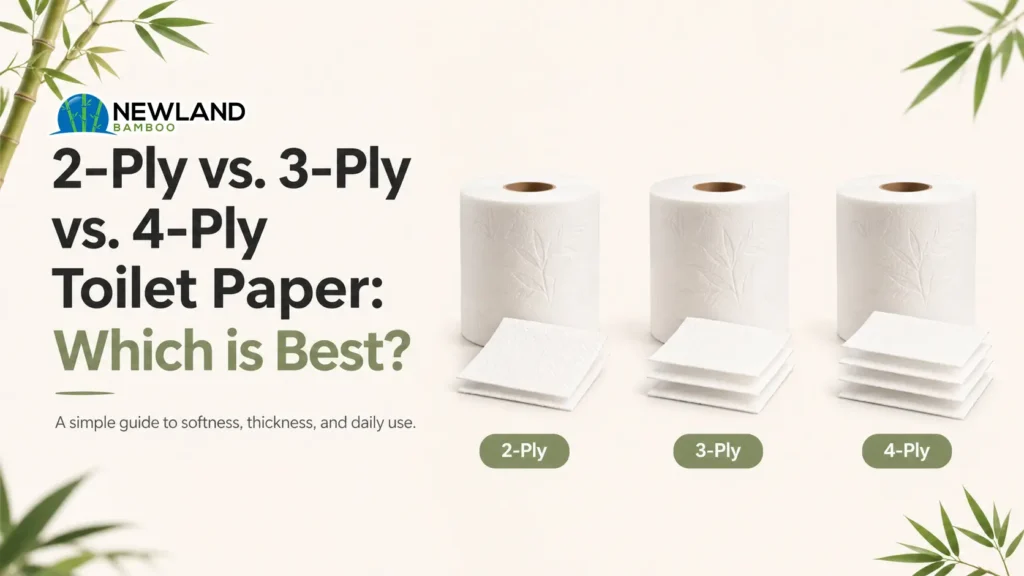
1-lagiges vs. 2-lagiges vs. 3-lagiges vs. 4-lagiges Toilettenpapier: Vergleichsleitfaden für Käufer
Kurzfazit: Welche Toilettenpapier-Lagenzahl sollten Käufer wählen?
Für die meisten B2B-Einkäufer, 2-lagiges und 3-lagiges Toilettenpapier sind die sicherste Wahl. 2-lagiges Papier eignet sich gut für den gewerblichen Vertrieb, Hotels, den Großhandel und den preisbewussten Einzelhandel, da es ein ausgewogenes Verhältnis zwischen Komfort, Kosten, Fadenzahl und Kartonverpackung bietet. 3-lagiges Papier ist die bessere Wahl, wenn das Produkt eine weichere, dickere Haptik erfordert, beispielsweise für Einzelhandelsmarken, E-Commerce-Verpackungen, den Premium-Gastgewerbesektor oder Eigenmarkenprojekte.
1-lagiges Toilettenpapier wird vor allem dann eingesetzt, wenn Kostenkontrolle und eine hohe Liefermenge wichtiger sind als Weichheit. Es eignet sich für öffentliche Toiletten, Schulen, Büros, Verkehrseinrichtungen und andere gewerbliche Umgebungen, in denen den Einkäufern das Nutzungsvolumen, die Austauschhäufigkeit und die Gesamtkosten wichtig sind.
4-lagiges Toilettenpapier sollte als Premium-Ausstattung und nicht als Standard-Upgrade betrachtet werden. Dadurch fühlt sich das Produkt zwar dicker und weicher an, allerdings wird auch mehr Material verbraucht, was zu einem größeren Rollendurchmesser, größeren Kartonabmessungen und einem höheren Versandvolumen führen kann. Für die meisten Großabnehmer sollte die 4-lagige Ausführung vor Produktionsbeginn anhand von Mustern und Verpackungsberechnungen bestätigt werden.
Die Lagenanzahl ist nur ein Aspekt der Spezifikation. Käufer sollten vor der Entscheidung, welches Toilettenpapier für ihren Markt geeignet ist, auch die Grammatur, die Anzahl der Blätter, den Rollendurchmesser, die Prägung, das Verpackungsformat und die Kartonbeladung vergleichen.
Schnellvergleich: 1-lagiges vs. 2-lagiges vs. 3-lagiges vs. 4-lagiges Toilettenpapier
| Faktor | 1-lagiges Toilettenpapier | 2-lagiges Toilettenpapier | 3-lagiges Toilettenpapier | 4-lagiges Toilettenpapier |
|---|---|---|---|---|
| Anzahl der Schichten | 1 Schicht | 2 Schichten | 3 Schichten | 4 Schichten |
| Häufige Suchbegriffe | einlagiges Toilettenpapier, einlagiges Toilettenpapier | zweilagiges Toilettenpapier, zweilagiges Toilettenpapier | dreilagiges Toilettenpapier, dreilagiges Toilettenpapier | vierlagiges Toilettenpapier, 4-lagige Toilettenpapierrollen |
| Dicke | Niedrig | Mittel | Hoch | Sehr hoch |
| Sanftheit | Grundlagen | Ausgewogen | Premium | Luxus |
| Absorptionsfähigkeit | Unter | Gut | Hoch | Sehr hoch |
| Stärke | Grundlagen | Gut | Stark | Sehr stark |
| Kostenniveau | Niedrigster | Kostengünstig | Höher | Höchste |
| Potenzial hinsichtlich der Anzahl der Laken | Hoch | Mittel bis hoch | Mittel | Unter |
| Auswirkungen des Rollendurchmessers | Kleiner | Ausgewogen | Größer | Größter |
| Kartonverladung | Am besten | Gut | Mittel | Unter |
| Allgemeine Verwendung | Öffentliche Toiletten, Einrichtungen, kostensparende Ausstattung | Gewerbeversorgung, Hotels, Großhandel, Discounter | Einzelhandelsmarken, E-Commerce, Eigenmarken, Premium-Gastronomie | Luxus-Einzelhandel, Premium-Hotels, hochwertige Eigenmarken |
| Optimaler Käufertyp | Institutionelle und gewerbliche Käufer | Vertriebshändler, Hotels, Großhändler und allgemeine Einkäufer | Einzelhandelsmarken und Einkäufer von Eigenmarken | Einkäufer von Premium-Marken und im Luxus-Gastgewerbe |
Die optimale Lagenanzahl bei Toilettenpapier hängt vom Zielmarkt ab. Ein kostenbewusster Einkäufer für öffentliche Einrichtungen bevorzugt möglicherweise 1-lagiges oder standardmäßiges 2-lagiges Toilettenpapier, während eine Einzelhandelsmarke sich für 3- oder 4-lagige Toilettenpapierrollen entscheiden könnte, um eine stärkere Positionierung im Regal und ein besseres Nutzererlebnis zu erzielen.
Was bedeutet „Ply“ bei Toilettenpapier?
Mit „Lagen“ ist die Anzahl der Papierschichten gemeint, aus denen ein Blatt Toilettenpapier besteht. Einfach ausgedrückt: Ein 1-lagiges Blatt besteht aus einer Schicht, ein 2-lagiges Blatt aus zwei Schichten, ein 3-lagiges Blatt aus drei Schichten und ein 4-lagiges Blatt aus vier Schichten.
Eine Lage Toilettenpapier wird üblicherweise als „Ply“ bezeichnet. In den Spezifikationen für Toilettenpapier geben die „Tissue-Plys“ an, wie viele Lagen in jedem Blatt miteinander verbunden sind. Die ISO legt außerdem eine Standard für die Terminologie im Bereich Tissue-Produkte für die in den Bereichen Tissuepapier und Tissueprodukte verwendete Terminologie.
Mehr Lagen bedeuten in der Regel mehr Dicke, Weichheit, Saugfähigkeit und Festigkeit. Allerdings bedeuten mehr Lagen nicht automatisch besseres Toilettenpapier. Ein gut konzipiertes 2-lagiges Toilettenpapier mit geeignetem Flächengewicht, guter Faserqualität und der richtigen Prägung kann sich besser anfühlen als ein minderwertiges 3-lagiges Produkt.
Für Großabnehmer hat die Lagenanzahl auch Auswirkungen auf praktische Einkaufsfaktoren. Eine dickere Toilettenpapierrolle kann den Rollendurchmesser vergrößern, die Anzahl der Blätter pro Rolle verringern, die Kartongröße verändern und die Beladung der Transportbehälter beeinflussen. Aus diesem Grund sollte die Lagenanzahl stets im Zusammenhang mit dem Flächengewicht (GSM), der Blattanzahl, der Rollengröße, dem Verpackungsformat und der Positionierung auf dem Zielmarkt betrachtet werden.
1-lagiges Toilettenpapier: Kostengünstig bei hohem Verbrauch
Einschichtiges Toilettenpapier besteht aus einer einzigen Lage, ist daher in der Regel dünner und sparsamer als zwei-, drei- oder vierschichtiges Toilettenpapier. Käufer bezeichnen es manchmal auch als „einlagiges Toilettenpapier“ oder „Toilettenpapier mit einer Lage“, insbesondere beim Vergleich der technischen Daten von handelsüblichen Toilettenpapieren der Basisklasse.
Für B2B-Einkäufer ist 1-lagiges Toilettenpapier in erster Linie eine Entscheidung zur Kostenkontrolle. Es wird häufig in öffentlichen Toiletten, Schulen, Büros, Verkehrseinrichtungen, institutionellen Gebäuden und anderen stark frequentierten Umgebungen verwendet, in denen ein hoher Verbrauch herrscht und die Austauschhäufigkeit eine wichtige Rolle spielt.
Der Hauptvorteil liegt in der Effizienz. Da pro Blatt weniger Material verbraucht wird, können Einkäufer je nach den endgültigen Rollenspezifikationen möglicherweise mehr Blätter pro Rolle einplanen, die Lagerbestände besser steuern oder die Verladung praktischer gestalten. Dadurch eignet sich einlagiges Toilettenpapier besonders für die großvolumige gewerbliche Versorgung.
Der Nachteil ist der Komfort. Einlagiges Toilettenpapier fühlt sich in der Regel dünner und weniger weich an, sodass es möglicherweise nicht die richtige Wahl für Einzelhandelsmarken, Hotels oder Eigenmarkenprodukte ist, bei denen der Komfort besonders im Vordergrund stehen muss. Einkäufer sollten dennoch das Flächengewicht (GSM), die Blattfestigkeit und die Leistung anhand von Mustern prüfen, da sich nicht alle einlagigen Produkte gleich anfühlen.
Eine detailliertere Aufschlüsselung der Einkaufsausgaben finden Sie in unserem Leitfaden für 1-lagiges Toilettenpapier.
Wann sich einlagiges Toilettenpapier lohnt
| Situation des Käufers | Warum 1-lagig funktionieren könnte |
|---|---|
| Ausstattung öffentlicher Toiletten | Kostenkontrolle und häufige Nutzung sind wichtig |
| Institutioneller Einkauf | Bei einer Nachfrage in großen Mengen sind oft kostengünstige Spezifikationen erforderlich |
| Gebäudemanagement | Käufer legen möglicherweise Wert auf die Anzahl der Lagen und die Ersatzplanung |
| preisbewusste Märkte | Ein geringerer Materialverbrauch kann die Wertpositionierung unterstützen |
| Einfache gewerbliche Lieferung | Die Grundleistung könnte für die Zielgruppe ausreichen |
1-lagig bedeutet nicht automatisch “minderwertig”. Es handelt sich um eine bewusste Entscheidung hinsichtlich der Spezifikation. Die entscheidende Frage ist, ob das Produkt zum Markt, zum Preisniveau und zur Einsatzumgebung des Käufers passt.
2-lagiges Toilettenpapier: Die ausgewogene Wahl für gewerbliche Abnehmer und Großhandelskunden
Zweilagiges Toilettenpapier besteht aus zwei Lagen Tissuepapier. Es ist oft der praktischste Ausgangspunkt für Einkäufer, die Komfort, Kosten, Rollengröße und Kartonverpackung vergleichen. In Gesprächen mit Lieferanten bezeichnen Einkäufer diese Spezifikation möglicherweise auch als zweilagiges Toilettenpapier, doppellagiges Toilettenpapier oder 2-lagiges Toilettenpapier.
2-lagiges Papier ist beliebt, weil es den Käufern ein ausgewogenes Produkt bietet. Es fühlt sich in der Regel stabiler und angenehmer an als 1-lagiges Papier, lässt sich jedoch hinsichtlich Kosten und Verpackung leichter handhaben als viele 3- oder 4-lagige Produkte.
Für viele B2B-Einkäufer eignet sich 2-lagiges Toilettenpapier für verschiedene Vertriebskanäle: gewerbliche Belieferung, Hotels, Bürogebäude, Großhandel, Multipacks im Einzelhandel und Einstiegsprodukte unter Eigenmarken. Es ist den Endverbrauchern vertraut und flexibel genug für verschiedene Preisklassen.
Die endgültige Qualität hängt nach wie vor von den vollständigen Spezifikationen ab. Ein zweilagiges Produkt mit geringem Flächengewicht kann sich eher einfach anfühlen, während ein besser konzipiertes zweilagiges Toilettenpapier mit geeignetem Flächengewicht und Prägung sich weich, reißfest und zuverlässig anfühlen kann.
Eine ausführlichere Erläuterung der Zweischichtstruktur und der Anwendungsfälle im Einkauf finden Sie in unserem Leitfaden unter Was ist zweilagiges Toilettenpapier?.
Wann sich zweilagiges Toilettenpapier lohnt
| Situation des Käufers | Warum 2-lagig funktionieren könnte |
|---|---|
| Großhandel | Ausgewogenes Verhältnis zwischen Kosten und Benutzererlebnis |
| Hotel- und Gewerbebedarf | Guter Komfort ohne übermäßige Kosten |
| Vorteilspackungen für den Einzelhandel | Eine für viele Märkte vertraute Spezifikation |
| Einstiegsprodukte für Handelsmarken | Geeigneter Ausgangspunkt für Markentests |
| Bestellungen mit verschiedenen Artikelnummern | Lässt sich gut mit Kosmetiktüchern, Papierhandtüchern oder Servietten kombinieren |
Für viele Käufer ist zweilagiges Toilettenpapier die sicherste Wahl. Es lässt sich leichter anbringen als einlagiges und ist in der Regel kostengünstiger als drei- oder vierlagiges.
3-lagiges Toilettenpapier: Hochwertiges Gefühl für den Einzelhandel und Eigenmarkenprodukte
Dreilagiges Toilettenpapier besteht aus drei Lagen Tissuepapier. Es wird häufig gewählt, wenn Käufer ein weicheres, dickeres und hochwertigeres Toilettenpapierprodukt wünschen. Suchende bezeichnen es möglicherweise auch als „dreilagiges Toilettenpapier“ oder „Triple-Ply-Toilettenpapier“, doch die entscheidende Frage beim Kauf ist in der Regel dieselbe: Ob die zusätzliche Lage für die Zielgruppe einen ausreichenden Mehrwert bietet.
Für B2B-Einkäufer ist 3-lagiges Toilettenpapier oft eine gute Wahl für Einzelhandelsmarken, E-Commerce-Verpackungen, Eigenmarkenprojekte, hochwertige Produkte für das Gastgewerbe sowie Märkte, in denen Verbraucher ein volleres Griffgefühl erwarten. Es kann zu einer besseren Positionierung im Regal und einer stärkeren Qualitätsbotschaft beitragen als ein einfaches 1-lagiges oder ein standardmäßiges 2-lagiges Produkt.
Der Hauptvorteil liegt in der Benutzererfahrung. Ein gut gestaltetes dreilagiges Toilettenpapier fühlt sich voller, weicher und saugfähiger an. Es eignet sich zudem gut für Prägungen, bedruckte Verpackungen, Multipacks im Einzelhandel und individuelle Verpackungslösungen.
Der Kompromiss liegt zwischen Kosten und Verpackungseffizienz. Mehr Lagen bedeuten in der Regel mehr Material pro Bogen. Dies kann zu höheren Stückkosten, einem größeren Rollendurchmesser und einem größeren Kartonvolumen führen. Für Großabnehmer kann sich dies auf die Frachtplanung und die Gesamtkosten pro Rolle auswirken.
Wann sich dreilagiges Toilettenpapier lohnt
| Situation des Käufers | Warum 3-lagig funktionieren könnte |
|---|---|
| Tissue-Marke für den Einzelhandel | Bessere wahrgenommene Qualität und bessere Platzierung im Regal |
| E-Commerce-Multipack | Deutlicherer Hinweis auf den Komfort in den Produktbeschreibungen |
| Premium-Eigenmarke | Unterstützt eine verbesserte Markenpositionierung |
| Ausstattung der Hotelzimmer | Bessere Benutzererfahrung als bei handelsüblichen Standard-Taschentüchern |
| Marke für Toilettenpapier aus Bambus | Unterstreicht die Weichheit und den Wert des Produkts |
3-lagiges Toilettenpapier ist eine gute Wahl, wenn der Käufer ein hochwertiges Toilettenpapierprodukt wünscht, aber dennoch Wert auf eine praktische Kartonverpackung und Kostenkontrolle legt. Es lässt sich oft leichter vermarkten als 4-lagiges Toilettenpapier, da es hochwertig wirkt, ohne zu sperrig oder zu teuer zu sein.
4-lagiges Toilettenpapier: Luxuspositionierung mit höheren Kosten und Auswirkungen auf die Verpackung
Vierlagiges Toilettenpapier besteht aus vier Lagen Tissuepapier. Es wird in der Regel gewählt, wenn ein deutlich dickeres und weicheres Produkt gewünscht wird, nicht jedoch als kostengünstige Standardvariante. Käufer suchen möglicherweise nach „vierlagigem Toilettenpapier“ oder „4-lagigen Toilettenpapierrollen“, doch beim tatsächlichen Einkauf sollte es als Premium-Spezifikation behandelt werden.
Für Einkäufer im Einzelhandel und im Gastgewerbe kann 4-lagiges Material sinnvoll sein, wenn das Produkt auf eine Luxuspositionierung ausgerichtet ist. Es eignet sich möglicherweise für hochwertige Eigenmarken, Boutique-Hotels, Luxus-Zimmerausstattung oder Spezialprodukte im Einzelhandel, bei denen Weichheit und Dicke zu den Verkaufsargumenten zählen.
Allerdings ist eine 4-lagige Ausführung nicht automatisch die beste Wahl für jeden Markt. Mehr Lagen können den Rollendurchmesser vergrößern, die Anzahl der Bögen pro Rolle verringern, die Kartonverpackung verändern und das Versandvolumen erhöhen. Dies kann sich auf die Gesamtkosten bis zum Bestimmungsort auswirken, insbesondere bei Groß- und Containerbestellungen.
Käufer sollten auch das Nutzerverhalten berücksichtigen. In manchen Märkten wird sehr dickes Toilettenpapier möglicherweise als Premiumprodukt angesehen. In anderen Märkten legen Käufer möglicherweise mehr Wert auf die Blattanzahl, den Wert pro Rolle, den Preis pro Rolle, die Lagereffizienz oder darauf, ob das Toilettenpapier ihren Anforderungen an die Produktleistung entspricht.
Wann sich 4-lagiges Toilettenpapier lohnt
| Situation des Käufers | Warum 4-Ply funktionieren könnte |
|---|---|
| Luxus-Einzelhandelsprodukt | Starkes Gefühl von Weichheit und Dicke |
| Erstklassige Gastfreundschaft | Ein besseres Gästeerlebnis in den Zimmern der gehobenen Kategorie |
| Eigenmarke mit hoher Gewinnspanne | Unterstützt eine verbesserte Produktpositionierung |
| Spezialpapierprodukt | Hilft bei der Unterscheidung von herkömmlichen 2-lagigen oder 3-lagigen Produkten |
| Kleine Premium-Produktlinie | Einfacher zu verwalten als kostensensible Lieferungen in großen Mengen |
Bei 4-lagigem Papier ist Vorsicht geboten. Es kann sich zwar um ein gutes Premiumprodukt handeln, doch sollten Käufer vor der Bestätigung der Spezifikation Muster, das Flächengewicht (GSM), den Rollendurchmesser, die Kartonabmessungen, die Verpackungsart und den Zielpreis prüfen.
2-lagiges, 3-lagiges und 4-lagiges Toilettenpapier: Was ändert sich beim tatsächlichen Kauf?
Wenn Käufer 2-lagiges, 3-lagiges und 4-lagiges Toilettenpapier vergleichen, liegt der Unterschied nicht nur in der Weichheit. Jede zusätzliche Lage kann sich auf den gesamten Einkaufsplan auswirken, einschließlich Materialkosten, Rollendurchmesser, Kartongröße, Lagerplatzbedarf und Frachteffizienz.
| Einkaufsfaktor | 2-lagig | 3-lagig | 4-lagig |
|---|---|---|---|
| Benutzererfahrung | Ausgewogen | Premium | Luxus |
| Kosten | Mäßig | Höher | Höchste |
| Rollendurchmesser | In der Regel leichter zu kontrollieren | Größer, wenn die Blattzahl hoch bleibt | Am größten, sofern keine Anpassung vorgenommen wird |
| Flexibilität bei der Anzahl der Lagen | Gut | Mittel | Unter |
| Karton-Verpackung | Effizient | Muss überprüft werden | Muss sorgfältig geprüft werden |
| Containerbeladung | Meistens besser | Kann die Beladungsmenge verringern | Die Ladungsmenge kann noch weiter reduziert werden |
| Positionierung im Einzelhandel | Preis-Leistungs-Verhältnis im mittleren Segment | Premium | Luxus oder Spezialität |
| Beste Passform | Großhandel, Gastronomie, gewerbliche Belieferung, Discounter | Eigenmarken, E-Commerce, Einzelhandel, Premium-Gastronomie | Premium-Einzelhandel, Luxushotellerie und Spezialitäten |
Beispielsweise könnte ein Käufer eine 3-lagige Toilettenpapierrolle mit derselben Blattanzahl wie bei einer 2-lagigen Rolle anfordern. Das mag nach einer einfachen Aufwertung klingen, doch die Rolle kann dadurch größer werden, die Kartongröße kann sich ändern und die endgültige Beladungsmenge pro Karton kann sinken.
Aus diesem Grund sollten B2B-Einkäufer Toilettenpapier nicht allein anhand der Lagenzahl vergleichen. Die wichtigere Frage ist vielmehr, ob die gesamte Spezifikation weiterhin mit dem Zielpreis, dem Verpackungsformat, der Regalposition und dem Logistikplan vereinbar ist.
Warum die Anzahl der Lagen allein nicht ausschlaggebend für die Qualität von Toilettenpapier ist
Die Lagenanzahl ist leicht zu verstehen, gibt jedoch nicht das ganze Bild wieder. Zwei Toilettenpapierprodukte mit derselben Lagenanzahl können sich sehr unterschiedlich anfühlen, wenn sich das Flächengewicht (GSM), die Faserqualität, die Prägung, die Blattgröße und die Schichtenverleimung unterscheiden.
Ein gutes 2-lagiges Produkt kann ein minderwertiges 3-lagiges Produkt in puncto Leistung übertreffen. Ein 3-lagiges Produkt kann sich hochwertig anfühlen, ohne dass man auf ein 4-lagiges Produkt umsteigen muss. Ein 4-lagiges Produkt kann sich sehr weich anfühlen, ist jedoch möglicherweise nicht praktikabel, wenn die Rolle zu groß wird oder die Einstandskosten zu hoch sind.
GSM pro Lage
GSM steht für Gramm pro Quadratmeter. Diese Angabe hilft Käufern, das Papiergewicht und die Papierstärke einzuschätzen. Bei der Prüfung von Tissue-Produkten ist die Grammatur eine messbare Spezifikation, und die Norm ISO 12625-6 regelt die Bestimmung des Flächengewichts für Tissuepapier und Tissueprodukte.
Für Käufer ist das GSM-Gewicht von Bedeutung, da es sich auf Weichheit, Festigkeit, Saugfähigkeit, Rollengewicht und Kosten auswirkt. Ein zweilagiges Toilettenpapier mit einem höheren GSM-Gewicht pro Lage fühlt sich möglicherweise dicker und fester an als ein dreilagiges Produkt mit niedrigem GSM-Gewicht.
Beim Vergleich von 2-lagigem, 3-lagigem oder 4-lagigem Toilettenpapier sollten Käufer sowohl nach der Lagenanzahl als auch nach der Grammatur (GSM) fragen. Eine ausführlichere Erläuterung finden Sie in unserem Leitfaden zu Toilettenpapier – GSM und Stärke.
Qualität von Bambuszellstoff und -fasern
Auch die Faserqualität wirkt sich auf das Endprodukt aus. Toilettenpapier aus Bambuszellstoff kann zwar als pflanzliches Produkt beworben werden, doch sollten Käufer dennoch die tatsächlichen Spezifikationen vergleichen, anstatt sich allein auf Angaben zum Material zu verlassen.
Bei einem Projekt für Toilettenpapier aus Bambus sind folgende Punkte zu berücksichtigen: Lagenanzahl, Flächengewicht (GSM), Weichheit, Festigkeit, Blattanzahl, Prägung, Verpackungsform und Musterqualität. Die Materialauswahl ist zwar wichtig, doch das Enderlebnis mit dem Produkt hängt davon ab, wie die Gesamtspezifikation zusammengestellt wird.
Prägung und Verklebung
Durch Prägung lassen sich Haptik und Eigenschaften von Toilettenpapier verändern. Ein geeignetes Prägemuster kann die Weichheit, die Saugfähigkeit und das Aussehen verbessern. Außerdem kann es dazu beitragen, dass mehrlagige Blätter besser zusammenhalten.
Für Einkäufer von Eigenmarken kann die Prägung zudem zur Produktdifferenzierung beitragen. Ein gut gewähltes Muster kann einem 2- oder 3-lagigen Toilettenpapier eine hochwertigere Haptik verleihen, ohne dass einfach nur weitere Lagen hinzugefügt werden müssen.
Anzahl der Bleche und Rollendurchmesser
Die Lagenanzahl wirkt sich auch auf die Blattanzahl und den Rollendurchmesser aus. Werden mehr Lagen hinzugefügt, die Blattanzahl bleibt jedoch gleich, kann die Rolle größer werden. Soll der Rollendurchmesser innerhalb einer Zielgröße bleiben, müssen möglicherweise die Blattanzahl, das Flächengewicht (GSM) oder das Verpackungsformat angepasst werden.
Dies ist für Einzelhandelsverpackungen, Kartonverpackungen, die Passgenauigkeit von Spendern und die Befüllung von Behältern von Bedeutung. Einkäufer sollten vor der Freigabe der Produktion die Bogengröße, die Anzahl der Bögen pro Rolle, den Rollendurchmesser, die Hülsengröße und die Kartongröße überprüfen. Weitere Informationen zu den Abmessungen finden Sie in unserem Leitfaden zu Abmessungen der Toilettenpapierrolle.
Wie sich die Lagenanzahl auf die Rollengröße, die Blattanzahl und die Kartonverpackung auswirkt
Für B2B-Einkäufer hat die Lagenanzahl direkte Auswirkungen auf Verpackung und Logistik. Dies ist insbesondere bei Großhandelsbestellungen, Eigenmarkenprojekten und Containertransporten von Bedeutung.
Dickeres Toilettenpapier nimmt in der Regel mehr Platz ein. Wenn sich ein Käufer für 3-lagiges oder 4-lagiges statt für 2-lagiges Toilettenpapier entscheidet, kann sich der Rollendurchmesser vergrößern. Das kann sich darauf auswirken, wie viele Rollen in eine Packung passen, wie viele Packungen in einen Karton passen und wie viele Kartons in einen Container passen.
| Spezifikationsbereich | Warum Sperrholz so wichtig ist |
|---|---|
| Blätter pro Rolle | Eine höhere Lagenanzahl kann die Anzahl der Bögen verringern, wenn der Rollendurchmesser begrenzt bleiben muss |
| Durchmesser der Rolle | Mehr Lagen können die Toilettenpapierrolle größer machen |
| Packungsgröße | Bei größeren Rollen kann sich die Verpackung in 4er-, 6er-, 12er- oder 24er-Packungen ändern. |
| Größe des Kartons | Die Kartonabmessungen müssen möglicherweise angepasst werden |
| Containerbeladung | Größere Kartons können die Gesamtladungsmenge verringern |
| Frachtkosten | Ein höheres Volumen kann die Einstandskosten erhöhen |
| Passform im Verkaufsregal | Größere Packungen können die Darstellung und Lagerung beeinträchtigen |
Das bedeutet nicht, dass Käufer Produkte mit höherer Lagenzahl meiden sollten. Es bedeutet vielmehr, dass die Spezifikation richtig geplant werden muss. Ein 3- oder 4-lagiges Toilettenpapierprodukt kann sehr gut funktionieren, wenn die Rollengröße, die Blattanzahl und die Verpackungsstruktur auf den jeweiligen Vertriebskanal abgestimmt sind.
So sollten B2B-Einkäufer die richtige Anzahl an Lagen Toilettenpapier auswählen
Die richtige Anzahl der Lagen beim Toilettenpapier hängt vom Käufermarkt, vom Vertriebskanal, von der Preisklasse und von den Erwartungen der Verbraucher ab.
| Typ des Käufers | Empfohlene Schichtanzahl | Grund |
|---|---|---|
| Ausstattung von öffentlichen Toiletten und Sanitäranlagen | 1-lagig oder standardmäßig 2-lagig | Kostenkontrolle und Einsatz in großen Mengen |
| Büro- und Gewerbebedarf | 2-lagig | Ein ausgewogenes Verhältnis zwischen Kosten und Komfort |
| Hotelausstattung | 2-lagig oder 3-lagig | Hängt vom Standard des Hotels und den Erwartungen der Gäste ab |
| Großhändler | 2-lagig | Einfacherer Verkauf an verschiedene Kundengruppen |
| Tissue-Marke für den Einzelhandel | 3-lagig | Bessere Platzierung im Regal und bessere Wahrnehmung durch die Verbraucher |
| E-Commerce-Marke für Tissue-Produkte | 3-lagig | Ein deutlicheres Versprechen an Online-Käufer |
| Premium-Eigenmarke | 3-lagig oder 4-lagig | Unterstützt die Positionierung im höheren Preissegment |
| Luxuriöse Gastlichkeit | 4-fädig | Mehr Weichheit und ein erstklassiges Erlebnis |
Einkäufer sollten die Fadenanzahl nicht allein deshalb wählen, weil eine höhere Zahl besser aussieht. Eine 4-lagige Rolle mag zwar hochwertig wirken, ist aber möglicherweise nicht die beste Wahl für ein preisbewusstes Großhandelsprogramm. Eine 1-lagige Rolle ist zwar kostengünstig, passt aber möglicherweise nicht zu einer Premium-Einzelhandelsmarke. Ein 2- oder 3-lagiges Produkt bietet Käufern oft mehr Flexibilität.
Käufer, die technische Daten vergleichen, können sich auch unsere Auswahl an Toilettenpapier aus Bambus um sich über die verfügbaren Produktoptionen für den Großhandel, den Einzelhandel, das Gastgewerbe und die Lieferung von Eigenmarken zu informieren.
Checkliste für Käufer vor der Bestellung von Bambus-Toilettenpapier von Ply
Bevor eine Spezifikation für Toilettenpapier bestätigt wird, sollten Einkäufer die grundlegenden Einkaufsdaten zusammenstellen. Dies hilft dem Lieferanten dabei, zu prüfen, ob die Produktplanung realisierbar ist.
| Der Käufer sollte Folgendes bereitstellen | Warum es hilft |
|---|---|
| Zielmarkt | Verschiedene Märkte haben unterschiedliche Erwartungen hinsichtlich Komfort und Preis. |
| Kanal verwenden | Einzelhandel, Hotellerie, gewerbliche Kunden und Großhandel erfordern unterschiedliche Spezifikationen |
| Bevorzugte Schichtanzahl | Trägt zur Festlegung der Produktrichtung bei |
| GSM-Ziel | Ermöglicht den Vergleich der tatsächlichen Dicke und Festigkeit |
| Blattgröße | Beeinflusst den Würfelwert, das Spielerlebnis und die Verpackung |
| Blätter pro Rolle | Beeinflusst den Rollenwert, den Rollendurchmesser und die Kartongröße |
| Durchmesser der Rolle | Wichtig für Verpackung, Lagerung und Passgenauigkeit des Spenders |
| Kerngröße | Wichtig für die Rollenstruktur und die Verwendung des Spenders |
| Präferenz für Prägung | Beeinflusst die Weichheit, die Saugfähigkeit und das Aussehen |
| Format der Verpackung | Wichtig für Einzelhandelsverpackungen, verpackte Rollen und das Design von Eigenmarken |
| Geschätzte Bestellmenge | Unterstützt die Überprüfung der Mindestbestellmenge, des Produktionsplans und der Preisgestaltung |
| Zielland | Unterstützt die Überprüfung der Anforderungen an Kennzeichnung, Verpackung und Dokumentation |
Bei Eigenmarkenprojekten sollten Einkäufer zudem die Markenpositionierung, den Verpackungsstil, die angestrebte Preisspanne und die gewünschte Packungsgröße festlegen. Ein Projekt für hochwertiges 3- oder 4-lagiges Bambus-Toilettenpapier erfordert möglicherweise einen anderen Verpackungs- und Kartonplan als eine Standard-Großhandelsbestellung für 2-lagiges Toilettenpapier.
Falls das Verpackungsformat Teil des Projekts ist, ist unser kundenspezifische Gewebeverpackungen Der Support kann Käufern dabei helfen, die Anforderungen an verpackte Rollen, Einzelhandelsverpackungen, Kartonverpackungen und das Branding zu prüfen.
Für OEM-Einkäufer und Markeninhaber bietet Newland Bamboo außerdem Unterstützung bei OEM- und Eigenmarkengewebe Projekte auf der Grundlage von Zielmarkt, Spezifikation, Verpackung und Bestellmenge.
FAQ
Was bedeutet „Lagen“ bei Toilettenpapier?
Mit „Lagen“ ist die Anzahl der Papierschichten gemeint, aus denen ein Blatt Toilettenpapier besteht. 1-lagig hat eine Schicht, 2-lagig hat zwei Schichten, 3-lagig hat drei Schichten und 4-lagig hat vier Schichten.
Wie nennt man eine Lage Toilettenpapier?
Eine Lage Toilettenpapier wird üblicherweise als „Ply“ bezeichnet. In den Spezifikationen für Toiletten- und Badepapier geben die „Tissue-Plys“ an, wie viele Papierschichten in jedem Blatt miteinander verbunden sind.
Was ist besser: einlagiges oder zweilagiges Toilettenpapier?
Zweilagiges Toilettenpapier fühlt sich in der Regel weicher und reißfester an als einlagiges Toilettenpapier. Einlagiges Toilettenpapier kann jedoch eine praktische Wahl für den gewerblichen Großverbrauch, öffentliche Toiletten und kostenbewusste Beschaffungen sein.
Was ist besser: 2-lagiges oder 3-lagiges Toilettenpapier?
Zweilagiges Toilettenpapier bietet in der Regel das beste Verhältnis zwischen Preis, Komfort und Verpackungseffizienz. Dreilagiges Toilettenpapier ist die bessere Wahl, wenn Käufer ein hochwertigeres Gefühl für Produkte im Einzelhandel, im Gastgewerbe oder bei Eigenmarken wünschen.
Was ist 4-lagiges Toilettenpapier?
4-lagiges Toilettenpapier besteht aus vier Lagen Tissuepapier. Es ist in der Regel dicker, weicher und saugfähiger, kann jedoch auch zu höheren Kosten, einem größeren Rollendurchmesser und einem höheren Verpackungsvolumen führen.
Gibt es 4-lagiges Toilettenpapier?
Ja, es gibt 4-lagiges Toilettenpapier, doch es wird in der Regel eher für Premium- oder Luxusprodukte verwendet als für kostengünstige Standardprodukte. Käufer sollten vor der Auswahl Muster, das Flächengewicht (GSM), die Rollengröße und die Kartonverpackung prüfen.
Ist 4-lagiges Toilettenpapier immer besser?
Zwar lässt sich mit 4-lagigem Toilettenpapier eine Luxuspositionierung erreichen, doch ist es nicht immer die beste Wahl für jeden Käufer. B2B-Käufer sollten Weichheit, Grammatur, Blattanzahl, Rollendurchmesser, Kartonverpackung und Zielpreis vergleichen, bevor sie sich für 4-lagiges Toilettenpapier entscheiden.
Warum fühlt sich manche zweilagiges Toilettenpapier besser an als dreilagiges?
Ein zweilagiges Toilettenpapier kann sich besser anfühlen als ein dreilagiges Produkt, wenn es eine höhere Grammatur, eine bessere Faserqualität, eine geeignete Prägung und eine gute Verbindung zwischen den Lagen aufweist. Die Lagenanzahl ist wichtig, bestimmt jedoch nicht allein die Qualität.
Hat die Lagenzahl des Toilettenpapiers Einfluss auf die Rollengröße und die Anzahl der Blätter?
Ja. Eine höhere Lagenanzahl kann die Dicke und den Rollendurchmesser erhöhen. Wenn der Rollendurchmesser innerhalb einer vorgegebenen Größe bleiben muss, muss der Lieferant möglicherweise die Lagenanzahl, das Flächengewicht oder das Verpackungsformat anpassen.
Welche maximale Lagenzahl sollten Käufer bei Toilettenpapier berücksichtigen?
Die meisten B2B-Toilettenpapierprojekte konzentrieren sich auf 1-lagiges, 2-lagiges, 3-lagiges oder 4-lagiges Toilettenpapier. Produkte mit höherer Lagenzahl wie 5-lagiges, 6-lagiges, 8-lagiges oder 10-lagiges Toilettenpapier tauchen zwar gelegentlich in Suchergebnissen auf, sind jedoch keine gängige Wahl für Standard-Großhandels-, Großabnehmer- oder Eigenmarken-Toilettenpapierprogramme.
Welche Toilettenpapier-Lagenstärke eignet sich am besten für Großabnehmer?
Für viele Großabnehmer ist 2-lagiges Toilettenpapier die sicherste und flexibelste Wahl. 1-lagiges Toilettenpapier eignet sich möglicherweise für den kostenbewussten gewerblichen Einsatz, während 3- und 4-lagiges Toilettenpapier besser für den Premium-Einzelhandel, das Gastgewerbe und die Positionierung als Eigenmarke geeignet ist.
Welche Lagenstärke eignet sich am besten für Bambus-Toilettenpapier unter Eigenmarke?
Bei Bambus-Toilettenpapier für Eigenmarken ist 3-lagiges Papier oft eine gute Wahl, da es ein hochwertiges Gefühl vermittelt, ohne zu voluminös zu sein. 4-lagiges Papier eignet sich möglicherweise für die Positionierung im Luxussegment, während 2-lagiges Papier für preisgünstige oder mittelpreisige Eigenmarkenprodukte geeignet sein kann.
Benötigen Sie Hilfe bei der Auswahl der Spezifikationen für Bambus-Toilettenpapier?
Die Wahl der richtigen Toilettenpapier-Lagenstärke hängt von mehr als nur der Anzahl der Lagen ab. Käufer sollten vor der Auftragsbestätigung die Lagenstärke, das Flächengewicht (GSM), die Blattanzahl, den Rollendurchmesser, die Prägung, das Verpackungsformat, die Kartonverpackung und die Zielgruppe vergleichen.
Neuland-Bambus Wir können Projekte rund um Bambus-Toilettenpapier für Groß- und Einzelhandel, das Gastgewerbe sowie Eigenmarken-Abnehmer unterstützen. Teilen Sie uns Ihren Zielmarkt, die gewünschte Lagenanzahl, die Blattanzahl, die Rollengröße, Ihre Verpackungsanforderungen und die geschätzte Bestellmenge mit, damit unser Team Ihnen dabei helfen kann, geeignete Spezifikationen für Bambus-Toilettenpapier für Ihr Projekt zu finden.