
Reel Paper Case Study: The Retail Shelf Test
Reel Paper is not interesting only because it sells bamboo toilet paper. Many brands can make that claim now.
The more useful part of the Reel Paper case is what happened when a sustainability-first paper product moved into a mainstream retail system. That changes the test completely. Online, a brand has space to explain its mission, subscription model, impact story, and material choice. On a Target shelf, most of that space disappears.
A shopper sees the pack. A retail buyer sees the shelf space. A warehouse team sees the carton. A finance team sees margin. A replenishment team sees whether the same product can come back on time, in the same format, without causing problems.
That is why Reel Paper is worth studying for bamboo paper buyers. Target did not simply test whether papel higiénico de bambú could look good in a clean brand photo. It tested whether a sustainability claim could survive pack count, shelf space, carton movement, product proof, replenishment, and repeat customer expectations.
For private label buyers, the point is not to copy Reel Paper’s color, claim style, or 12-pack format. The point is to understand what has to be solved before a bamboo paper product is ready for a serious channel.
A Retail Shelf Is Less Patient Than a Brand Website
A website gives a sustainable paper brand time. If the visitor does not understand bamboo, tree-free, plastic-free, B Corp, or impact giving, the page can keep explaining.
A retail shelf does not have that patience.
The front panel has to carry most of the work. It has to tell the shopper what the product is, why the material is different, how many rolls are inside, whether the pack feels clean enough for a bathroom product, and why the price is acceptable.
If the pack needs a long explanation, it is already struggling.
This is where bamboo toilet paper becomes less of a marketing idea and more of a product design problem. The pack has to look sustainable, but not weak. It has to avoid plastic, but still protect a soft paper product. It has to carry claims, but not turn the front panel into a certification wall. It has to be compact enough for retail, but not so small that the economics fall apart.
A buyer can see this tension quickly in physical samples. A paper-based pack may look premium when one box is placed on a table. Stack it, move it, press it against other cartons, and open it after storage, and the real question appears: does the product still look clean, round, and retail-ready?
That is the shelf test. Sustainability gets the first look. Product format, packaging strength, and claim clarity decide whether the product deserves the space.
The 12-Pack Was Not Just a Smaller Box
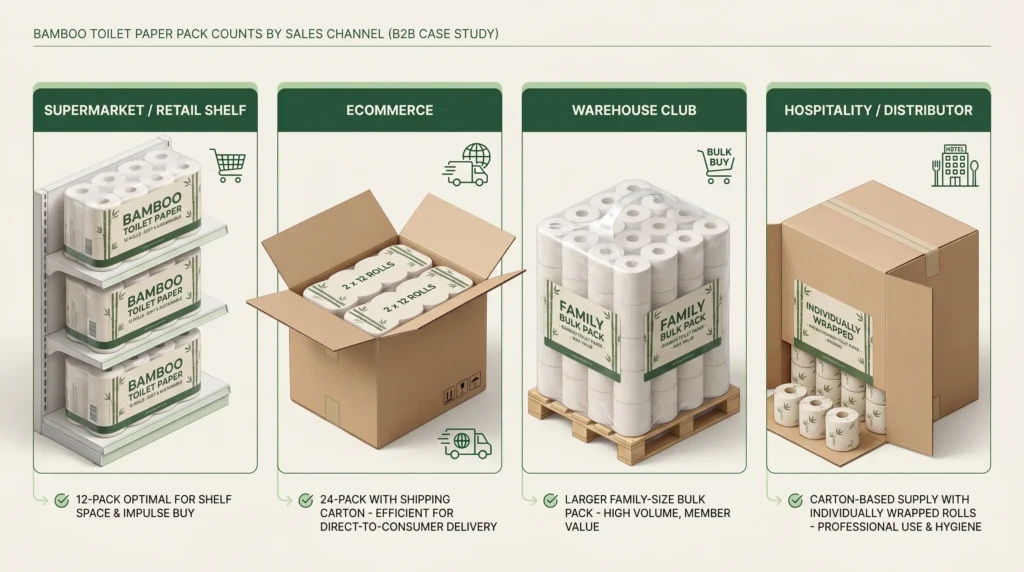
Reel’s Target launch used a specialty 12-pack. That detail matters.
For toilet paper, pack count changes the buying decision. A 24-pack or 48-pack can look like better value, but it asks a new customer to commit more money, more storage space, and more trust before they know whether they like bamboo paper. A 12-pack lowers that first decision. It is easier to carry, easier to store, easier to place on shelf, and easier to try.
From a Target-style retail logic, that makes sense. A new sustainable paper brand cannot always demand the same shelf footprint as a mature national brand. A smaller pack gives the product a chance to enter the aisle without asking the retailer for too much space at the beginning.
But this is exactly where many buyers misunderstand the case.
The lesson is not “use 12 rolls.” The lesson is “match the pack count to the channel.”
A Costco-style buyer may want the opposite. Warehouse retail depends on value perception and volume. A 12-pack can feel too small in a channel where the customer expects a large family-size supply. For Amazon, the shipping carton may matter more than the retail front panel. For hotels, offices, and distributors, a pretty 12-pack may be irrelevant; they may care more about carton count, roll count, case packing, storage efficiency, and reorder rhythm.
This is why Suministro de pañuelos de papel para el comercio minorista y el comercio electrónico should be planned differently. A shelf-ready pack, an ecommerce carton, and a distributor case pack do not solve the same problem.
So before asking the designer to make a 12-pack look beautiful, the buying team needs to answer a more basic question: where will this product actually sell?
Pack count affects price point, shelf fit, shipping cost, carton size, barcode setup, pallet plan, and customer perception. If the format is wrong, better artwork only makes the wrong decision look nicer.
Plastic-Free Packaging Has to Survive More Than a Photoshoot
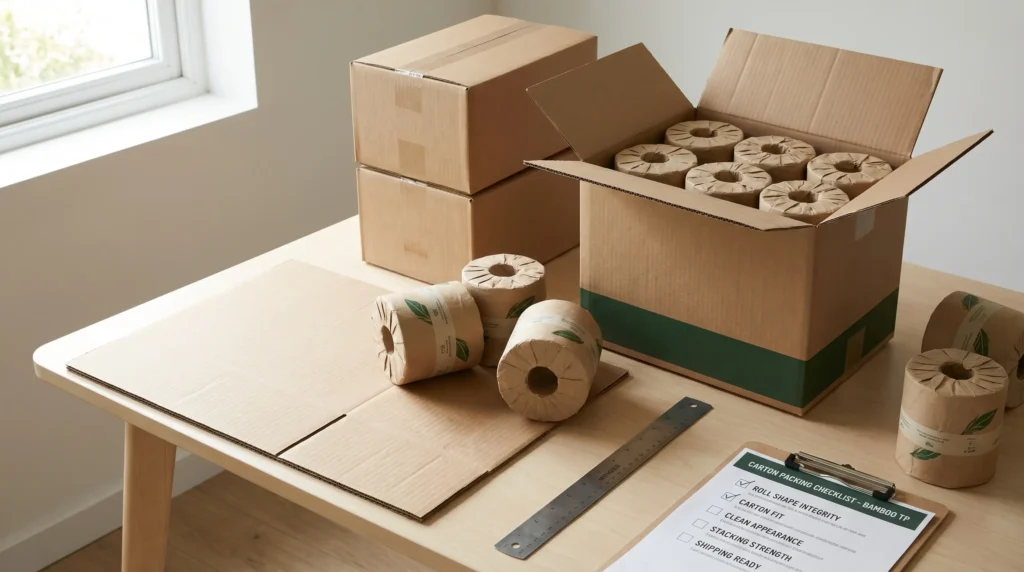
Plastic-free packaging is one of Reel Paper’s clearest retail signals. It is easy for shoppers to understand. A bamboo toilet paper brand wrapped in heavy plastic creates an obvious contradiction, so the packaging claim matters.
But plastic-free packaging also creates a practical problem: toilet paper is bulky, soft, and easy to deform.
A design render can look clean. A single sample can look premium. The real test starts when rolls are packed into cartons, stacked, moved, compressed, stored, shipped, opened, and handled by people who are not thinking about the brand story.
For toilet paper, the failure is often not dramatic. The wrap does not have to tear completely to become a problem. It can soften, rub, dent, loosen, wrinkle, or make the rolls look slightly dirty. The customer may not know what happened in shipping, but they will know the product no longer feels bathroom-ready.
That is why plastic-free packaging should be treated as a performance specification, not only a sustainability claim.
A practical review does not need to start with a laboratory. Pack the rolls into the intended carton. Stack the cartons. Move them. Let them sit. Open them again. Check whether the roll shape, outer wrap, corner protection, and shelf appearance still look acceptable. If the product is for ecommerce, add another question: does the inner pack still look clean after the outer carton has done its job?
For buyers building a similar line, envases de papel tisú personalizados should be checked as a physical supply decision, not only as a brand design choice. For a deeper packaging discussion, see our guide to plastic-free toilet paper packaging and the buyer checks behind it.
This is the kind of detail that does not show up in a mood board. Paper wrap, carton strength, moisture exposure, compression tolerance, storage time, and shipping route all affect whether the claim can survive the channel.
A beautiful paper package that fails in transit is not a sustainability advantage. It is a customer service issue waiting for the first bad unboxing photo.
Retail Expansion Is Where the Supply Plan Gets Exposed
Getting into Target is one milestone. Expanding across Target is a different test.
A limited retail launch can survive some inefficiency. A broader retail rollout is less forgiving. Reel’s later retail expansion report showed a much wider Target footprint, which means more cartons, more handling, more replenishment cycles, more barcode scans, more chances for packaging damage, and more pressure on production consistency.
This is especially true for toilet paper. It is not a small, high-margin product that hides inside a neat display box. It takes space everywhere: in the factory, in the warehouse, in the container, in the retailer’s backroom, and on the shelf.
That is why retail expansion is not only a marketing achievement. It is a supply chain audit performed in public.
Small changes become visible. If the roll diameter changes slightly, the pack may not sit the same way. If the carton weakens, the shelf-ready appearance suffers. If the wrapping material changes, customers may notice. If reorder lead time becomes unstable, the retailer sees the problem quickly. If the product takes too much space for the sales velocity it delivers, the shelf allocation becomes harder to defend.
The public Reel Paper story shows the visible part: Target access, expanded store count, plastic-free positioning, and brand validation. What public information does not show is just as important: margin by SKU, carton damage rate, retailer feedback, supplier structure, inventory buffer, sell-through by pack size, and the operating cost behind the retail expansion.
A private label buyer cannot copy the visible part and ignore the hidden part.
Before scaling a bamboo toilet paper line, the product file has to be boring in the best way. Roll size, ply, sheet count, GSM, embossing, core size, pack count, wrapping method, carton size, loading plan, and reorder lead time all need to be repeatable.
Retail does not only ask whether the first order looks good. It asks whether the tenth order looks the same.
B Corp Makes the Company Look Trustworthy. It Does Not Certify the Roll.
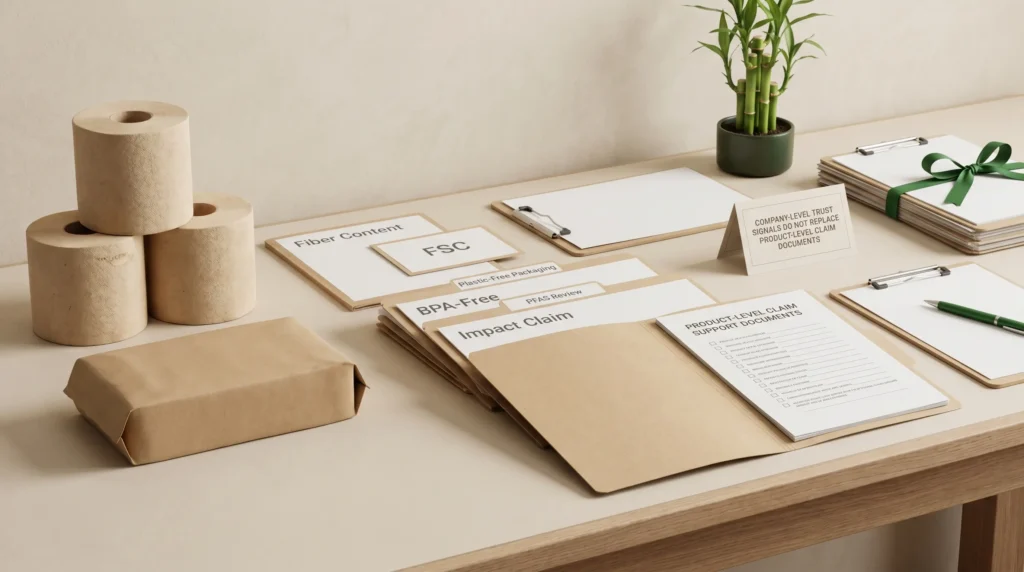
B Corp is useful. It gives a company-level trust signal and helps a brand show that it has been assessed beyond basic product marketing.
But B Corp does not prove every product claim on the pack.
This distinction matters because sustainable paper brands often stack claims too quickly. Bamboo. Tree-free. Plastic-free. FSC. BPA-free. No dyes. No inks. PFAS-free. Biodegradable. Compostable. Septic-safe. Social impact. Carbon-related language.
Those words do not carry the same kind of proof.
Some describe the fiber. Some describe the packaging. Some describe the company. Some describe chemical review. Some describe disposal conditions. Some describe a donation or impact program. Some may work in one market and need review before they appear in another.
The front panel may only show five or six words, but each word creates a documentation burden.
This is where packaging approval should slow down. Before a claim goes into artwork, the team should know exactly what is being claimed, which document supports it, and where the claim will appear. A phrase used in a sales deck is not the same as a phrase printed on packaging. A phrase used on a website is not the same as a phrase used in paid ads. A phrase used in the U.S. may not be safe to copy into the EU, UK, Japan, Australia, or another market without review.
Fiber-related claims should also connect back to the actual material de pulpa de bambú, not only to a brand-level sustainability message.
Reel Paper’s public claim set is useful to study because it shows how many layers a sustainable toilet paper brand may carry at once. Its Target product listing includes claims such as 100% bamboo, 3-ply, zero plastic, no inks or dyes, and BPA free. But a new brand should not treat claim language as decoration. Claims are part of the product system.
Impact Messaging Works Better When It Has a Real Mechanism
Reel Paper’s partnership with SOIL is another useful part of the case. The impact message is not just “we give back.” It has a named partner and a stated contribution mechanism.
That matters because vague impact claims are easy to write and hard to defend.
For a bamboo paper brand, impact messaging can help the product feel larger than a commodity. But it also creates another layer of responsibility. Retailers and distributors may ask how the claim works. Customers may ask where the money goes. Marketing teams may want to repeat the message across packaging, product pages, email, ads, and retail materials.
If the mechanism is unclear, the message becomes fragile.
A practical impact claim needs a partner name, a contribution rule, a reporting method, and approved wording. Without those, the claim may sound positive but become difficult to use in real sales situations.
This does not mean every bamboo paper brand needs a donation model. Some brands may be stronger with a simpler product claim: bamboo fiber, plastic-free packaging, FSC support, or verified packaging materials. But if an impact message is part of the brand, it should be built like a claim, not like a slogan.
What Public Sources Still Do Not Tell Us
Public information can show Reel Paper’s retail announcements, product positioning, certification signals, packaging direction, and impact partnership. It cannot show the full operating picture.
We do not know the exact economics of the 12-pack. We do not know whether the smaller format improved trial enough to offset any loss in per-roll efficiency. We do not know the carton damage rate, Target buyer feedback, supplier structure, bamboo pulp sourcing details, inventory buffer, or long-term sell-through by SKU.
That does not make the case less useful. It makes the case more honest.
A brand case study should not pretend that visible success explains the whole operating system. It should separate known facts from reasonable retail logic.
Known: Reel entered Target with a specialty 12-pack and later expanded its Target presence.
Reasonable inference: the 12-pack likely helped reduce the trial barrier and fit retail shelf constraints better than a larger pack.
Unknown: whether that SKU was the most profitable format, how it performed by store type, and what operational compromises were required behind the scenes.
This distinction is important for private label buyers. Copying the visible format is easy. Copying the economics, supply discipline, and retail support system is the hard part.
What a Private Label Buyer Should Actually Take from Reel Paper
The Reel Paper case is not a template. It is a stress test.
It shows that bamboo toilet paper can be presented in a mainstream retail channel, but it also shows how many details have to line up before that presentation works.
The first detail is format. Pack count must match the channel. A 12-pack may help retail trial. A 24-pack may work better online. A larger format may be better for warehouse or distributor supply. Individually wrapped rolls may fit hospitality or commercial channels. There is no universal best pack.
The second detail is packaging performance. Plastic-free packaging has to protect the product, not only express the brand. The paper, wrap, carton, pallet plan, and shipping route all matter.
The third detail is claim control. B Corp, bamboo, FSC, plastic-free, BPA-free, no dyes, PFAS-free, biodegradable, compostable, and impact messaging need different proof. The packaging design should not be finished before the claim file is ready.
The fourth detail is repeat supply. A sustainable brand may win the first order with a strong story. It wins the second, third, and tenth order by delivering the same product again.
Para Proyectos de tejidos OEM y de marcas blancas, the product file should be ready before the final artwork, because pack count, claim wording, carton planning, and repeat supply all affect launch risk.
That is the part many new brands underestimate. The customer sees the pack. The retailer sees the replenishment record.
FAQ: Real Questions Buyers Ask After Studying Reel Paper
We want to enter a regional supermarket. Should we use a 12-pack like Reel, or a larger family pack?
Start with the store format, not the competitor example. A 12-pack can work when the retailer wants trial, compact shelf use, and a lower first-purchase barrier. A larger family pack may work better when customers expect value, stock-up behavior, or fewer repeat trips. Before choosing, check shelf space, target retail price, carton size, pallet plan, and expected reorder volume.
A retailer asked for plastic-free packaging. What do we need to confirm before saying yes?
Confirm the physical pack before promising the claim. The wrap should protect the roll shape, the carton should handle stacking, and the product should still look clean after storage and shipping. For ecommerce, also check whether the inner pack still looks acceptable after parcel handling. Plastic-free packaging only helps the brand if it still protects the product.
Our company is not B Corp certified. Can we still build trust for a bamboo paper line?
Yes, but do not blur the meaning of certification. If the company does not have B Corp certification, focus on product-level proof: bamboo fiber content, FSC support, packaging material, chemical review, plastic-free documentation, and market-specific claim wording. Trust can come from clear documents and consistent specifications, not only from a logo.
Which claims should be ready before packaging design starts?
Prepare the claims that will appear on the front panel first. For bamboo toilet paper, that may include bamboo content, FSC, plastic-free packaging, BPA-free wording, dye-free wording, PFAS-free review, septic-safe language, biodegradability or compostability wording, and any impact claim. Each claim should have a supporting document, a clear use case, and a destination-market review before it goes into artwork.
Before You Build a Reel-Style Bamboo Paper Line
A Reel-style bamboo paper line should not begin with a mood board. It should begin with three working files.
The first is the channel file: where the product will be sold, what pack count fits that channel, what price point is realistic, how the carton moves, and how the product will be replenished.
The second is the packaging file: wrapping material, carton strength, shelf appearance, storage risk, compression risk, shipping route, and whether the product still looks clean after handling.
The third is the claim file: bamboo content, FSC needs, plastic-free packaging, chemical-related wording, certification language, impact messaging, and destination-market review.
Only after those three files are clear does the brand story become safe to scale.
For bamboo paper buyers, Reel Paper’s Target story is useful because it shows the difference between a good sustainability message and a channel-ready product. The message gets attention. The product file decides whether the line can be sampled, listed, explained, verified, reordered, and kept on the shelf.
Newland Bambú can support buyers at that product-file stage: roll specification, packaging structure, claim support, carton planning, and repeat-order consistency for bamboo toilet paper, bamboo paper towels, facial tissue, and other bamboo paper products.