
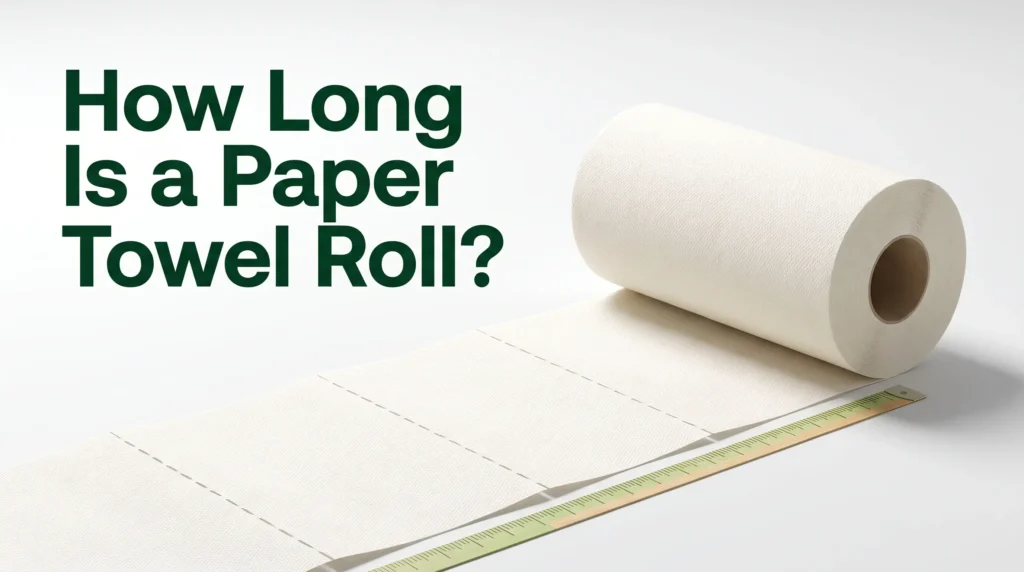
In three current household examples checked for this guide, the total length of a paper towel roll ranges from 40.8 feet to about 100.1 feet (12.4 to 30.5 meters) when fully unwound. The exact length depends mainly on the perforation length and the number of tear-off sections. The commonly cited 11-inch measurement usually describes the roll width, not the full running length of the paper. These figures are product examples, not a universal standard.
What Does “How Long Is a Paper Towel Roll?” Mean?
The phrase can refer to the width of the finished roll, the length of one tear-off section, or the full paper web wound onto the core. The measurement must be named before two products can be compared.
| Measurement | What it describes | Preferred specification |
|---|---|---|
| Roll width or roll height | Distance between the two flat cut ends | Inches or millimeters |
| Sheet length or perforation length | Distance between two tear lines | Inches or millimeters per section |
| Total roll length | Full paper web when completely unwound | Feet or meters per roll |
For many household products, an 11 × 6-inch sheet specification means the roll is about 11 inches wide and each tear-off section is about 6 inches long. The second value, together with the section count, determines the total running length.
This article focuses on total roll length, sheet count and perforation. Width, outer diameter, circumference and core measurements remain part of the broader paper towel roll dimensions specification.
How Many Feet Are in a Household Paper Towel Roll?
There is no single standard paper towel roll length. The three current examples below range from 40.8 feet to about 100.1 feet because their perforation lengths and section counts differ.
| Product example | Perforation length | Sections per roll | Total length | Evidence status |
|---|---|---|---|---|
| Bounty PGC74795 | 5.9 in | 83 | 40.8 ft | Listed by retailer |
| Uline S-7711 | 8.6 in actual | 85 | About 60.9 ft | Calculated from published specifications |
| Scott S-7132 | 9.38 in actual | 128 | About 100.1 ft | Calculated from published specifications |
The Bounty product page directly lists a 40.8-foot roll length, a 5.9-inch sheet length and 83 sections. The Uline and Scott pages list the actual sheet dimensions and section counts used for the calculated results.
For the calculated rows:
- Uline S-7711: 8.6 inches × 85 sections = 731 inches, or about 60.9 feet.
- Scott S-7132: 9.38 inches × 128 sections = 1,200.64 inches, or about 100.1 feet.
Product data were checked in July 2026. Listed values come directly from public product specifications; calculated values use the published perforation length and section count. These examples show how products differ, but they do not establish a market average or global standard.
Labels such as regular, double and mega are not sufficient for a technical comparison. Buyers should compare the numerical perforation length, section count and total roll length.
How Do You Calculate the Total Length of a Paper Towel Roll?
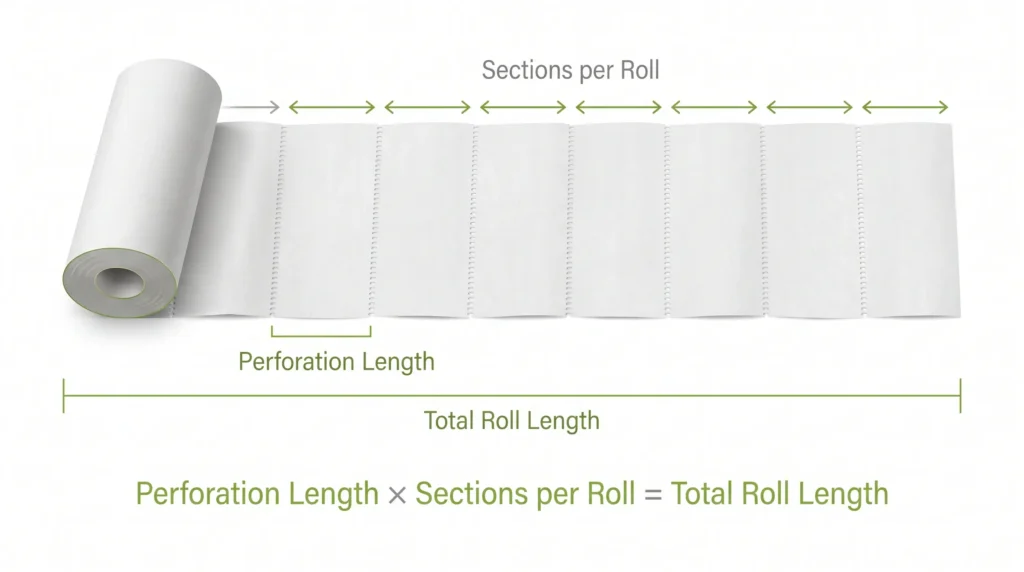
For a roll with equal-length tear-off sections, multiply the perforation length by the number of sections on the roll.
Total roll length = perforation length × sections per roll
When the perforation length is stated in inches:
- Divide the result by 12 to convert inches to feet.
- Multiply the result by 0.0254 to convert inches to meters.
For example, a roll with 140 sections and a 6-inch perforation interval contains:
140 × 6 = 840 inches
840 ÷ 12 = 70 feet
840 × 0.0254 = 21.34 meters
The calculation is valid only when the count and perforation definition match. When a package lists sheets per roll, confirm whether it counts every short select-a-size section, full-sheet equivalents, or sections in an alternating pattern.
Before comparing quotations, confirm what one “sheet” or “section” means.
How to Calculate a Mixed Perforation Pattern
When a roll contains more than one perforation interval, calculate each group separately and add the results.
Total roll length = (quantity A × length A) + (quantity B × length B)
A hypothetical roll with 70 sections at 10.2 inches and 70 sections at 6 inches would contain:
(70 × 10.2) + (70 × 6) = 1,134 inches = 94.5 feet
A paper-towel patent describes full-sheet perforations around 10.2 inches, select-a-size intervals around 5.7 to 7.1 inches, and alternating patterns within one roll. These are technical examples showing that mixed patterns exist; they are not universal retail specifications.
How Do Full Sheets and Select-a-Size Perforations Change Roll Length?
A shorter tear-off section does not automatically mean a roll contains less paper. Total length depends on the section length multiplied by the number of sections.
Consider two simplified specifications:
- Roll A: 80 sections × 10 inches = 800 inches, or 66.7 feet.
- Roll B: 140 sections × 6 inches = 840 inches, or 70 feet.
Roll B has shorter tear-off sections but slightly more total paper. This is why a higher or lower sheet count cannot be interpreted without the perforation length.
Perforation also affects the use format. Shorter sections may suit light wiping, while longer sections may suit larger spills. A length calculation confirms paper quantity, but a sample is still needed to assess usable sheet area, tear-off behavior and the fit between the format and the intended market.
This section addresses only the effect of perforation on total length. A complete comparison of full-sheet and select-a-size formats belongs in a separate product-format guide.
Why Can Similar-Diameter Rolls Contain Different Total Lengths?
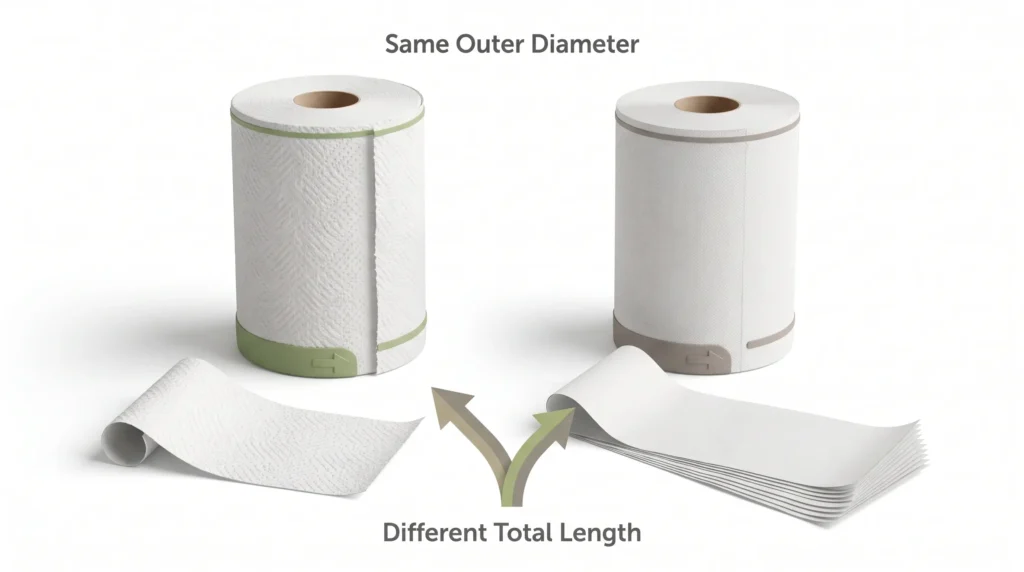
Similar outside diameters do not guarantee similar paper quantities. Sheet count and perforation determine running length, while ply, GSM, embossing, core diameter and winding density determine how much volume the paper occupies.
The current Uline and Scott examples illustrate the difference. Both product pages list a 4.75-inch roll diameter and a 1.5-inch core. However, their published sheet dimensions and section counts imply about 60.9 feet for the 2-ply Uline roll and about 100.1 feet for the 1-ply Scott roll.
The main variables are:
- section count;
- perforation length;
- ply and basis weight;
- embossing depth and effective bulk;
- core diameter;
- winding density.
A larger-looking roll may contain thicker or more deeply embossed paper rather than a longer web. Outside diameter is therefore useful for holder fit, pack dimensions, carton planning and shelf appearance, but it is not proof of total roll length.
Can You Calculate Paper Length from Roll Diameter?
Roll diameter can support an engineering estimate, but it cannot accurately confirm kitchen-paper length on its own. A geometric estimate also needs the core diameter and the effective material thickness. For embossed multi-ply tissue, effective thickness changes with compression, embossing and winding tension, so a small input error can produce a large length error.
Use diameter-based estimates for early packaging or equipment checks only. For sample approval and production acceptance, rely on the declared total roll length, the approved perforation length and section count, or a documented full-web measurement.
What Paper Towel Roll Length Specifications Should Buyers Confirm?
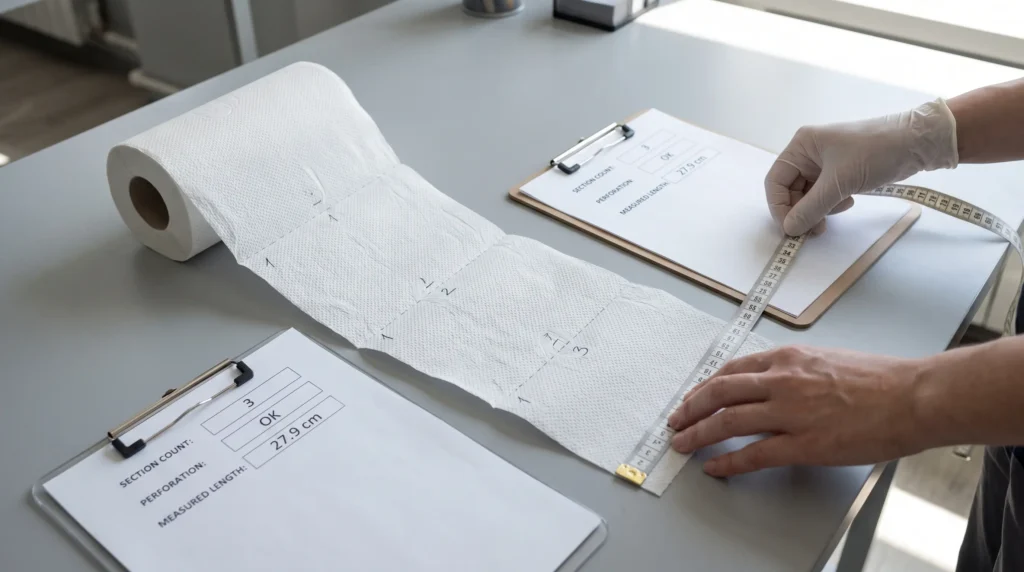
B2B buyers should define the complete length system rather than asking for a “standard roll.” Each value should state what is measured, the unit, and how the supplier and buyer will verify it.
| Specification field | What to confirm | Why it matters |
|---|---|---|
| Roll width | Finished cut width in mm or inches | Affects sheet width, packaging and holder fit |
| Perforation length | Distance between tear lines | Determines usable section size and the length calculation |
| Perforation pattern | Equal, alternating or mixed intervals | Prevents incorrect calculations |
| Sections per roll | Physical perforated sections or another defined counting method | Makes quotations comparable |
| Total roll length | Feet or meters per finished roll | Confirms total paper quantity |
| Ply and GSM | Ply structure and basis weight | Affect thickness, roll diameter and product positioning |
| Outer diameter and core | Finished OD plus core dimensions | Support packaging, carton and holder planning |
| Tolerance | Allowed variation in length, count and dimensions | Defines sample and production acceptance |
| Packaging format | Individual wrap, multipack or bulk carton | Connects roll size to retail and shipping needs |
A statement such as “100 sheets per roll” is incomplete without the sheet dimensions. A statement such as “70 feet per roll” may also be insufficient when the buyer needs a particular tear-off format.
For a practical perforation spot check, count a defined group of consecutive sections, measure their combined unwound length without stretching the paper, and compare the average interval with the approved specification. Full-roll verification must also confirm the total section count or measure the complete unwound web.
The strongest RFQ includes both the total roll length and the sheet-count/perforation combination used to achieve it. During sample approval, record the method together with the result so later production checks use the same basis.
FAQ About Paper Towel Roll Length
How Should Mixed Perforation Lengths Be Listed in an RFQ?
List each perforation interval and the number of sections using that interval, then state the required total roll length. For example, identify the quantity of full sections, the quantity of shorter sections and the repeating pattern instead of writing only “mixed sheets.”
Should a Supplier Quote Nominal or Measured Total Roll Length?
The quotation should state the nominal design value and its calculation basis. Sample and production records should also state the verification method, measured result and agreed tolerance when physical checks are required.
What Tolerance Should Be Used for Paper Towel Roll Length?
There is no universal tolerance that should be assumed for every product and order. The buyer and supplier should agree in writing on the nominal value, sampling method, measurement method and acceptable variation before production approval.
Prepare a Roll-Length Specification for Sample Review
Importers, distributors, retailers and private-label brands can prepare a clearer sample specification by listing:
- target roll width;
- perforation length and pattern;
- sections per roll;
- total roll length;
- ply and GSM;
- outside diameter and core size;
- packaging format and carton requirements;
- destination market and sales channel;
- a reference product, package drawing or specification sheet.
Newland Bamboo can review these inputs together with Bamboo Kitchen Paper Towels samples, perforation options, embossing, packaging feasibility and carton planning. The commercial next step should preserve the values established in this guide rather than asking the buyer to restart with a generic inquiry.