
Introduction: Why South Korea Matters for Bamboo Tissue Suppliers
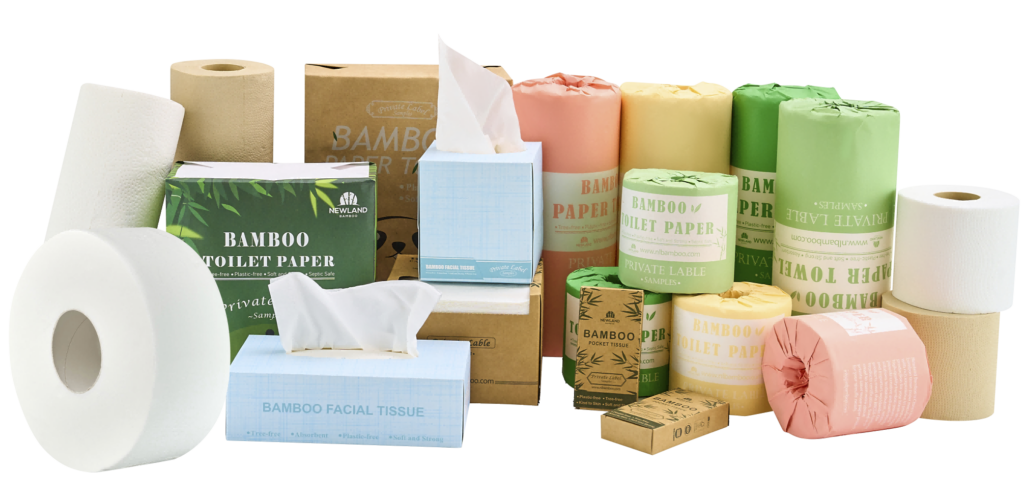
South Korea has emerged as one of Asia’s most selective and regulation-aware markets for household paper products. While overall toilet paper consumption remains stable, demand is clearly shifting toward products positioned as safer, more sustainable, and better aligned with environmental values. Bamboo toilet paper sits precisely at this intersection.
Unlike price-driven emerging markets, Korea treats bamboo tissue not as a low-cost substitute, but as an upgraded category. For importers, private-label brands, and institutional buyers, sourcing decisions are shaped by compliance risk, product consistency, and long-term supply stability rather than headline pricing alone.
This article examines the Korean bamboo toilet paper market from a manufacturing and supply chain perspective, focusing on real procurement behavior, structural constraints, and execution strategies relevant to B2B buyers.
Market Reality: Size, Growth, and Demand Signals
Market Size and Growth Projections (2023–2027)
While Korea does not publish bamboo tissue as a standalone statistical category, industry estimates based on import data, retail shelf expansion, and private-label launches indicate steady growth between 2023 and 2024. Bamboo and other non-wood pulp tissue products are estimated to grow at a high single-digit annual rate, outperforming the broader household paper segment.
Looking ahead to 2024–2027, most market observers expect continued expansion driven by three factors. Environmental regulation remains the primary driver, followed by rising consumer health awareness and gradual price normalization as supply chains mature.
Channel Penetration: Where Bamboo Toilet Paper Is Actually Sold
Bamboo toilet paper in Korea is not evenly distributed across channels.
Large supermarkets and hypermarkets typically treat bamboo tissue as a premium or specialty SKU, often under private labels. E-commerce platforms, particularly those emphasizing convenience and subscription models, show faster adoption due to lower shelf constraints and stronger sustainability storytelling.
Commercial channels such as hotels, offices, and medical facilities remain conservative but are increasingly testing bamboo-based products in response to ESG commitments and brand positioning requirements.
Each channel applies different standards to pricing, packaging, and performance, making channel strategy a critical sourcing consideration.
Price Sensitivity: How Much Premium Korean Buyers Accept
Korean consumers are generally willing to pay a moderate premium for bamboo toilet paper compared to standard wood pulp tissue. The acceptable premium varies by channel but is closely tied to perceived benefits such as skin friendliness, fiber purity, and environmental credibility.
From a B2B perspective, procurement decisions focus less on absolute price and more on consistency. Buyers prioritize stable cost structures that allow predictable retail pricing rather than aggressive short-term discounts.
How Korean Buyers Think: Decision Logic Behind Procurement

Buyer Segmentation in Korea
Bamboo toilet paper buyers in Korea typically fall into three categories.
Private-label and e-commerce brands emphasize differentiation and speed to market. Offline retailers prioritize compliance, packaging aesthetics, and supply continuity. Commercial and institutional buyers focus on performance stability and reputational risk management.
Understanding which segment a buyer belongs to is often more important than product specification alone.
The Korean Buyer’s Decision Journey
Procurement in Korea follows a structured and cautious process.
Supplier screening often begins through industry networks, trade associations, or referrals rather than open marketplaces. Shortlisted suppliers then enter a sample testing phase, usually involving two to three rounds over several weeks. These tests evaluate softness, strength, dust levels, and dissolvability under localized conditions.
Successful suppliers may face factory audits or quality system reviews, either directly or via third-party inspectors. Contract negotiation places strong emphasis on quality responsibility clauses, including penalties for inconsistency.
This process favors manufacturers with stable systems and experience in regulated export markets.
Why Korea Still Relies on China for Bamboo Toilet Paper
Raw Material and Capacity Reality
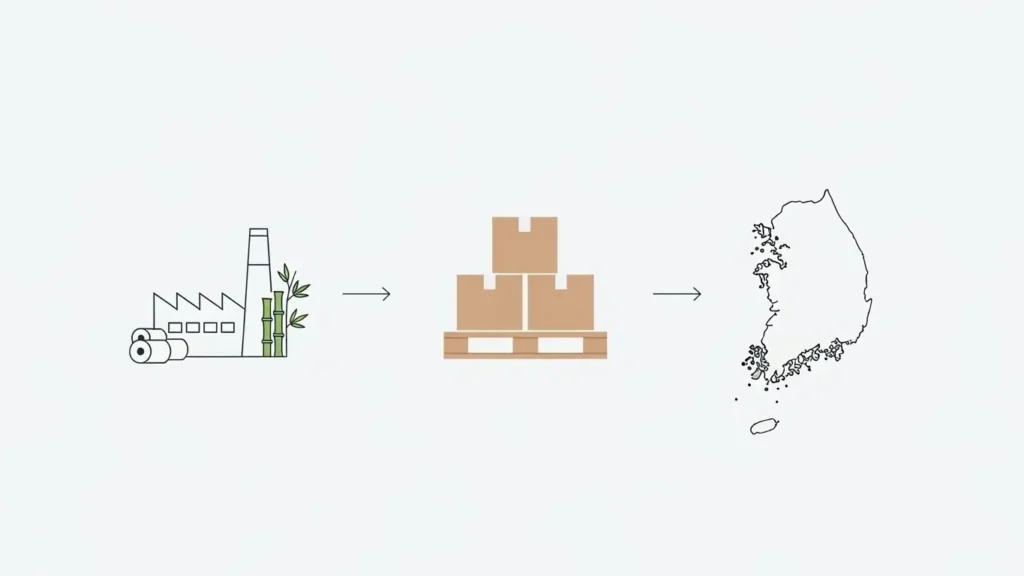
Korea lacks domestic bamboo pulp resources at scale. While local tissue production exists, bamboo pulp remains almost entirely imported. This structural limitation makes overseas sourcing unavoidable for bamboo-based products.
China remains the only country with both sufficient bamboo pulp availability and mature tissue manufacturing capacity to support consistent exports at scale.
The Chinese Supply Chain Advantage Beyond Cost
China’s bamboo tissue supply chain is concentrated in several regions, including Sichuan, Fujian, and Zhejiang, each contributing specialized capabilities.
Beyond raw material access, Chinese manufacturers have developed stable bamboo pulp and blended bamboo-wood pulp formulations that balance softness, strength, and dissolvability. These technical refinements address earlier concerns that bamboo tissue was either too stiff or insufficiently dispersible.
Equally important is production flexibility. Many Korean buyers begin with limited volumes, often in the range of 500 to 2,000 cartons. Chinese factories are structurally better equipped to support these pilot orders while maintaining quality consistency.
Logistics efficiency further reinforces this advantage. Direct shipping routes from major Chinese ports to Busan and Incheon are typically shorter and more predictable than alternatives from Southeast Asia.
Competitive Landscape: Who Is Already Supplying Korea
Chinese Suppliers
Most bamboo toilet paper supplied to Korea originates from China, primarily from coastal or bamboo-rich provinces. While manufacturing capacity is strong, quality consistency varies widely, creating both competition and opportunity for disciplined producers.
Southeast Asian Suppliers
Vietnam and Thailand have entered the bamboo tissue space but face constraints in raw material availability and scale. While cost structures can be competitive, supply stability remains a concern for Korean buyers.
Korean Local Brands
Many Korean bamboo tissue brands rely on OEM manufacturing abroad. Domestic branding strength does not necessarily imply domestic production.
Market Gaps and Unmet Needs
Despite growing competition, gaps remain. Bamboo kitchen paper, customized commercial-grade products, and consistent mid-volume OEM partners are still underrepresented, leaving room for specialized manufacturers.
Case Insight: Entering a Top Korean Retail Channel
A China-based bamboo tissue manufacturer partnered with a Korean private-label brand to enter a top-tier retail channel.
The initial strategy focused on positioning the product as suitable for sensitive skin, supported by performance testing rather than exaggerated claims. Market entry began online to validate demand before expanding offline.
Packaging was redesigned from dense, information-heavy layouts to minimalist Korean-style aesthetics. Early reorders within three months signaled acceptance, enabling gradual volume expansion.
The key success factors were quality consistency, fast communication, and willingness to adapt packaging and documentation to Korean expectations.
Compliance and Greenwashing Risk in Korea
Navigating Environmental Claims Regulations
Korean regulators closely monitor environmental marketing language. Broad claims such as “100% eco-friendly” attract scrutiny, while comparative or specific statements are generally safer.
Manufacturers must align claims with verifiable attributes and avoid overstated benefits.
Certifications and Documentation Buyers Expect
FSC certification is widely recognized, but buyers may also request Korean-standard documentation or environmental labels. Clear raw material traceability and origin documentation are increasingly expected, particularly for bamboo-based products.
Risk Mitigation Strategies for New Market Entrants
Entering the Korean market involves non-obvious risks.
Cultural communication styles favor indirect negotiation and consensus building. Quality risk is mitigated through clearly defined inspection standards. Logistics risk is reduced through experienced freight partners familiar with Korean ports.
Payment terms often involve detailed contractual safeguards, making preparation essential for first-time suppliers.
Future Trends
Product innovation is moving toward functional bamboo tissue, including antibacterial enhancements and fiber blends. Packaging innovation focuses on fully biodegradable or water-soluble materials.
Subscription models targeting single-person households and customized B2B solutions for hotels and offices are expected to grow.
Conclusion: What Actually Matters for Success in Korea
Korea is not a trial market for bamboo toilet paper. It rewards suppliers who combine technical competence, regulatory awareness, and operational discipline.
For buyers, long-term success depends on selecting manufacturers that understand both bamboo material science and Korean procurement realities. For manufacturers, Korea offers a demanding but sustainable growth opportunity.
Working with Newland Bamboo for the Korean Bamboo Toilet Paper Market
Sourcing bamboo toilet paper for the Korean market requires a manufacturing partner that understands both material performance and regulatory expectations. Beyond sustainability claims, Korean buyers prioritize product consistency, traceable raw materials, and reliable long-term execution.
Newland Bamboo is a specialized manufacturer focused exclusively on bamboo pulp toilet paper for export markets. With controlled bamboo pulp sourcing, stable production standards, and flexible OEM capabilities, Newland Bamboo supports Korean importers, private–label brands, and institutional buyers from initial sampling to scalable mass production.manufacturer focused exclusively on bamboo pulp toilet paper for export markets. With controlled bamboo pulp sourcing, stable production standards, and flexible OEM capabilities, Newland Bamboo supports Korean importers, private–label brands, and institutional buyers from initial samanufacturer focused exclusively on bamboo pulp toilet paper for export markets. With controlled bamboo pulp sourcing, stable production standards, and flexible OEM capabilities, Newland Bamboo supports Korean importers, private-labemanufacturer focused exclusively on bamboo pulp toilet paper for export markets. With controlled bamboo pulp sourcing, stable production standards, and flexible OEM capabilities, Newlmanufacturer focused exclusively on bamboo pulp toilet paper for export markets. With controlled bamboo pulp sourcing, stable productimanufacturer focused exclusively on bamboo pulp toilet paper for export markets. Wmanufacturer focused exclusively o
For Korean buyers evaluating bamboo toilet paper suppliers, working directly with Newland Bamboo helps reduce sourcing risk, streamline communication, and ensure documentation readiness for Korean import and compliance requirements.
If you are exploring bamboo toilet paper sourcing or OEM projects for South Korea, product specifications, samples, and technical discussions can be arranged based on your project scope.
Newland Bamboo has supported multiple bamboo toilet paper sourcing projects for the Korean market, including private–label and institutional buyers, from initial sampling to scalable production.
👉[Request Bamboo Toilet Paper Samples from Newland Bamboo]
👉[Contact Newland Bamboo’s Manufacturing Team]
FAQ
-
Is bamboo toilet paper popular in South Korea?
Yes. Demand is growing steadily, particularly in premium retail and e-commerce channels.
-
How do Chinese suppliers address greenwashing concerns?
By using precise, verifiable claims supported by documentation rather than broad marketing language.
-
Is bamboo toilet paper less soft than wood pulp tissue?
Modern bamboo pulp formulations and blends can achieve comparable softness while maintaining strength.
-
What origin documentation does Korean customs require?
Clear certificates of origin and raw material traceability are commonly requested, especially for bamboo-based products.