
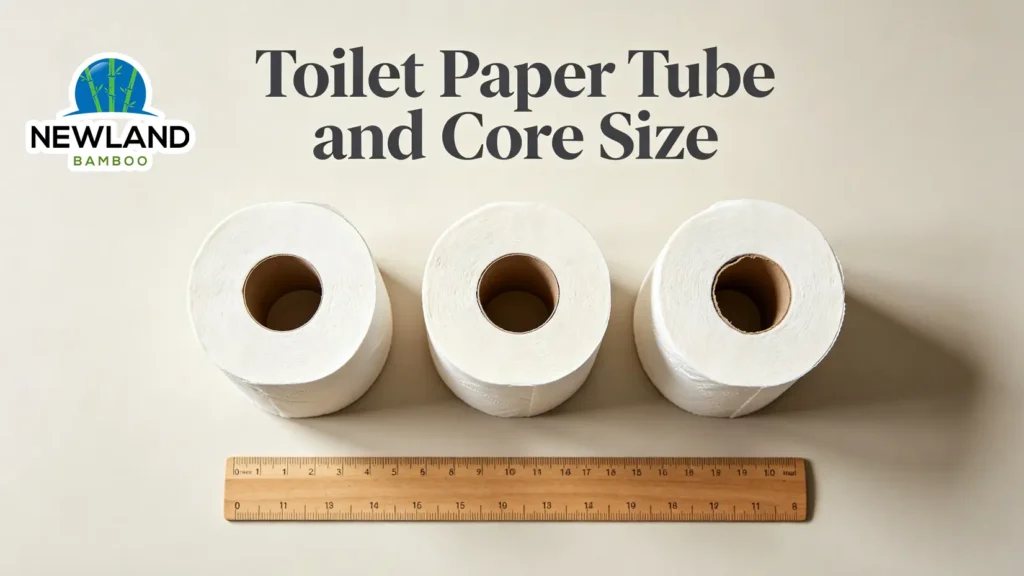
A standard toilet paper tube is usually about 4 inches long, with a common inner core diameter of about 1.5–1.75 inches. Many people call this part a toilet paper tube, while factories and B2B suppliers usually describe it as a toilet paper core or toilet paper roll core. In the UK, Australia, and some other markets, the same cardboard part may also be called a toilet roll tube or toilet roll core.
The exact size can vary by market, brand, roll format, dispenser type, and whether the product is a household roll, commercial roll, jumbo roll, small-core toilet paper, or coreless toilet paper. For buyers, the tube is not just an empty cardboard part. It affects roll fit, dispenser compatibility, packaging, carton layout, shipping stability, and sample approval before bulk production.
This guide explains toilet paper tube size, standard toilet paper tube size, toilet roll tube size, toilet paper tube dimensions, toilet roll tube dimensions, core diameter, circumference, wall thickness, tolerance, and the key details buyers should confirm when developing custom toilet paper rolls.
Key Takeaways
- A toilet paper tube is commonly called a toilet paper core or toilet paper roll core in factory specifications, while toilet roll tube and toilet roll core are common UK-style alternatives.
- Standard toilet paper tubes are often around 4 inches long, with common inner diameters around 1.5–1.75 inches.
- Buyers should check inner diameter, outer diameter, wall thickness, tolerance, and dispenser fit, not only the visible tube size.
- Small-core and coreless toilet paper can change usability, roll stability, packing, and dispenser performance.
- For custom bamboo toilet paper, core size should be confirmed together with roll width, roll diameter, ply, GSM, sheet count, packaging, carton packing, and sample approval.
What Is a Toilet Paper Tube or Toilet Paper Core?
A toilet paper tube is the cardboard or paperboard part inside a toilet paper roll. It helps the paper keep its round shape and allows the roll to turn on a holder or dispenser.
Some users may also describe it as a toilet paper cardboard tube, especially when referring to the empty cardboard part left after the paper is used.
In consumer language, people often call it a toilet paper tube, toilet paper roll tube, toilet roll tube, or cardboard tube inside a toilet paper roll. In factory specifications, the same part is more often called a toilet paper core, toilet paper roll core, toilet roll core, paper core, or roll core.
Many searches for toilet paper tubes relate to crafts or reuse, but this guide focuses on tube dimensions, core size, and roll specifications for toilet paper buyers.
For B2B buyers, this wording matters. When discussing samples, drawings, or roll specifications with a supplier, “core” is usually the more precise term.
Tube vs Core: Consumer Wording and Factory Wording
| Term | What It Usually Means | Buyer Note |
|---|---|---|
| Toilet paper tube | Common user wording for the cardboard part inside the roll | Good for general explanation and search intent |
| Toilet paper core | Factory and specification wording | Better for OEM, sampling, and production discussion |
| Toilet paper roll core | More specific B2B wording | Useful when confirming roll structure |
| Toilet roll tube | UK-style wording for the cardboard tube inside a toilet roll | Useful for buyers searching in the UK, Australia, and similar markets |
| Toilet roll core | UK-style or factory wording related to toilet roll specifications | Useful when discussing core diameter, roll structure, and dispenser fit |
| Cardboard core / paperboard core | Material-focused wording | Useful when discussing strength, recyclability, or wall thickness |
| Inner core | The hollow space inside the tube | Important for holder or dispenser fit |
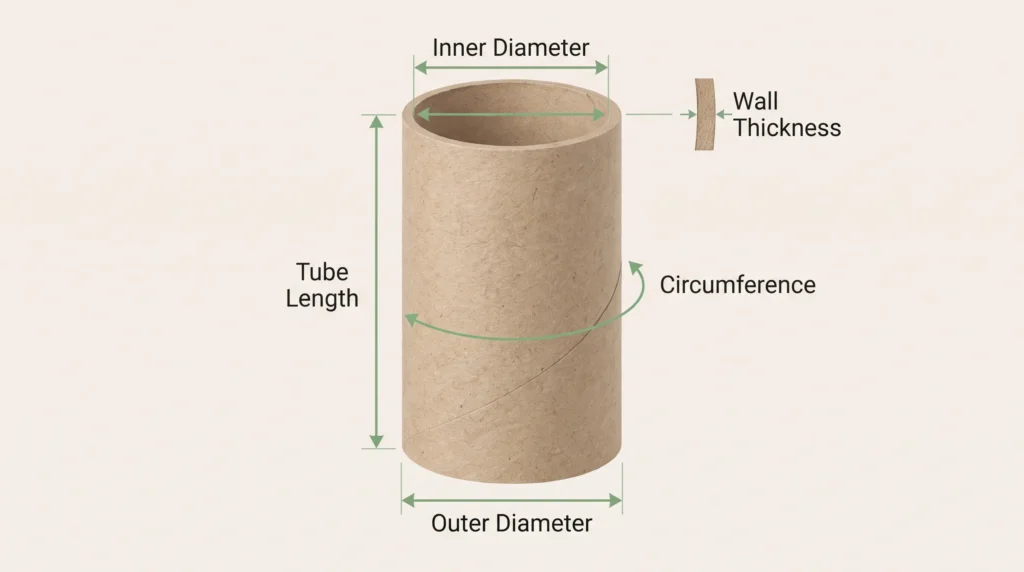
A simple way to explain it is:
A toilet paper tube is what users see. A toilet paper core is what factories specify. A toilet roll tube is usually the same part described in UK-style wording.
Tube/Core vs the Full Toilet Paper Roll
The toilet paper tube is only one part of the finished roll. It should not be confused with the full toilet paper roll.
| Measurement | Refers To | Why It Matters |
|---|---|---|
| Tube length | Length of the cardboard core | Usually follows roll width |
| Core inner diameter | Hollow opening inside the tube | Affects holder and dispenser fit |
| Core outer diameter | Outside edge of the cardboard core | Affected by wall thickness |
| Roll outer diameter | Full outside diameter of the finished roll | Affects pack size, carton loading, and shelf presentation |
| Roll width | Width or height of the roll | Affects market fit, packaging, and dispenser compatibility |
For complete toilet paper roll specifications, buyers should also check roll width, roll diameter, ply, GSM, sheet count, embossing, packaging, and carton packing. For the full roll-level specification, see our guide to toilet paper roll dimensions.
Core Length, Paper Edge, and Roll Appearance
Tube length usually follows the roll width, but buyers should still check how the paper edge sits against the core.
In some rolls, the paper edge is almost flush with the core end. In others, the tissue may be slightly recessed, or the core may be slightly exposed. This small detail can affect appearance, dispenser clearance, packaging presentation, and how the roll looks in retail or hospitality channels.
Before sample approval, confirm:
- Whether the paper edge is flush with the core end
- Whether the core end is exposed
- Whether the tissue edge is recessed
- Whether both roll edges look even
- Whether the roll still fits the target dispenser or holder
This is especially important for private label toilet paper, where the visual quality of the finished roll affects downstream customer confidence.
Toilet Paper Tube Size and Dimensions: Length, Diameter, and Circumference
Most standard toilet paper tubes are close in size, but they are not identical across every brand or market. The common reference size is about 4 inches long, with an inner diameter around 1.5–1.75 inches.
For B2B orders, these numbers should be treated as a reference, not a final production standard. The final size should be confirmed through a sample, specification sheet, and dispenser test when needed.
The same measurement logic applies when the product is described as a toilet roll tube, toilet roll core, toilet roll tube size, or toilet roll tube dimensions in UK-style search wording.
Common Toilet Paper Tube Dimensions
| Measurement | Common Reference | Buyer Note |
|---|---|---|
| Tube length | About 4 inches / 100–102 mm | Usually matches or closely follows roll width |
| Core inner diameter | About 1.5–1.75 inches / 38–44 mm | Important for holder and dispenser fit |
| Core outer diameter | Slightly larger than inner diameter | Depends on cardboard wall thickness |
| Tube circumference | About 5 inches if diameter is around 1.6 inches | Depends on whether you measure inner or outer circumference |
| Wall thickness | Often around 1.5–2.5 mm for many standard tubes | A practical reference, not a universal standard |
Toilet Paper Tube Length: How Long Is a Toilet Paper Roll Tube in Inches?
If buyers ask how long is a toilet paper tube or how long is a toilet paper roll tube in inches, the common reference answer is about 4 inches. Some rolls may be slightly shorter or longer depending on the target market, roll width, and product format.
Some buyers also ask how wide a toilet paper roll tube is. In most specifications, this usually refers to the tube length or roll width, while the diameter of a toilet paper roll tube refers to the round opening of the core.
For example, household toilet paper rolls often use a tube length close to the roll width. If a roll is designed for a compact market format or a commercial dispenser, the tube length may change.
Buyers should not approve a bulk order only based on a generic online answer. For private label toilet paper or custom bamboo toilet paper, the supplier should confirm the exact tube length together with roll width, roll diameter, and packaging format.
If you also need to compare tube length with the usable paper length, see our guide on how long a toilet paper roll is.
What Is the Diameter of a Toilet Paper Tube?
The common toilet paper tube diameter is usually about 1.5-1.75 inches for standard household rolls. If buyers search for the diameter of toilet paper tube, they usually mean this core opening, but they should still confirm inner diameter versus outer diameter. In production discussions, buyers should ask whether this number refers to the inner diameter or the outer diameter.
The inner diameter is usually more important for dispenser fit because it determines whether the roll can slide onto the holder or spindle. The outer diameter includes the cardboard wall and may change depending on the paperboard thickness.
If buyers ask for toilet roll tube diameter, the same rule applies: confirm whether the requested measurement is the inner opening of the core or the outside edge of the cardboard tube.
Toilet Paper Tube Circumference: What Is the Circumference of a Toilet Paper Tube?
The circumference of toilet paper tube or circumference of a toilet paper roll tube depends on the diameter being measured. If the tube diameter is about 1.6 inches, the circumference is about 5.03 inches.
The simple formula is:
Circumference = π × Diameter
For example:
3.1416 × 1.6 inches = 5.03 inches
For UK-style wording, the same calculation applies to the circumference of a toilet roll tube. If buyers ask for toilet roll tube diameter, they should also clarify whether they mean the inner diameter or the outer diameter of the cardboard core.
This is useful when checking tube drawings, packaging space, or sample measurements. However, buyers should be careful not to confuse three different measurements:
| Term | Meaning |
|---|---|
| Inner circumference of the tube | The inside edge of the cardboard core |
| Outer circumference of the tube | The outside edge of the cardboard tube wall |
| Full roll circumference | The outside edge of the finished toilet paper roll |
Tube circumference is different from full toilet paper roll circumference, which measures the outside edge of the finished roll.
For sourcing and sample approval, the core inner diameter, tube length, roll width, and roll outer diameter are usually more useful than circumference alone.
Inner Diameter vs Outer Diameter: Which One Should Buyers Check?
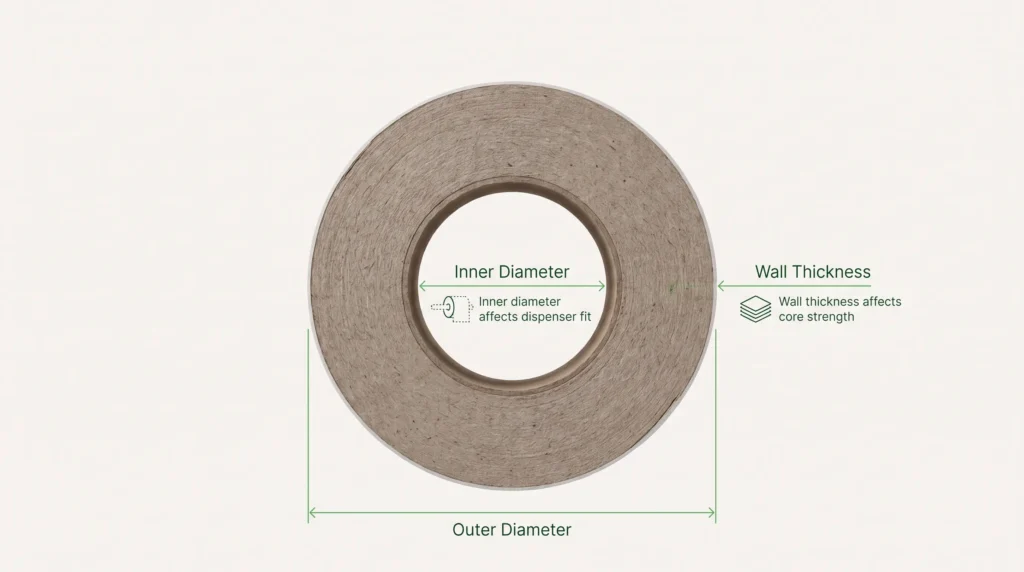
Buyers should prioritize the inner diameter when checking holder or dispenser fit, and review the outer diameter when core strength, wall thickness, or packing stability matters.
When buyers ask about the toilet paper roll core diameter, toilet roll core diameter, or core diameter of a toilet paper roll, they should clarify whether they mean the inner opening of the core or the outer diameter including the cardboard wall.
Some specification sheets may use wording such as “core diameter of toilet paper roll,” “toilet paper core dimensions,” or “toilet paper roll core dimensions.” In practical purchasing communication, this usually means the core diameter of the finished roll, but the buyer still needs to confirm whether the supplier is measuring inner diameter or outer diameter.
Inner Diameter for Holder and Dispenser Fit
The inner diameter is the hollow opening inside the toilet paper core. This is the key measurement for holder and dispenser fit.
If the inner diameter is too small, the roll may not slide onto the holder. If it is too large, the roll may feel loose, spin too quickly, create noise, or move unevenly during use. This problem becomes more serious in commercial bathrooms, hotels, offices, schools, and high-traffic facilities.
For a specific commercial toilet paper dispenser, confirm these details with the supplier:
- Dispenser spindle diameter
- Required toilet paper core diameter
- Acceptable tolerance
- Roll width
- Roll outer diameter
- Full-roll test result
A good sample test should use finished rolls, not only empty tubes.
Outer Diameter and Wall Thickness for Tube Strength
The outer diameter includes the cardboard wall. It is affected by wall thickness, core paper strength, glue layers, and roll type.
For many standard toilet paper tubes, wall thickness may be around 1.5–2.5 mm, but this is only a practical reference, not a universal standard. Heavier commercial rolls, jumbo rolls, long-distance export orders, or tightly packed cartons may require stronger or thicker cores.
Buyers should confirm outer diameter and wall thickness when:
- The roll is large or heavy
- The product is for commercial dispensers
- The shipment involves long-distance export
- The packaging is tightly packed
- The tube must resist collapse during use
- The finished rolls will be stacked for storage
Wall Thickness, Tolerance, and Core Strength
Wall thickness alone does not tell the full story. A thicker core is not always better if the inner diameter becomes too small or the roll no longer fits the dispenser.
For B2B buyers, three details matter together:
| Detail | Why It Matters |
|---|---|
| Wall thickness | Affects tube strength and outer diameter |
| Inner diameter tolerance | Affects dispenser fit and roll rotation |
| Core strength | Affects whether the tube collapses during packing, shipping, or use |
For OEM toilet paper orders, ask the supplier to state the core inner diameter tolerance on the specification sheet. Some dispenser-sensitive projects may control the core ID within a tight range such as around ±0.5 mm, but the final tolerance should match the dispenser system, roll type, and sample approval standard.
Core internal diameter and tolerance are also formal specification topics in paper and board reel standards such as ISO 13542.
Buyers can also ask the supplier whether the core has enough compression resistance for packing and shipping. In practical purchasing language, this means checking whether the tube can resist flattening, crushing, or deformation before the product reaches the customer.
For industrial paper and board cores, flat crush resistance is also recognized as a formal testing concept in ISO 11093-9.
This is especially important for:
- Jumbo roll tissue
- Commercial toilet paper
- Export orders
- Humid storage environments
- High-stack carton packing
- Private label projects with strict appearance requirements
Are All Toilet Paper Tubes the Same Size?
No. Most toilet paper tubes are similar, but they are not all the same size.
Household rolls often follow common market sizes and fit regular bathroom holders. Commercial rolls, jumbo rolls, private label products, and regional formats may use different core sizes. Even small differences can matter when a buyer needs dispenser compatibility, exact carton packing, or strict product appearance.
A practical reference is:
| Use Case | Common Core Direction | Buyer Note |
|---|---|---|
| Household retail rolls | Usually close to standard core formats | Confirm roll width, sheet count, and packaging |
| Commercial dispenser rolls | May use standard, small-core, or system-specific cores | Must match dispenser spindle and housing |
| Jumbo roll tissue | May use larger and stronger cores | Check roll weight, core strength, and dispenser type |
| Private label / OEM rolls | Can be adjusted within practical production limits | Confirm with sample and specification sheet |
For high-traffic facilities, buyers can also review bamboo jumbo rolls when core strength, roll diameter, and dispenser fit are part of the order requirement.
Private label buyers may request a custom core size for brand positioning, cost control, packaging design, or dispenser compatibility. That is why sample approval is important before bulk production.
Standard Core, Small Core, and Coreless Toilet Paper
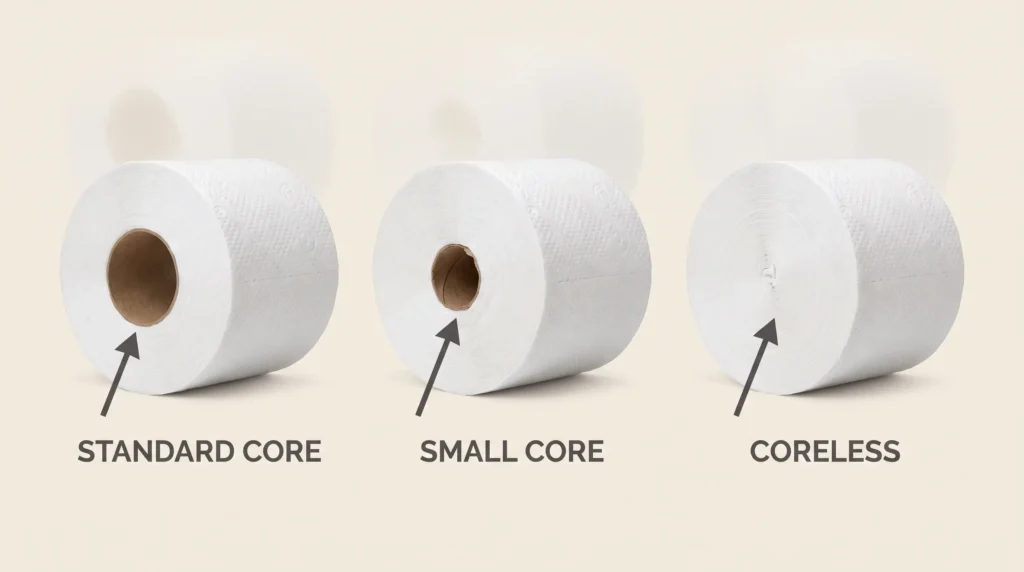
Most household and retail rolls use a standard core, while small-core and coreless toilet paper should only be chosen when the dispenser system, packing method, and target channel support that format.
Not every toilet paper roll uses the same core structure. Buyers may need to compare standard core, small core, and coreless toilet paper before confirming samples.
Standard Core Toilet Paper
Standard core toilet paper is the most common format for household and retail rolls. It works with most regular holders and is easy for consumers to understand.
This is usually the safest option for:
- Supermarkets
- E-commerce packs
- Household retail
- Hospitality guest rooms
- General private label toilet paper
Small Core Toilet Paper
Small core toilet paper uses a smaller inner opening than standard rolls. It may be used in certain commercial systems, compact roll formats, or dispenser-controlled environments.
In commercial catalogues, similar formats may also appear as small core bath tissue, split core toilet tissue, or toilet tissue with 2 inch core, depending on the dispenser system and market wording.
Small core toilet paper can help increase the usable paper space in a roll, but it must match the dispenser. If the buyer is using a small core toilet paper dispenser, the core diameter should be confirmed before production.
A small core also has real trade-offs. If the dispenser spindle is much smaller than the core opening, the roll may wobble, spin noisily, or dispense too quickly. If the spindle is too close to the core size, the roll may not slide on smoothly or may jam during use.
For this reason, small core products should be tested with the actual dispenser before bulk orders.
Coreless or No-Core Toilet Paper
Coreless toilet paper, no core toilet paper, tube free toilet paper, tube free bath tissue, coreless toilet tissue, coreless bath tissue, and toilet tissue without cardboard all refer to roll formats that reduce or remove the traditional cardboard tube.
Coreless formats may reduce core waste and increase usable paper volume, but they require careful checking. To keep the center stable, coreless rolls often need tighter winding control. If the winding is too tight, the roll may feel harder. If it is too loose, the center may collapse, deform, or become difficult to use after packing and shipping.
For coreless toilet paper or coreless toilet tissue, buyers should check:
- Roll structure
- Winding tightness
- Roll stability
- Center opening condition
- Dispenser requirement
- Packaging protection
- Sample performance after shipping
Coreless does not automatically mean better. It may work for controlled commercial systems, but it can create problems if the roll center deforms during shipping or if the target dispenser was designed for cored rolls.
Why Core Diameter Matters for Dispenser Fit
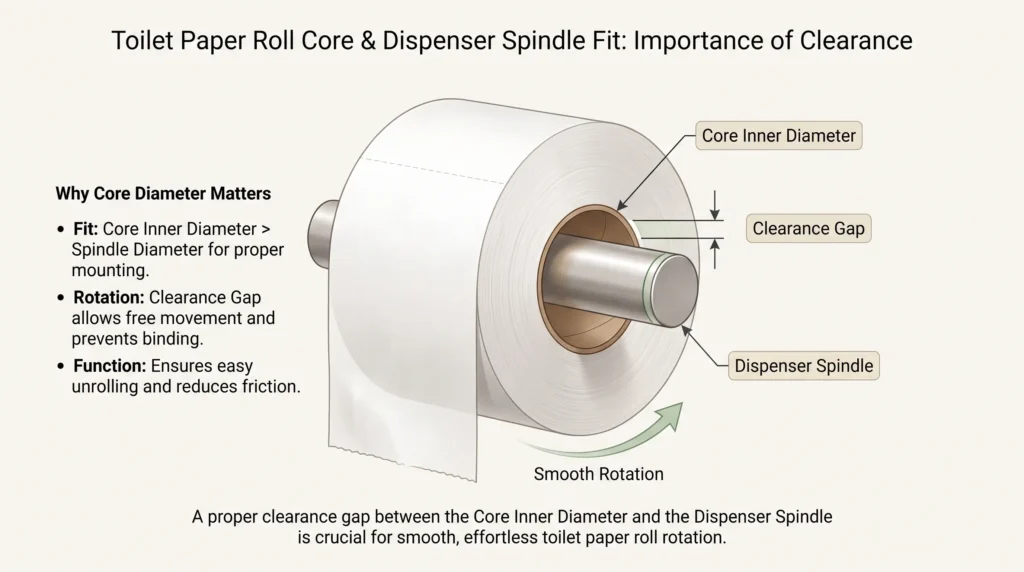
Core diameter matters because toilet paper rolls must rotate smoothly. A roll that does not fit the holder or dispenser can create user complaints, tearing, waste, noise, or replacement problems.
Common Problems Caused by the Wrong Core Size
Wrong core size may cause:
- The roll cannot slide onto the holder
- The roll spins too quickly
- The roll feels loose
- Paper tears unevenly
- The roll jams inside the dispenser
- Jumbo rolls collapse under weight
- Commercial users replace rolls too often
- The roll creates noise during dispensing
- The roll shifts sideways inside the dispenser
These problems are especially important for hotels, offices, schools, hospitals, public restrooms, and other away-from-home channels.
Core-to-Spindle Clearance: A Practical Starting Point
A practical way to think about dispenser fit is:
Core inner diameter should be slightly larger than the dispenser spindle diameter.
As a starting point, a clearance of about 1–2 mm may help the roll slide onto the spindle smoothly without excessive wobble. However, this should not be treated as a universal standard. The final clearance depends on the dispenser design, roll weight, core material, tolerance, and finished-roll test.
For locked dispenser systems or brand-specific commercial dispensers, buyers should follow the dispenser supplier’s requirement first.
How to Check Dispenser Compatibility Before Bulk Orders
Before approving bulk toilet paper production, buyers should follow a simple process:
- Measure the dispenser spindle diameter.
- Confirm the required core inner diameter.
- Check acceptable tolerance with the supplier.
- Confirm roll width and roll outer diameter.
- Test finished rolls in the real dispenser.
- Approve samples before bulk production.
This is more reliable than checking an empty tube alone. A finished roll has paper weight, winding pressure, and packaging compression that may affect how it performs.
Are Toilet Paper Tubes Recyclable?
Yes, many clean cardboard toilet paper tubes can be recycled, but buyers should check local recycling program rules before using recyclable claims on packaging or product pages.
In UK-style wording, this question may appear as are toilet roll tubes recyclable, can toilet roll tubes be recycled, or can you recycle toilet roll tubes.
For brands, recyclable cores and paper-based packaging can support a clearer sustainability message. However, recycling claims should match the destination market and local disposal rules.
The recyclability and strength of a toilet paper core can also be affected by paperboard material, glue type, moisture resistance, printing or coding inside the core, labels, adhesive residue, and storage environment.
Recycled paperboard and water-based glue are common options for paper cores, but buyers selling into humid markets may also need better moisture resistance so the core does not soften during storage.
The tube is only one part of the product. For bamboo toilet paper, sustainability communication may also involve bamboo pulp material, FSC-related sourcing documents, plastic-free packaging options, product color, carton packing, and market claim review.
Do not rely on the toilet paper tube alone to support a full environmental claim.
What Buyers Should Confirm Before Custom Toilet Paper Orders
When requesting custom toilet paper rolls, buyers should not only ask for the toilet paper tube size. The core should be confirmed together with the full roll specification.
Here is a practical checklist:
| Item to Confirm | Why It Matters |
|---|---|
| Core type | Standard core, small core, or coreless |
| Core inner diameter | Holder and dispenser fit |
| Core inner diameter tolerance | Helps avoid fitting problems in bulk orders |
| Wall thickness | Affects strength and outer diameter |
| Tube length / roll width | Market fit and packaging layout |
| Paper edge position | Affects appearance and dispenser clearance |
| Roll outer diameter | Pack size, shelf presentation, and carton loading |
| Ply | Product thickness and market positioning |
| GSM | Softness, strength, and cost structure |
| Sheet count or roll length | Consumer value and roll capacity |
| Embossing | Appearance, feel, and brand differentiation |
| Packaging format | Retail, e-commerce, hospitality, or bulk supply |
| Carton packing | Export loading and warehouse handling |
| Destination market | Size expectations and claim review |
| Sample approval | Confirms real product performance before mass production |
For brand owners, these checks are especially useful in private label toilet paper projects, where the roll structure, packaging, and downstream channel requirements need to match before production.
This checklist is especially useful for private label toilet paper, bamboo toilet paper, commercial toilet paper, and OEM roll development.
A small core detail can affect the whole product plan. The buyer may approve the paper quality, but if the core diameter does not match the dispenser or packaging plan, the order may still create problems in the market.
If you are preparing a custom bamboo toilet paper order, send Newland Bamboo your target roll width, roll diameter, core diameter, dispenser requirement, packaging style, and destination market. Our team can review whether the planned tube and core structure is practical before sampling.
Sample Approval Evidence Buyers Can Ask For
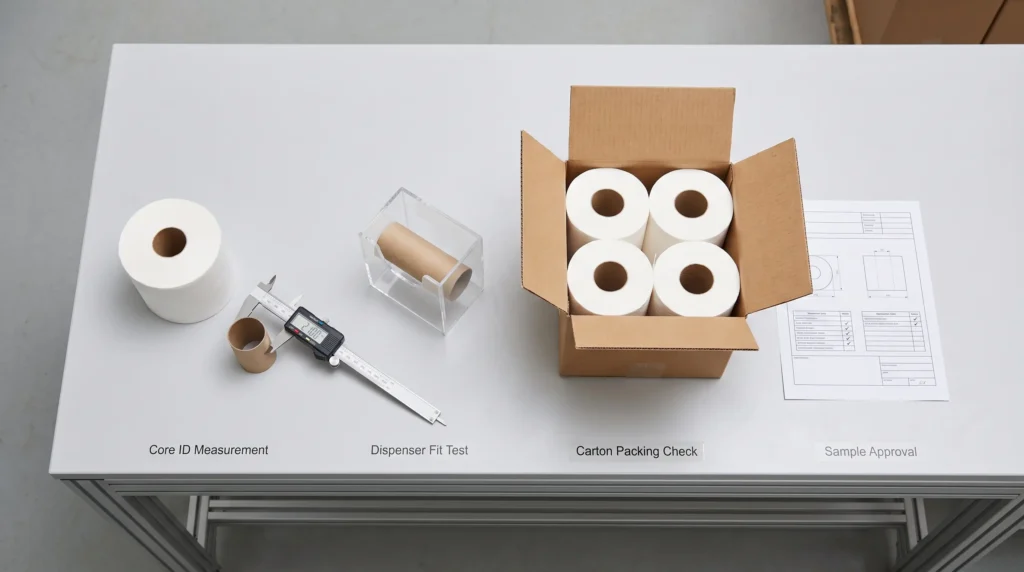
For a more reliable sample review, buyers can ask the supplier to provide simple visual evidence before confirming bulk production.
A roll may look correct on a desk but still fail in the dispenser, carton, or warehouse handling stage.
This can also be part of a broader sample approval and customization process before mass production.
Useful evidence includes:
- Caliper photo showing core inner diameter
- Caliper photo showing roll width
- Caliper photo showing roll outer diameter
- Photo showing the paper edge and core end
- Short video showing the roll on the target dispenser
- Short video showing roll rotation
- Carton packing photo after trial packing
- Specification sheet showing core diameter and tolerance
- Sample approval record before mass production
These details make communication clearer between the buyer, supplier, packaging team, distributor, and downstream customer.
How Core Size Affects Packing and Loading
Core size is part of the full roll dimension chain. When core diameter, wall thickness, roll width, or roll outer diameter changes, the final pack size may also change.
For bulk buyers, this can affect rolls per pack, packs per carton, carton size, carton weight, pallet layout, container loading, warehouse handling, and retail shelf presentation.
For larger orders, tube and roll specifications should also be checked with the bulk tissue supply and loading plan.
For example, reducing the core opening may slightly increase usable paper space if the roll outer diameter stays the same, but it may also increase winding pressure or require a stronger core structure. A tube length difference of only a few millimeters may affect how rolls sit in a pack or carton.
That is why tube/core size should be confirmed together with the whole roll and packaging plan, not as a separate detail.
How Newland Bamboo Helps Confirm Toilet Paper Tube and Core Specifications
Newland Bamboo supports B2B buyers with custom bamboo toilet paper specifications, including toilet paper core type, core diameter, tube length, roll width, roll diameter, ply, GSM, sheet count, embossing, packaging, carton packing, and sample approval.
For full product options, buyers can review our custom bamboo toilet paper specifications.
For buyers developing private label bamboo toilet paper, we can help review whether the planned roll structure is practical before bulk production.
You can send us:
- Target roll width
- Target roll diameter
- Core type and core diameter
- Required core tolerance, if any
- Ply and GSM
- Sheet count or roll length
- Packaging style
- Carton packing request
- Destination market
- Dispenser or channel requirement
- Sample approval requirement
Our team can help check the specification, prepare samples, and confirm whether the toilet paper tube and core structure fit your product plan.
FAQ
What is the tube inside a toilet paper roll called?
The tube inside a toilet paper roll is commonly called a toilet paper tube. In factory specifications, it is usually called a toilet paper core or toilet paper roll core.
What is toilet roll tube size?
Toilet roll tube size usually refers to the same measurement as toilet paper tube size: the tube length, inner diameter, outer diameter, and sometimes wall thickness. A common household reference is about 4 inches long, with an inner diameter around 1.5-1.75 inches.
Is a toilet roll tube the same as a toilet paper tube?
Yes. A toilet roll tube and a toilet paper tube usually refer to the same cardboard core inside the roll. “Toilet roll tube” is more common in UK-style wording, while “toilet paper tube” is more common in US-style wording.
How long is a toilet paper roll tube in inches?
A standard toilet paper roll tube is usually about 4 inches long. The exact length may vary by brand, market, roll width, and product format.
What is the diameter of a toilet paper tube?
The common toilet paper tube diameter is about 1.5–1.75 inches for standard household rolls. Buyers should confirm whether the measurement refers to inner diameter or outer diameter.
What are toilet paper core dimensions?
Toilet paper core dimensions usually include core inner diameter, core outer diameter, tube length, wall thickness, and tolerance. For sourcing, buyers should also confirm roll width, roll outer diameter, dispenser fit, and sample approval requirements.
What is toilet roll core diameter?
Toilet roll core diameter usually means the diameter of the cardboard core inside the roll. Buyers should confirm whether the supplier is referring to inner diameter or outer diameter, because inner diameter affects holder and dispenser fit.
What is the circumference of a toilet paper tube?
If the tube diameter is about 1.6 inches, the circumference is about 5.03 inches. The formula is circumference = π × diameter.
Are all toilet paper tubes the same size?
No. Most household toilet paper tubes are similar, but commercial rolls, jumbo rolls, small-core rolls, coreless toilet paper, and private label products may use different specifications.
Are toilet paper tubes recyclable?
Most clean cardboard toilet paper tubes are recyclable, depending on local recycling rules. Buyers should check the destination market before using recycling claims in product communication.
Are toilet roll tubes recyclable?
Many clean cardboard toilet roll tubes can be recycled, depending on local recycling rules. Buyers should check the destination market before using recyclable claims on packaging or product pages.
What is the core diameter of toilet paper roll?
The core diameter of toilet paper roll usually refers to the diameter of the cardboard core inside the finished roll. Buyers should confirm whether the supplier means inner diameter or outer diameter, because inner diameter affects dispenser fit while outer diameter is affected by wall thickness.
Does core diameter affect dispenser fit?
Yes. Core diameter affects whether the roll fits the holder or dispenser and whether it rotates smoothly. For commercial toilet paper, buyers should test finished rolls in the actual dispenser before bulk production.
What wall thickness should a toilet paper core have?
There is no single wall thickness for every toilet paper core. Many standard tubes may use a wall thickness around 1.5–2.5 mm as a practical reference, but heavier commercial rolls, jumbo rolls, export orders, or dispenser-sensitive projects may require different core strength.
What should buyers check when approving toilet paper core samples?
Buyers should check core inner diameter, tolerance, tube length, wall thickness, roll width, roll outer diameter, dispenser fit, carton packing, and finished-roll appearance. Caliper photos and dispenser test videos can make sample approval much clearer.
Final Note for Buyers
A toilet paper tube may look like a small detail, but it affects roll structure, dispenser fit, packaging, shipping stability, and buyer approval. For custom bamboo toilet paper orders, confirm the toilet paper core size together with roll width, roll diameter, ply, GSM, sheet count, packaging, carton packing, and samples.
Send Newland Bamboo your target roll specification, core requirement, packaging format, destination market, and dispenser requirement. We can help review the structure before sample approval and bulk production.