
Not Every Bamboo Benefit Belongs to Every Bamboo Product
Many bamboo claims start with the right plant and end up on the wrong product.
A bamboo grove can support a carbon story. A bamboo tissue roll cannot automatically borrow that claim. Bamboo charcoal can be used in odor-control products; ordinary bamboo pulp tissue should not be sold as deodorizing because of that. Bamboo textiles may be discussed for comfort and moisture handling, but paper buyers usually care more about pulp quality, sheet structure, softness, strength, and roll specs.

So when someone asks, “Why bamboo?” the useful answer is not just a list of benefits.
The useful answer is: which form of bamboo are we talking about?
Bamboo is a fast-growing plant. It is also a fiber source. It can become pulp, paper, boards, textiles, packaging, charcoal, kitchenware, and many other products. Those forms do not carry the same claims.
The 11 Bamboo Benefits Covered Here
This article keeps the 11 common benefits of bamboo, but separates them by where they actually come from:
- Bamboo can grow extremely fast under the right conditions.
- Bamboo renews through an underground rhizome system.
- Bamboo absorbs carbon dioxide and releases oxygen while growing.
- Bamboo roots and rhizomes can help protect soil.
- Bamboo gives manufacturers a plant-based material source.
- Some bamboo products can support biodegradable or lower-plastic discussions, depending on how they are made.
- Bamboo can reduce dependence on some traditional wood-based materials.
- Bamboo has strong consumer recognition as a natural material.
- Bamboo fiber can support moisture absorption and breathability in textile applications.
- Antibacterial and UV-related claims only apply in specific bamboo product contexts.
- Bamboo charcoal can be used for absorption and deodorizing products.
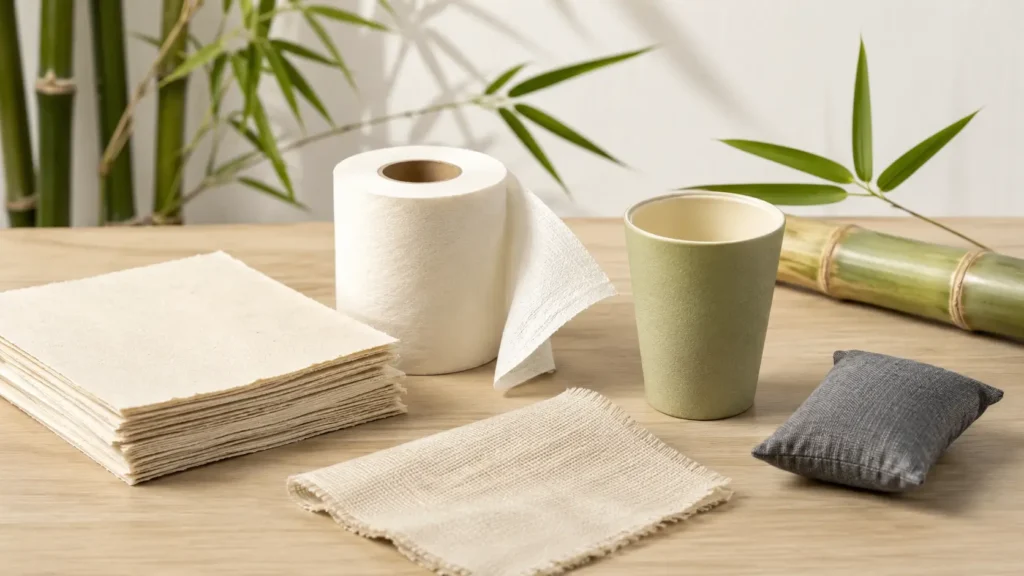
The list matters. The source of each benefit matters more.
Benefits That Start With the Living Bamboo Plant
Before bamboo becomes tissue, paper, textile, board, packaging, or charcoal, it is a living grass. Some of bamboo’s strongest benefits belong here: fast growth, rhizome regrowth, carbon absorption, oxygen release, and soil protection.
1. Bamboo can grow extremely fast
Bamboo’s growth speed is the benefit most people remember first.
Certain bamboo species have been recorded growing about 91 cm, or 35 inches, in a single day under exceptional shooting-season conditions. That figure explains why bamboo attracts attention as a fast-renewing plant, but it should be treated as a peak record, not the normal daily speed of every bamboo plant.
The number is useful. The supply question is more useful.
For material use, fast growth only matters when it can become repeatable raw material supply. A plant that grows quickly but cannot support consistent harvesting, processing, and fiber availability is not very helpful for paper, packaging, boards, or other industrial material routes.
Bamboo becomes commercially interesting when growth speed, harvest timing, land management, and usable fiber supply work together. For a deeper explanation of the growth-rate number, see our guide on how fast bamboo can grow.
2. Bamboo renews through underground rhizomes
The part people see is the culm. The part that makes bamboo unusual is underground.
Bamboo grows new culms from a rhizome system. Once a bamboo stand is established and managed well, new shoots can keep rising from that living network. The plant is not starting from zero after every harvest.
This is why bamboo renewability deserves more attention than the “fastest-growing plant” headline. The rhizome system allows managed bamboo stands to keep producing over repeated cycles. Species, climate, harvest age, and local growing conditions still matter, but bamboo has a biological advantage many slower tree resources do not have.
For industries that need repeat production, this is the practical part. A buyer does not only care whether a material sounds sustainable on a label. They care whether the material can support the next order, and the order after that.
3. Bamboo absorbs carbon dioxide and releases oxygen while growing
Bamboo absorbs carbon dioxide and releases oxygen through photosynthesis, like other green plants.
Where bamboo stands out is the combination of fast growth and dense biomass. That is why bamboo often appears in environmental restoration, carbon absorption, and plant-based material discussions.
This benefit belongs to living bamboo.
A bamboo grove can support a carbon story. A finished tissue roll needs more careful wording. The two can support the same brand direction, but they are not the same claim.
4. Bamboo roots and rhizomes can help protect soil
Bamboo is already useful before it becomes a product.
Its roots and rhizomes can help grip soil in suitable growing regions, supporting erosion control and slope stability. INBAR also discusses bamboo’s root system and rhizomes in the context of bamboo and land restoration. Fallen bamboo leaves can help cover the soil layer as well.
This point is not usually the main reason someone buys bamboo tissue or bamboo packaging, but it helps explain why bamboo is valued as a raw material crop. The plant has environmental value before it reaches a factory.
Benefits That Come From Bamboo as a Material
After harvest, bamboo is no longer just a plant in the field. It becomes a material route.
Culms can be used for boards, furniture, utensils, and household goods. Fibers can move into textiles or pulp. Bamboo pulp can be used for paper and tissue products. Bamboo can also be processed into charcoal for a completely different use case.
This is where the next group of bamboo benefits begins.
5. Bamboo gives manufacturers a plant-based material source
Bamboo gives manufacturers a recognizable plant-based starting point.
That matters because many product categories are looking for material stories that are easier for consumers to understand. Bamboo does not need much explanation. It already carries a natural, clean, simple image.
But the starting material is only the start.
A bamboo pulp sheet, a bamboo textile, a bamboo board, and a bamboo charcoal bag all move through different processing routes. Once processing begins, the finished product has to be judged by its actual structure, not just the plant it came from.
For paper and tissue, this is where bamboo pulp becomes relevant. The buyer is no longer talking about a bamboo forest. They are looking at pulp quality, sheet formation, softness, strength, ply, roll size, and whether the approved sample can be repeated in bulk production.
6. Some bamboo products can support biodegradable or lower-plastic discussions
Bamboo starts as a plant, so it naturally fits many biodegradable, compostable, and lower-plastic discussions.
The finished product decides how far that claim can go.
A plain bamboo paper sheet and a coated bamboo cup cannot use the same biodegradability claim. A bamboo basket, a bamboo board with adhesive, a bamboo textile, and a bamboo tissue roll are all made through different routes. If a coating, glue, additive, film, or mixed material enters the product, the claim changes.
This is not a small wording issue. It affects product labels, retailer requirements, certification discussions, and destination-market compliance.
A buyer planning retail packaging should ask three practical questions before using a claim:
What is the product made of?
What has been added?
What does the destination market require that claim to prove?
Bamboo gives manufacturers a strong plant-based starting material. The finished product still has to earn the claim.
7. Bamboo can reduce dependence on some wood-based materials
Bamboo does not have to replace wood everywhere to be valuable.
Its value is that it gives brands another plant-based material route. Bamboo can be used in boards, paper, packaging, kitchenware, utensils, household goods, textiles, and some construction-related applications.
In paper and tissue, bamboo pulp can support a tree-free material story. In home goods, bamboo culms and boards give products a natural look. In packaging, bamboo can help brands move away from purely plastic or traditional wood-fiber positioning.
Wood still has its place. So do cotton, recycled paper, metal, and plastic in the right application.
The point is not that bamboo wins every material comparison. The point is that it adds another usable option.
8. Bamboo has strong consumer recognition as a natural material
Some materials need a long explanation. Bamboo usually does not.
Consumers already connect bamboo with nature, simplicity, and clean design. That recognition is one reason bamboo appears in toothbrushes, cutting boards, paper products, kitchenware, furniture, packaging, textiles, and household items.
This can help product development. A bamboo product can carry a natural material story without forcing the brand to educate the customer from zero.
Still, recognition does not rescue a weak product. A rough bamboo tissue roll will not win repeat buyers just because the package says bamboo. A weak board will not become durable because the material sounds sustainable.
The bamboo story helps open the door. Product quality decides whether the customer comes back.
9. Bamboo fiber can support moisture absorption and breathability in textiles
Moisture absorption and breathability are mainly textile points.
They matter in bamboo towels, bedding, socks, and clothing, where comfort and moisture handling are part of the product promise.
For bamboo paper and tissue, the buyer is usually looking at different things: pulp quality, softness, strength, sheet structure, ply, wet performance, roll size, and production consistency.
A lot of generic bamboo benefit lists get lazy here. They take a textile benefit and place it on a paper product.
That makes the claim weaker, not stronger.
Claims That Only Fit Specific Bamboo Forms
Some bamboo benefits sound attractive because they are easy to say.
Antibacterial. UV protection. Deodorizing. Absorption.
These are also the easiest claims to misuse. They should not be copied across every bamboo product just because the word “bamboo” appears on the label.
10. Antibacterial and UV-related claims need product-specific support


Antibacterial claims need evidence from the specific product, not just the plant name.
Bamboo is often associated with clean and natural material positioning, but that does not make every bamboo product antibacterial. A bamboo textile, a bamboo cutting board, a bamboo tissue roll, and a bamboo charcoal bag are not the same finished product.
If a brand wants to make an antibacterial claim, the claim should match the material and the testing behind that specific item.
UV-related bamboo claims are even narrower. They usually belong to clothing, fabric, or outdoor textile discussions. They add very little to bamboo paper, bamboo pulp, bamboo boards, or bamboo charcoal.
This is a claim area to verify, not a phrase to copy.
11. Bamboo charcoal can be used for absorption and deodorizing products
Deodorizing is the clearest example of a bamboo benefit that belongs to a specific form.
If a bamboo product is designed for odor absorption, it is usually using bamboo charcoal. Shoe inserts, wardrobe bags, fridge deodorizer packs, storage products, and household odor-control items are common examples.
Bamboo charcoal is not ordinary bamboo fiber. Processing changes the material structure and gives it a different job.
A bamboo tissue roll is built around softness, strength, sheet quality, and daily paper use. A bamboo charcoal bag is built for absorption and odor control. They come from the same plant, but they are not selling the same benefit.
Deodorizing belongs to bamboo charcoal, not bamboo pulp tissue.
What This Means for Bamboo Paper and Tissue Products
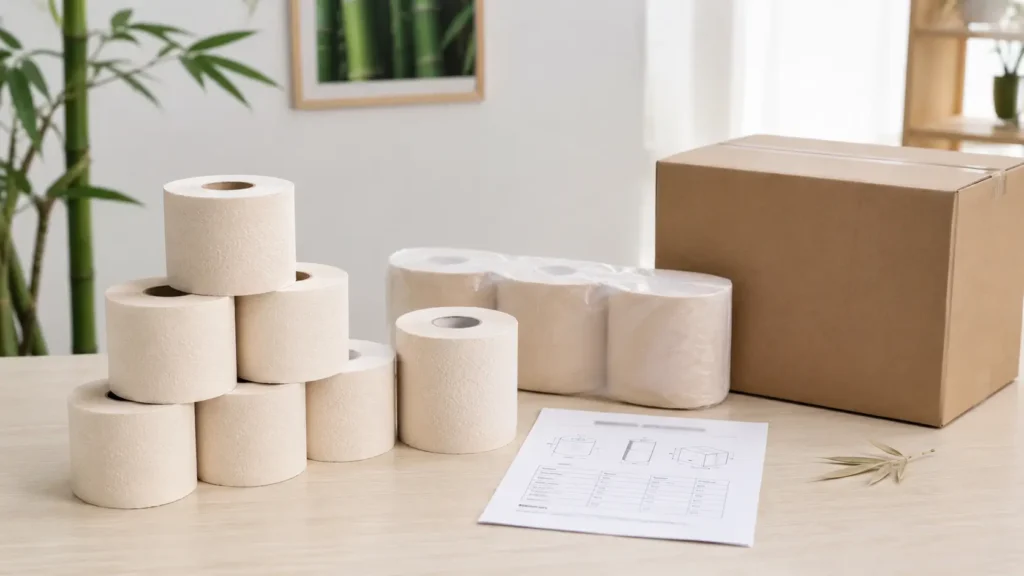
For bamboo paper and tissue, the question is not only whether bamboo is a good plant.
The project becomes practical when bamboo turns into a SKU.
A buyer has to confirm pulp choice, ply, sheet count, roll size, wrapping style, carton strength, and whether the approved sample can be repeated in bulk production. That work is less exciting than a bamboo forest story, but it is closer to how real B2B orders succeed or fail.
This is the part Newland Bamboo cares about in bamboo tissue products and bamboo toilet paper projects.
Bamboo gives the product a plant-based material foundation. Manufacturing decides whether that material becomes a soft, stable, export-ready paper product. The difference shows up in the sample, the carton, the roll specs, the packaging claim, and the repeat order.
For private label projects, buyers can also review packaging structure, artwork preparation, and sample confirmation through Newland Bamboo’s custom bamboo toilet paper manufacturing support.
A buyer cannot ship a bamboo story.
They ship cartons. They approve samples. They compare specifications. They come back only if the bulk order matches what was promised.
Bamboo Claims Buyers Should Check First
Are all bamboo products biodegradable?
No. Bamboo is plant-based, but the finished product decides the claim. A plain bamboo paper sheet and a coated bamboo cup cannot be described in the same way. Coatings, adhesives, additives, packaging materials, and certification requirements all affect whether a product can support a biodegradability or compostability claim.
Which bamboo benefits apply to paper and tissue?
Bamboo paper and tissue mainly use the bamboo pulp story: plant-based fiber, softness potential, sheet strength, roll structure, and tree-free positioning. Textile points such as breathability or UV-related claims are not the main reason buyers choose bamboo tissue products.
Can bamboo tissue claim antibacterial or deodorizing properties?
Not by default. Antibacterial claims need product-specific support, and deodorizing is usually a bamboo charcoal claim. A standard bamboo pulp tissue roll should not borrow claims that belong to charcoal bags or treated textile products.
Why do brands use bamboo instead of only wood-based materials?
Bamboo gives brands another plant-based material route and a natural material story consumers understand quickly. In paper and tissue, it can support tree-free positioning, but the final product still has to be judged by softness, strength, sheet count, roll size, packaging, and repeat-order consistency.