
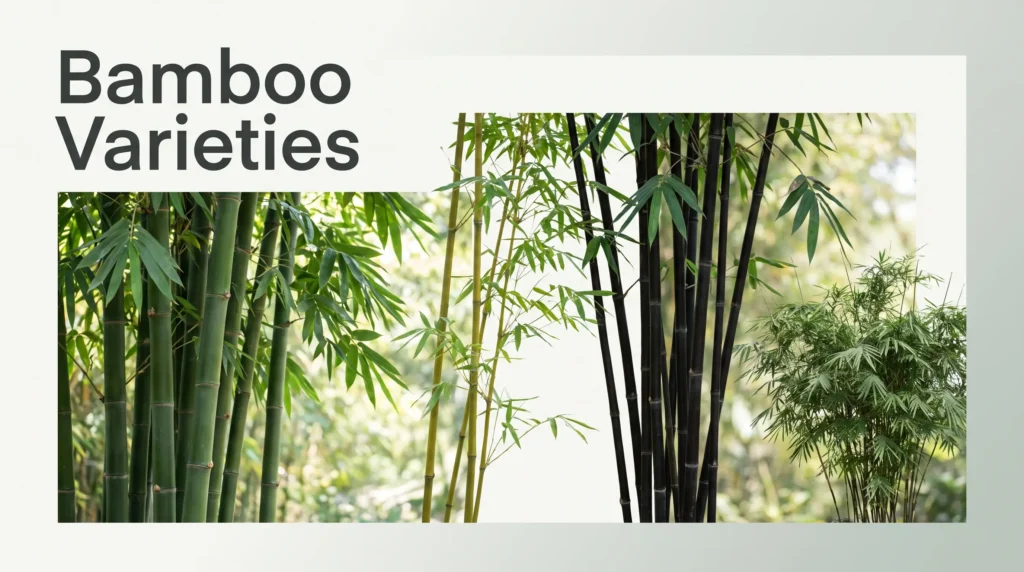
Bamboo includes roughly 1,400 to 1,500 accepted species across more than 70 genera, although the total changes as botanists revise accepted names, synonyms, and species boundaries. In everyday language, “bamboo varieties” may refer broadly to species, cultivated forms, or practical groups such as clumping and running bamboo. A useful comparison therefore starts with the correct classification level, then looks at growth habit, culm structure, and intended use.
What Does “Bamboo Varieties” Mean?
“Bamboo varieties” is a useful general phrase, but it is not always a precise botanical category. When a buyer, researcher, or reader names a particular variety of bamboo, the reference may point to a species, genus, cultivar, or simply a visible form. Botanically, those terms sit at different levels and should not be treated as interchangeable.
| Term | What it means | Example format | Why it matters |
|---|---|---|---|
| Genus | A group of closely related species | Phyllostachys | Organizes species that share important traits |
| Species | The basic named taxonomic unit | Phyllostachys edulis | Provides the clearest starting point for scientific identification |
| Botanical variety | A naturally occurring rank below species | var. within a scientific name | Describes a formally recognized natural variation |
| Cultivar | A cultivated selection maintained by people | A cultivar name in quotation marks | Often identifies selected color, form, or growth traits |
Genus, Species, Botanical Variety, and Cultivar
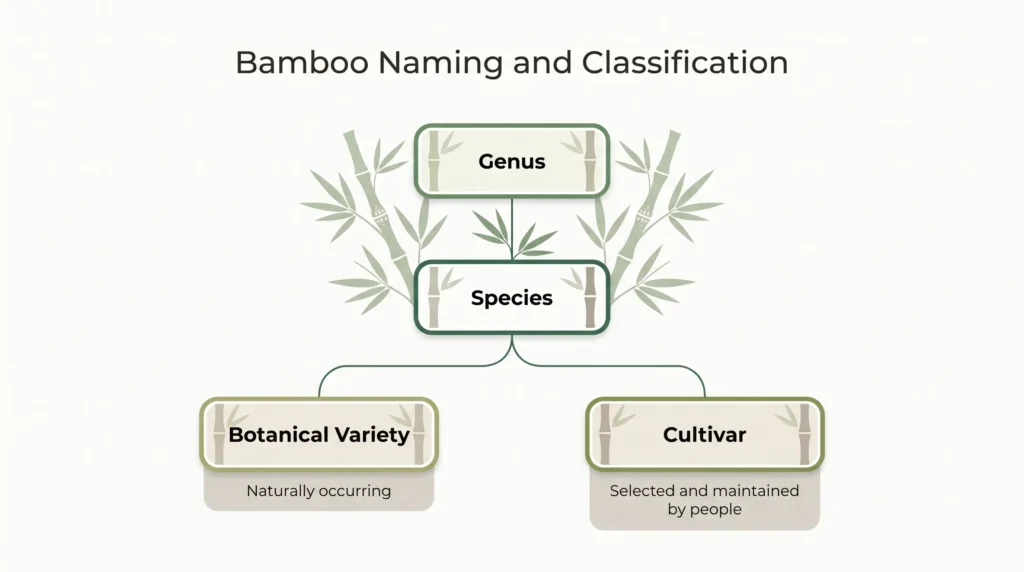
The first word in a scientific name is the genus, and the second identifies the species. For example, Phyllostachys edulis belongs to the genus Phyllostachys. A botanical variety is a recognized natural subdivision below species level, while a cultivar is a selected cultivated form.
This distinction matters because common names are often used loosely across markets. “Black bamboo,” for example, usually refers to Phyllostachys nigra, but similar wording may also be applied to other dark-culmed plants or cultivars. For research, technical specifications, or sourcing records, a scientific name is more reliable than a descriptive marketing name.
The practical rule is simple: use “bamboo varieties” for broad education, but request genus and species information when material identity could affect processing, documentation, or product claims.
How Many Bamboo Varieties Are There?
Current botanical references generally place bamboo at approximately 1,400 to 1,500 accepted species in more than 70 genera. The number is best treated as a range because accepted names, synonyms, newly described species, and disputed classifications continue to change. Nursery lists may appear much larger because they often count cultivars, subspecies, and forms alongside species. For comparison or sourcing, the important point is to know which taxonomic unit a supplier or reference is actually naming.
Why Can Common Bamboo Names Be Misleading?
Common bamboo names can be misleading because they may describe color, appearance, local usage, or a plant that is not botanically bamboo at all. Scientific names provide a more stable reference, even though accepted names can still change as taxonomy is revised.
Examples include:
- Lucky bamboo is Dracaena sanderiana, not a true bamboo.
- Heavenly bamboo is Nandina domestica, not a true bamboo.
- Bamboo palm commonly refers to a Chamaedorea palm, not a bamboo.
- Black bamboo often refers to Phyllostachys nigra, but culm color alone is not enough for identification.
Color may vary with age, sunlight, environment, and cultivar. Reliable identification may also require the rhizome pattern, branching structure, culm sheath, node features, leaves, and geographic origin.
This is more than a botanical detail. In trade or supplier documentation, an ambiguous common name can lead to a material being described too broadly or matched to the wrong technical expectation. When identity matters, record the scientific name if it is known or commercially required, and keep that information separate from finished-product performance claims.
What Are the Main Types of Bamboo?
Bamboo can be classified in several valid ways. The two most useful starting points are botanical growth form and rhizome growth habit. These describe how the plant grows; they do not by themselves determine whether a bamboo is suitable for food, construction, crafts, or pulp.
| Classification | Main groups | What the classification explains | What it does not prove |
|---|---|---|---|
| Growth form | Woody bamboo and herbaceous bamboo | Culm structure, plant form, and typical habitat | Final industrial suitability |
| Rhizome habit | Clumping and running bamboo | How new culms spread underground | Fiber quality or paper performance |
| Climate adaptation | Tropical, subtropical, and temperate types | General environmental fit | The exact range of every species |
| Intended use | Edible, ornamental, structural, craft, or pulp applications | Practical selection priorities | That every species in one group is interchangeable |
Woody Bamboo vs Herbaceous Bamboo
Most bamboo encountered in commercial use is woody bamboo. It produces jointed culms that harden as they mature and may range from small ornamental plants to giant structural species. Woody bamboo supplies most material used for shoots, poles, furniture, crafts, panels, and industrial fiber.
Herbaceous bamboos are generally smaller, softer-stemmed understory plants. They are part of the bamboo subfamily, but they do not produce the large woody culms normally associated with bamboo poles or industrial raw material.
The boundary matters because “bamboo” is broader than the tall canes seen in plantations, while most commercial discussions concern woody bamboo.
Clumping Bamboo vs Running Bamboo
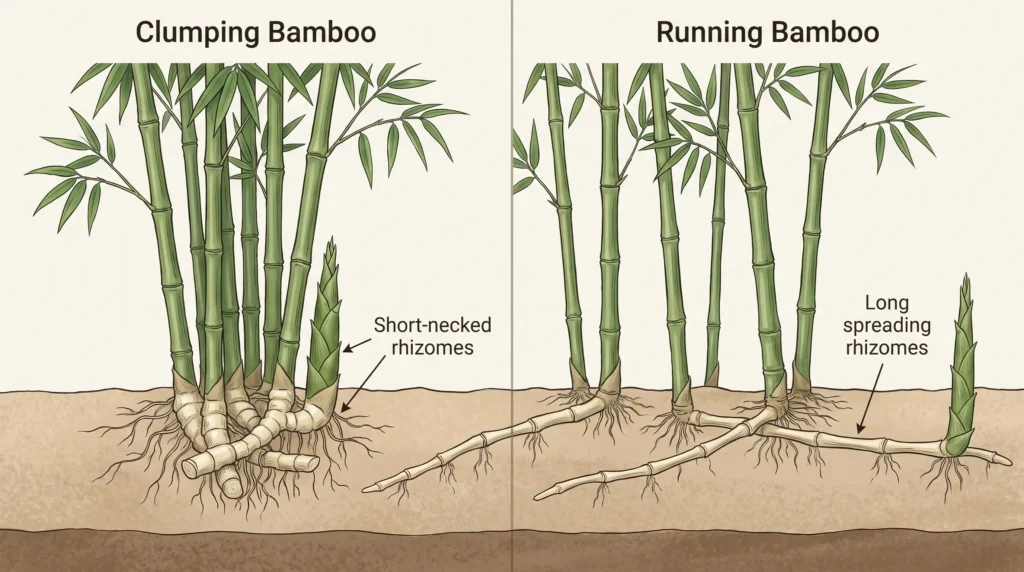
Clumping and running bamboo differ mainly in rhizome pattern and stand expansion. Clumping bamboo usually develops short-necked rhizomes that place new culms close to the parent plant. Running bamboo develops longer rhizomes that can send shoots farther from the original stand.
A clumping habit often produces a more concentrated stand, while a running habit can spread over a wider area. Running bamboo generally presents a higher spread risk, but clumping bamboo is not automatically non-invasive in every climate or site. Species behavior, conditions, and management still matter.
For industrial buyers, this classification may influence cultivation and supply management. It does not establish cellulose content, fiber morphology, softness, strength, or finished tissue performance.
Common Bamboo Genera and Representative Species
A short list of representative genera is more useful than an encyclopedia of ornamental names. The examples below show how bamboo groups differ in climate, growth habit, culm scale, and common applications.
| Genus | Representative species | General pattern | Commonly associated uses |
|---|---|---|---|
| Phyllostachys | P. edulis, P. nigra, P. aurea | Mainly temperate running woody bamboo | Shoots, poles, crafts, construction, and pulp research |
| Bambusa | B. vulgaris, B. textilis | Mainly tropical or subtropical clumping bamboo | Construction, weaving, furniture, landscaping, and pulp research |
| Dendrocalamus | D. asper, D. strictus | Large tropical or subtropical clumping bamboo | Edible shoots, structural poles, panels, and pulp or paper research |
| Fargesia | F. murielae, F. nitida | Temperate clumping bamboo, often with smaller culms | Ornamental planting and cold-climate landscaping |
| Guadua | G. angustifolia | Large American tropical bamboo | Structural construction, engineered products, and regional crafts |
| Gigantochloa | G. apus, G. atroviolacea | Tropical clumping bamboo | Building, furniture, musical instruments, and handicrafts |
These examples are not a ranking, and a genus does not have one uniform specification. Species within the same genus can differ in culm diameter, wall thickness, growth rate, chemical composition, and processing response.
Location also matters. A species that grows well in one climate may not provide the same yield or supply stability elsewhere. Detailed geographic distribution belongs in a growing-regions guide; here, location only explains why plants with similar names may not be commercially interchangeable.
How Do Bamboo Varieties Differ by Use?
Different varieties of bamboo suit different uses because each application requires a different combination of shoot quality, culm size, wall thickness, straightness, flexibility, durability, fiber characteristics, and supply consistency. Edible bamboo varieties may be selected for shoot quality and harvest traits, but they are not automatically the best choice for structural poles. An attractive ornamental cultivar may have little relevance to industrial fiber.
| Use | Important traits | Representative examples or groups | Buyer caution |
|---|---|---|---|
| Edible shoots | Flavor, shoot size, harvest timing, and safe preparation | Several Phyllostachys, Dendrocalamus, and Bambusa species | Edibility and preparation requirements are species-specific |
| Structural poles | Culm diameter, wall thickness, straightness, maturity, and durability | Guadua angustifolia, giant Dendrocalamus, selected Bambusa | Structural performance requires grading and treatment, not just a species name |
| Furniture and crafts | Workability, flexibility, surface appearance, and splitting behavior | Bambusa, Gigantochloa, Phyllostachys | Processing traditions and production methods affect suitability |
| Ornamental planting | Size, color, cold tolerance, and spread habit | Fargesia and ornamental Phyllostachys cultivars | Garden suitability is different from industrial sourcing |
| Pulp and paper | Fiber morphology, cellulose and lignin profile, ash, silica, age, and supply scale | Multiple woody bamboo species have been studied or used | Finished paper performance cannot be predicted from the common name alone |
The correct question is not which bamboo variety is universally “best,” but which material properties fit the intended product and process. Construction buyers prioritize culm geometry and mechanical performance. Food producers focus on shoots and harvest handling. Pulp and paper buyers need evidence about fiber, chemistry, raw-material consistency, and process compatibility.
What Makes a Bamboo Species Suitable for Pulp and Paper?
A bamboo species is suitable for pulp and paper only when its material characteristics, harvest condition, supply system, and pulping response fit the intended paper grade. The species name is one input, not a complete material specification.
| Factor | Why it matters | What a buyer should confirm |
|---|---|---|
| Fiber morphology | Influences strength, bonding, and sheet formation | Whether the pulp has been evaluated for the intended paper grade |
| Cellulose, lignin, ash, and silica | Affect yield, chemical demand, bleaching, and process control | Relevant pulp or raw-material data rather than a generic species claim |
| Culm maturity and consistency | Properties change with age and mixed incoming material | How raw-material consistency is managed |
| Storage and supply continuity | Affect deterioration, moisture, and commercial scale | Handling controls, traceability, and reliable volume |
| Pulping and tissue conversion | The same raw material may perform differently under different processes | Finished-sample softness, strength, absorbency, color, and converting behavior |
Multiple woody bamboo species have been studied or used for pulp and paper. Moso bamboo, Phyllostachys edulis, is widely known, but it is not the only bamboo considered for these applications. Suitability still depends on measurable material and process factors.
A species name is not a complete product specification. Buyers should confirm the documented material claim, relevant pulp or finished-product specifications, and an approved physical sample. When species-level identity is commercially necessary, useful supporting information may include the genus and species if identified, source or chain-of-custody documentation, available test references, and the supplier’s material description.
From Bamboo Species to Tissue Material Review
Importers, distributors, retailers, and private-label brands do not need to become bamboo taxonomists before evaluating a tissue product. They do need a clear material claim, relevant documentation, and a finished sample that matches the target specification.
A useful bamboo toilet paper review request should include:
- destination market and sales channel;
- target product type, color, and ply;
- sheet count, dimensions, GSM, and embossing expectations;
- packaging format and private-label requirements;
- bamboo genus or species, if already identified or commercially required;
- material, sourcing, chain-of-custody, or certification documents that need review;
- an available test reference, reference product, specification sheet, or packaging draft.
Newland Bamboo can review bamboo toilet paper samples and specification options against these inputs. Species-level raw-material details should be confirmed only when supported by relevant supply and production records; they should not be inferred from a broad common name.