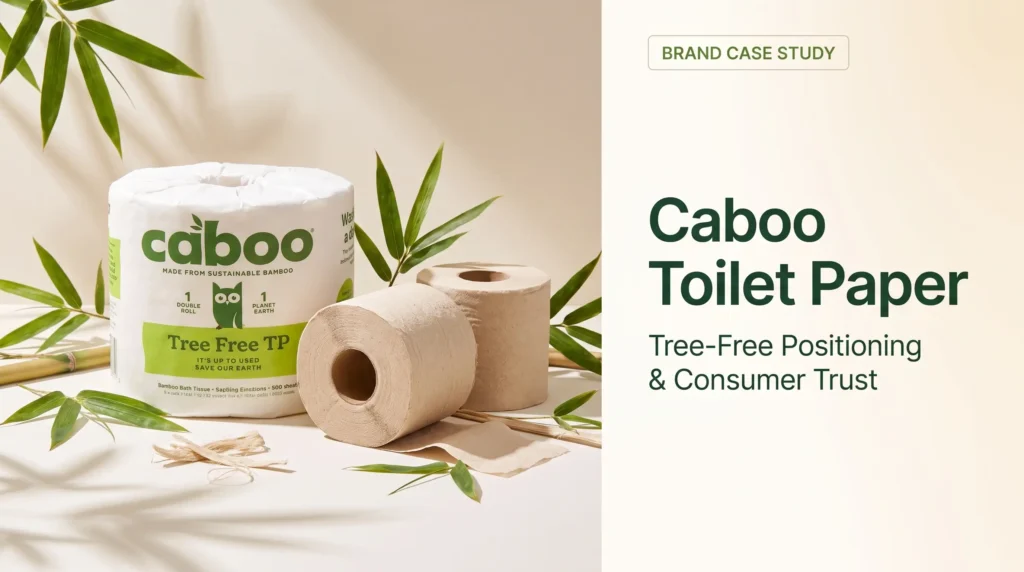
Quick Answer: What Makes Caboo Toilet Paper a Useful Brand Case?
Caboo toilet paper is a useful brand case because it turns one simple promise—Tree-Free—into a product, channel, and category system.
The brand does not rely on bamboo as a material claim alone. Its public offer connects a 24-roll toilet paper product, direct ecommerce, subscription purchasing, retail discovery, Amazon access, wholesale applications, and related tree-free household products.
The more important lesson appears after the brand wins attention. Search demand around Caboo moves into questions about reviews, bleaching, ingredients, PFAS, formaldehyde, manufacturing origin, and where to buy the product.
For private label tissue buyers, the case shows that a memorable environmental message can open the door, but product-level evidence and clear claim boundaries are what support trust.
This analysis uses Caboo’s public pages and the keyword dataset supplied for this project. It is not an independent product test or confirmation of Caboo’s suppliers.
Caboo Toilet Paper Public Fact Snapshot
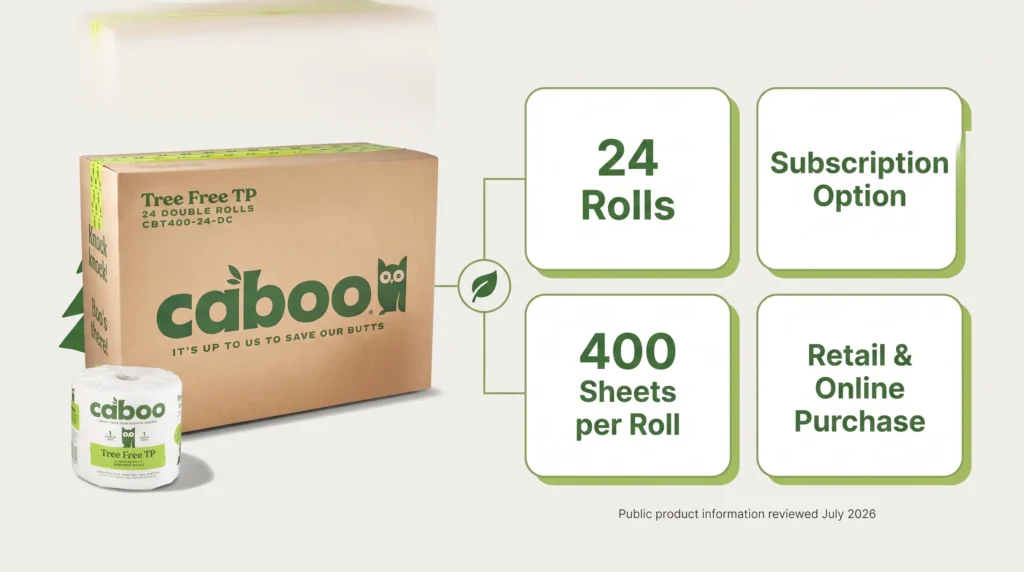
Caboo presents its main product as Caboo Tree-Free Bamboo Toilet Paper, using “tree-free” as the brand promise and “bamboo” as the material explanation. The Caboo bamboo toilet paper offer is supported by a defined pack, subscription option, and several purchase routes.
When reviewed in July 2026, the product page displayed 24 rolls with 400 sheets per roll, a subscribe-and-save option, and a message directing shoppers to Whole Foods Market. It also presented the product as septic safe, soft, biodegradable, BPA free, and free of elemental chlorine bleaching.
| Public Element | What Caboo Shows | Boundary |
|---|---|---|
| Product | Tree-Free Bamboo Toilet Paper | Does not define every Caboo SKU |
| Pack | 24 rolls, 400 sheets per roll | Other channels may use different selling units |
| Repeat purchase | Subscription with a stated discount | Does not reveal subscription performance |
| Retail discovery | Whole Foods message and store locator | Local inventory can change |
| Marketplace | Amazon route from the store locator | Does not confirm every listing or region |
| Wholesale | Public wholesaler application | Does not reveal wholesale scale |
| Product range | Toilet paper, paper towels, baby wipes, flushable wipes | Claims and accreditations may differ by category |
This is enough to show a functioning consumer offer. It is not enough to verify every performance, environmental, or safety claim independently.
How Caboo Turns “Tree-Free” into a Brand System
“Bamboo toilet paper” describes what the product is made from. “Tree-Free toilet paper” tells consumers what choice they are making.
That difference gives Caboo a stronger category frame:
| Material Language | Brand Language |
|---|---|
| Bamboo fiber | Tree-Free |
| Describes an input | Defines an alternative |
| Requires explanation | Creates a quick contrast |
| Fits one product | Can support a wider product family |
Caboo’s About page says the company wants to make traditional paper unnecessary and tree-free products a mainstream choice. The message is broader than one toilet paper specification.
The product offer then makes that promise usable. Caboo combines the environmental position with roll count, sheet count, softness language, septic-safe positioning, online ordering, subscription frequencies, and store discovery.
This matters because an environmental idea does not replace ordinary purchase questions. Consumers still need to understand what they receive, how it performs, where they can buy it, and how they can reorder it.
The same parent promise also supports category extension. Caboo sells toilet paper, paper towels, baby wipes, and flushable wipes. The products are different, but the customer can understand why they belong under one Tree-Free household brand.
That does not mean the products can share identical claims. A dry paper product and a wet wipe may have different fibers, ingredients, disposal instructions, tests, and accreditation scopes.
The transferable lesson is not to copy the phrase “Tree-Free.” It is to build a brand hierarchy:
One memorable parent promise → one credible product offer → several related categories with product-specific evidence.
Private label buyers still need to confirm the physical bamboo toilet paper specifications behind the promise, including ply, GSM, sheets, dimensions, embossing, color, core, pack count, and packaging structure.
How Caboo Supports the Same Positioning Across Multiple Channels
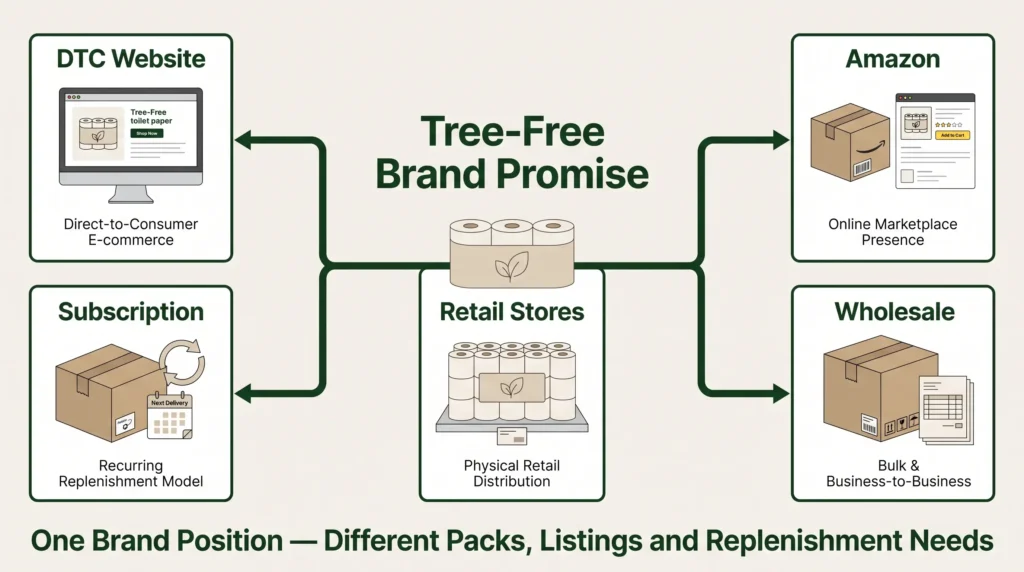
Caboo is not presented as a DTC-only brand.
Its public purchase routes include:
- direct ecommerce;
- subscription delivery;
- Whole Foods discovery;
- the Caboo Store Locator;
- an Amazon shopping route;
- a separate wholesale application.
The public pages do not show how much revenue comes from each channel. The useful point is that the same Tree-Free position can be reached through several buying paths.
The visible brand may remain consistent, but the operating requirements change:
| Channel | Main Requirement |
|---|---|
| DTC | Product page, shipping carton, customer education |
| Subscription | Replenishment timing and repeat-order value |
| Amazon | Listing images, marketplace copy, fulfillment fit |
| Retail | Shelf communication, barcode, pack size, retailer review |
| Wholesale | Case pack, distributor information, repeat supply |
A tissue brand planning several channels should not assume that one packaging configuration will perform equally well everywhere.
The core promise can remain stable. The sellable pack, carton, imagery, claim review, and replenishment plan may need to change by channel.
What Caboo Search Demand Reveals About Product Trust
The keyword dataset supplied for this analysis shows that users do not stop at the Caboo brand name. Searches for a Caboo toilet paper review sit alongside questions about ingredients, bleaching, PFAS, formaldehyde, “non-toxic” wording, manufacturing origin, and purchase locations.
Those searches are not proof that the product contains a questioned substance or has a safety problem. They show what consumers want the brand to clarify.
The trust journey looks like this:
Environmental interest → product-performance questions → ingredient and processing questions → evidence and origin verification.
Caboo’s public pages answer some questions clearly and leave others open from the pages reviewed.
| Trust Question | Public Information Reviewed | Evidence Status |
|---|---|---|
| Is it made from bamboo? | Product is presented as Tree-Free Bamboo Toilet Paper | Answered at product-positioning level |
| Is it septic safe? | Product page states “Septic Safe” | Published product claim |
| Does it use elemental chlorine bleaching? | Product page states it is free of elemental chlorine bleaching | Answered with a wording boundary |
| Is it completely unbleached? | The reviewed page does not describe the product simply as fully unbleached | Not confirmed |
| Is it PFAS-free? | Not clearly stated on the reviewed toilet paper page | Open from reviewed page |
| Is it formaldehyde-free? | Not clearly stated on the reviewed toilet paper page | Open from reviewed page |
| What are the full ingredients? | Bamboo positioning is provided, but no detailed toilet-paper ingredient declaration was identified | Partly answered |
| Where is it made? | About page refers to factories and farms in China, but not a named toilet paper facility | Partly answered |
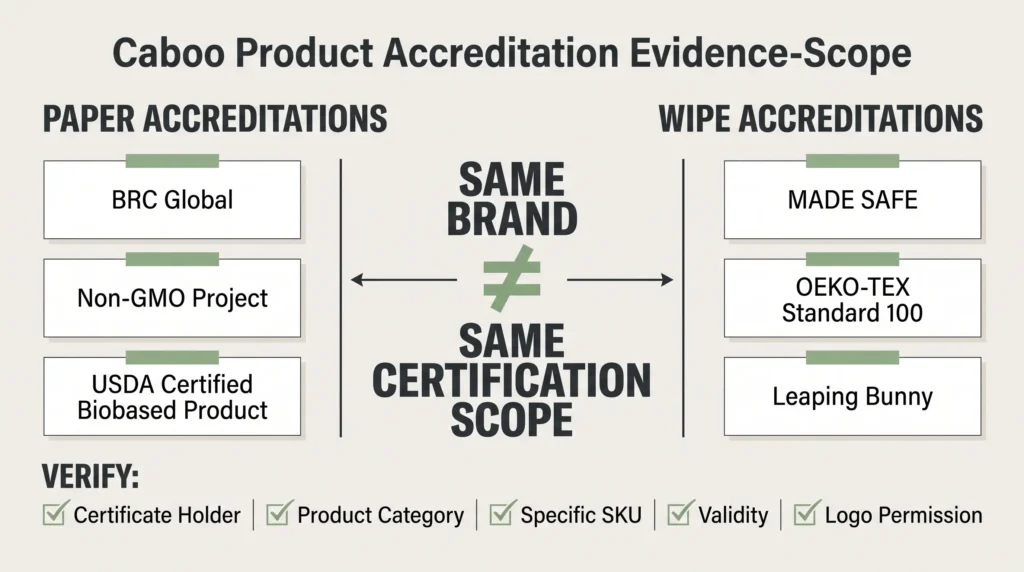
Caboo’s Sustainability page adds another useful lesson. It separates Paper Accreditations from Wipe Accreditations. BRC Global, Non-GMO Project, and USDA Certified Biobased Product appear under paper, while MADE SAFE, OEKO-TEX Standard 100, and Leaping Bunny appear under wipes.
That category separation is better than presenting every logo as universal. However, a category heading still does not replace a certificate-scope check.
Before printing a claim or logo, a private label buyer should confirm:
- the certificate holder;
- covered product or facility;
- applicable SKU;
- validity date;
- permitted logo use;
- approved wording;
- destination-market or retailer requirements.
One sustainability story can unify a brand. The supporting evidence still needs to be managed by product and category.
How Caboo Presents Its China Supply Chain
Caboo’s About page says the company works across U.S. distribution centers and factories, Canadian offices, and factories and farms in China. It also says the company knows where its products are sourced, made, and shipped.
That wording does not identify the factory producing the toilet paper SKU. It also does not establish that Caboo owns a Chinese factory or that every product follows the same sourcing route.
The notable point is that Caboo does not treat China sourcing as automatically incompatible with an environmental brand.
For private label buyers, the more useful distinction is not “imported versus sustainable.” It is:
- traceable versus unclear sourcing;
- controlled versus inconsistent specifications;
- supported versus unsupported claims;
- accurate versus misleading origin wording.
An imported tissue brand should be ready to explain material origin, manufacturing location, quality control, document scope, packaging inputs, and shipping route without making the supply chain sound simpler than it is.
Five B2B Lessons for Private Label Tissue Brands
1. Choose One Memorable Parent Promise
Caboo uses Tree-Free as the idea consumers can remember. Supporting details sit underneath it.
A new brand should decide what one message should remain after the customer looks away from the pack.
2. Make the Product Offer Prove the Position
The brand promise must connect to a real roll, pack, price position, use experience, and reorder path.
A strong story cannot compensate for an unclear sheet count, weak packaging, inconsistent quality, or a product that does not fit the target channel.
3. Design for Channels, Not Just for the Brand Website
Retail, DTC, Amazon, subscription, and wholesale may share a message but require different packs, cartons, listings, and inventory plans.
Channel planning should begin before the first SKU and artwork are finalized.
4. Separate Claims and Documents by Product
Do not treat a company-level accreditation page as permission to place every mark on every SKU.
Maintain a claim register covering the product, document, scope, validity, approved wording, and logo-use status.
5. Prepare for the Questions That Follow Awareness
Once consumers recognize an environmental brand, they may ask more technical questions about bleaching, ingredients, PFAS, formaldehyde, origin, and performance.
Brands should prepare those answers before they appear in retailer audits, marketplace questions, reviews, or customer-service messages.
A buyer preparing a private label toilet paper project should provide the target market, channel, parent promise, first SKU, pack format, artwork status, proposed claims, and required documents.
Newland Bamboo can review how those inputs connect to product specifications, packaging, samples, and available evidence before bulk production.
FAQ About Caboo Toilet Paper
Is Caboo toilet paper made from bamboo?
Caboo presents the product as Tree-Free Bamboo Toilet Paper. The current product specification or packaging should be used when confirming the exact material wording for a specific SKU.
Is Caboo toilet paper bleached or unbleached?
The reviewed product page states that Caboo toilet paper is free of elemental chlorine bleaching. That is not the same as confirming that the product is completely unbleached.
Does Caboo state that its toilet paper is PFAS-free or formaldehyde-free?
The reviewed toilet paper page did not clearly state either claim. PFAS-free or formaldehyde-free wording should require a relevant product-level declaration or test document rather than inference from general sustainability content.
Where is Caboo toilet paper made?
Caboo’s About page references factories and farms in China, alongside U.S. distribution centers and factories and Canadian offices. It does not name the specific production facility for the toilet paper SKU reviewed here.
Where can you buy Caboo toilet paper?
Caboo sells through its website, provides an Amazon route and local-store search through its store locator, and promotes Whole Foods Market on the product page. Actual local inventory should be checked before purchase.
Public Information Note
This case study is based on Caboo’s public product, About, Sustainability, Store Locator, and Wholesale pages, together with the keyword data supplied for this project.
Newland Bamboo does not claim to manufacture Caboo products, know its confidential suppliers, independently verify its product claims, or confirm every current retail listing.