
Warum dieser Fall für Einkäufer von Eigenmarken von Bedeutung ist
Who Gives A Crap is often described as a funny toilet paper brand with colorful wrapping and a strong purpose message.
That description is not wrong, but it is too comfortable.
The more useful question is harder: how does a company promise to donate 50% of profits, sell a bulky household paper product, build a subscription business, serve wholesale customers, expand internationally, and still move into mainstream retail?
That is the tension that makes this case worth studying.
Who Gives A Crap is not just a story about good branding. It is a story about how a purpose-led household paper brand has to carry several pressures at the same time: product cost, packaging identity, subscription operations, B2B ordering, retail presentation, supply continuity, and public impact claims.
This article is based on public sources. Those sources show the visible brand path: the 2012 toilet-seat crowdfunding campaign, the 50% profit donation promise, the wrapped-roll packaging system, the recycled and bamboo paper routes, the subscription and B2B systems, and retail expansion into channels such as Tesco, Whole Foods, and Waitrose.
They do not show the full private economics behind the brand.
That boundary matters. We cannot see the true supplier file, product margin, DTC retention rate, B2B wholesale pricing, packaging failure rate, or retailer terms. So this article does not treat Who Gives A Crap as a formula to copy.
It treats the brand as a set of pressure points.
For private label bamboo toilet paper buyers, the useful question is not “How do we copy Who Gives A Crap?”
The better question is: which parts of the product, packaging, claim support, channel system, and supply plan must be confirmed before a purpose-led toilet paper brand can survive beyond a clever story?
An Australian Paper Brand Built from a Crowdfunding Event
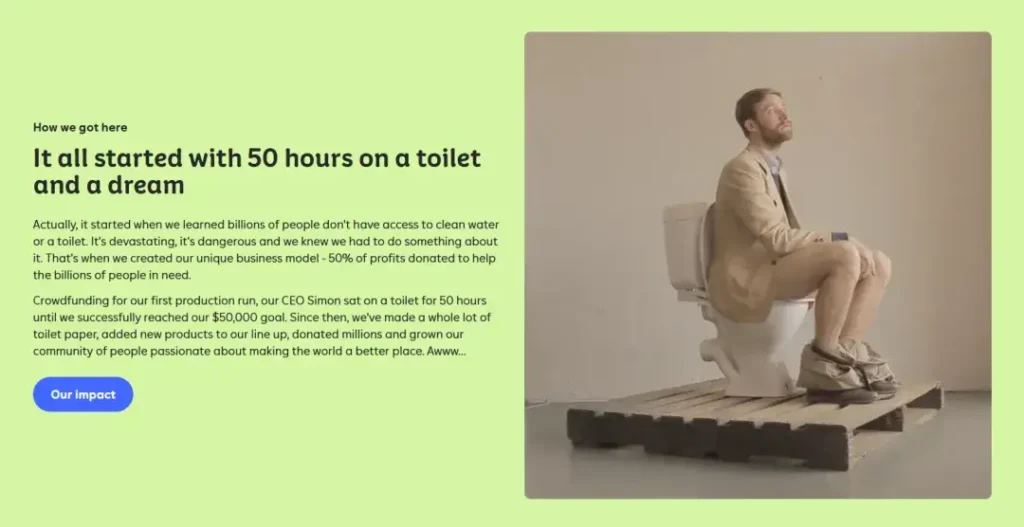
Who Gives A Crap is an Australian household paper brand founded in Melbourne, according to its official About Us page.
The public origin story is unusually specific for a toilet paper company. In 2012, Simon Griffiths launched an Indiegogo campaign while sitting on a toilet to raise money for the company’s first production run. The campaign positioned the product as toilet paper that would use 50% of profits to help build toilets and improve sanitation.
The crowdfunding page also said the funds would go into the first bulk production run and the brand’s “First Edition.” It noted that the team had spent two years working on the product, logistics, and business model before moving into bulk production.
That detail matters.
This was not only a publicity story. The public campaign was tied to manufacturing execution: product development, logistics planning, first production, and first customer demand.
Toilet paper is normally a low-attention category. Most consumers do not want to talk about it. They buy it, store it, use it, and replace it.
Who Gives A Crap’s launch created a reason to talk.
The toilet stunt, the brand name, and the sanitation purpose made the product easier to repeat in conversation. A person did not need to understand paper converting, pulp sourcing, or retail strategy to understand the basic idea: this is toilet paper connected to toilets for people who need them.
For a private label buyer, the point is not to copy the stunt.
The practical point is that a low-interest product needs a clear entry point before the buyer asks customers to compare softness, roll count, material, packaging, or price.
That entry point could be a cause, a material promise, a packaging system, a local market story, a hotel or office trial program, or a subscription convenience angle.
But attention is only the beginning. Product quality, packaging durability, carton planning, logistics, and repeat delivery decide whether the brand can keep selling after the first story is told.
The 50% Profit Promise Is Also a Cost Structure Problem
Who Gives A Crap’s 50% profit donation promise is one of the most memorable parts of the brand.
It is also one of the easiest parts to misunderstand.
From the outside, “we donate 50% of profits” sounds like a strong purpose message. But for any private label buyer trying to build a similar brand, the more uncomfortable question is financial: what kind of product cost, packaging cost, freight cost, system cost, and channel margin can survive that promise?
A purpose claim does not sit above the business model. It sits inside it.
If a brand commits to donating a share of profits, that brand still has to pay for paper, converting, wrapping, cartons, shipping, warehousing, subscription software, email systems, customer service, returns, B2B pricing, retailer requirements, and inventory risk.
That is why the lesson is not “copy the 50% number.”
The lesson is: do not put an impact promise on the front of a brand until the cost structure behind the product can carry it.
B Lab’s public profile for Good Goods Holdings Pty Ltd gives the company behind Who Gives A Crap an overall B Impact Score of 125.5. It also describes the company as selling toilet paper, tissues, paper towels, and related products while donating 50% of profits to help build toilets and support access to safe water.
That information is useful, but it should not be over-read.
B Corp certification is a company-level trust signal. It can support trust around governance, impact, transparency, and accountability. It does not prove the softness of a roll, the fiber composition of a bamboo product, the disintegration performance, the packaging recyclability, or the claim wording for a destination market.
A private label buyer should separate the layers:
Company-level claim: B Corp, mission, donation model, governance.
Product-level claim: recycled content, bamboo content, ply, sheet count, septic-safe wording, softness direction.
Packaging-level claim: paper wrap, plastic-free wording, recyclability, compostability, carton structure.
Channel-level claim: retail badges, marketplace labels, distributor documents, B2B buyer files.
The danger is mixing them.
A brand can have a strong company-level mission and still need product-level documentation. A product can use bamboo and still need careful claim review. A plastic-free wrapper can still create physical packaging risks during shipping and storage.
For buyers, the 50% profit promise should not be read as a branding trick. It should be read as a warning: the stronger the public promise, the more disciplined the product economics must be.
Turning a Low-Interest Product into Something People Could Talk About
The name Who Gives A Crap is not subtle.
That is part of the point.
Toilet paper is not a naturally exciting category. A serious sustainability or sanitation message could easily become heavy, worthy, or forgettable. Who Gives A Crap uses humor to make the topic easier to approach.
The brand name does several jobs at once.
It signals the product category. It hints at the sanitation mission. It creates a phrase people can repeat. It gives the brand a tone that is different from conventional supermarket tissue brands.
The sourcing implication is not that every tissue brand should use jokes.
Humor is not a universal strategy. In some markets, especially hospitality, office supply, healthcare, or conservative retail channels, a playful tone may not fit.
The broader lesson is tone-market fit.
A brand selling to young DTC consumers can take more risks with name, packaging, and copy. A brand selling into hotels, offices, distributors, or mainstream retail may need a tone that is still memorable but more controlled.
For a private label Bambustoilettenpapier brand, tone should be decided before packaging copy is written. It affects product names, front-panel claims, carton marks, marketplace titles, social content, and customer service language.
Who Gives A Crap shows that tone can help a commodity product become memorable. It also reminds buyers that tone must match the channel and customer.
Packaging Made the Roll Visible Before the Product Was Used
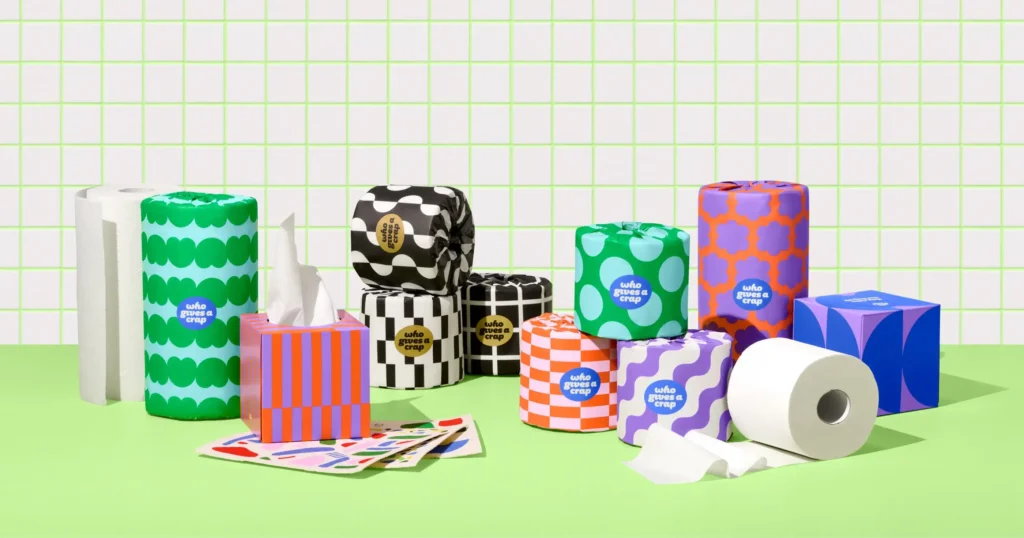
Packaging is one of the strongest parts of the Who Gives A Crap case.
Toilet paper is usually hidden away, stacked in a bathroom cabinet, or displayed in generic plastic multipacks. Who Gives A Crap made the individual roll visually recognizable through colorful paper wrapping and a retail-ready packaging system.
This was not only an aesthetic choice.
Lyon & Lyon’s packaging case describes the goal as visually disrupting an “aesthetically stagnant” toilet paper aisle. It also points to a real channel problem: sustainability messaging can be easier to communicate online than in retail, where a customer has only a few seconds to notice and understand a product.
Guardian’s 2025 report adds another important angle. It noted the business value of the wrapping and reported Simon Griffiths saying that without wrapping, the company might only be a fraction of its current size.
This changes how buyers should think about packaging.
Packaging is not only protection. It is part of the product experience before the paper is used.
For a toilet paper brand, packaging can help solve several problems:
- The product is low-interest
- The product is physically bulky
- The product may be more expensive than conventional tissue
- The material or impact story needs to be understood quickly
- The pack must work in ecommerce photos
- The pack may need to stand out on a retail shelf
- The product may be stored or displayed in a bathroom
Who Gives A Crap’s wrapping makes the roll visible. It turns a usually hidden product into something that can sit in a bathroom, appear in a photo, or stand out on a shelf.
It also changes the customer experience around a routine purchase. The box, wrapped rolls, bathroom storage, delivery moment, and reorder reminder all become part of the brand touchpoint. For a private label buyer, this means packaging should not be reviewed only as a front-panel design. It should also be reviewed as an unboxing asset, storage asset, product photography asset, reorder cue, and word-of-mouth trigger.
That does not mean every private label buyer should use colorful single-roll wraps.
For sourcing teams, the real question is channel fit. Wrapper design, roll size, case pack, product photography, and retail display cannot be separated. Kundenspezifische Tissue-Verpackungen is not a final artwork step; it is part of the channel plan.
A DTC subscription brand may need packaging that works for unboxing and product photography. A retail brand may need front-panel clarity, barcode placement, shelf blocking, and pack hierarchy. A hotel or office supplier may need cleaner carton handling, dispenser compatibility, and less decorative wrap. An eco-focused buyer may want plastic-free packaging, but still needs moisture protection and shipping durability.
The practical question is not “Should my brand look like Who Gives A Crap?”
The better question is: what does packaging need to do before the customer even touches the paper?
Subscription, B2B, and Retail Are Systems, Not Just Channels
Who Gives A Crap’s public channel story is easy to simplify: it started online, built subscriptions, expanded internationally, served wholesale customers, and later moved into mainstream retail.
That summary is clean, but it hides the operating burden.
A subscription business is not just a “subscribe and save” button. Recharge’s Who Gives A Crap subscription case study shows that Who Gives A Crap used Klaviyo and Recharge to send subscribers an upcoming order email three days before billing, allowing customers to delay an order if they did not need more product yet.
That small detail matters.
Toilet paper is a repeat-purchase product, but repeat purchase does not mean automatic satisfaction. Customers may need to delay, skip, change address, adjust quantity, or pause because they already have enough stock at home.
That means the cost of a subscription model is not only in the roll and the carton. It is also in the system that manages timing, reminders, customer behavior, inventory, and fulfillment.
B2B adds another layer.
Shopify’s Who Gives A Crap case study says Who Gives A Crap used expansion stores and B2B on Shopify to support wholesale markets, including dedicated workflows such as bespoke price lists, self-service ordering, and automated fulfillment.
That is a very different problem from selling a single box of toilet paper to one household.
A wholesale buyer may need account pricing, repeat orders, case-pack consistency, delivery planning, invoice handling, and stable product files. A distributor or office-supply buyer does not only care whether the wrapper is funny. They care whether the product can be reordered with the same specification.
Retail adds a third layer.
Guardian’s 2025 report on Who Gives A Crap places Who Gives A Crap in a mainstream retail context, including Tesco in the UK and earlier listings with Whole Foods and Waitrose. Retail gives visibility, but it also adds shelf constraints, price comparison, pack hierarchy, barcode requirements, case packs, pallet planning, retailer review, and replenishment pressure.
For a private label buyer, the real lesson is this:
DTC, subscription, B2B, and retail are not four marketing channels sitting on top of the same product file. Each one changes what the product file must contain.
A brand that wants to sell through multiple channels needs to confirm early:
- What pack count works for DTC?
- What pack count works for retail?
- What carton structure supports B2B?
- What subscription frequency makes sense?
- What happens when a subscriber delays an order?
- What product file does a wholesale buyer reorder from?
- What claims can survive retailer review?
- What inventory buffer is needed if demand spikes?
- What system handles customer changes, B2B pricing, and fulfillment?
This is where many private label brands underestimate the work.
They plan the brand story first, the packaging second, and the operating system last. A household paper brand should do the opposite: define the repeat-order model, channel plan, packaging requirements, and supply file before the public story starts scaling.
Growth Can Expose Supply Chain Weakness
The COVID period is easy to misread in toilet paper stories.
Toilet paper demand surged, online interest rose, and many paper brands suddenly had more attention than they expected. From the outside, that can look like a lucky growth window.
Who Gives A Crap’s public interviews show a more complicated picture.
Qantas interview with Simon Griffiths reported that he pushed back on the idea that the company was simply a “winner” during the COVID panic-buying period, because supply chain issues and staff burnout risks came with the sales surge.
That is a more useful lesson than the growth headline.
A demand spike is not automatically good news for a household paper brand. It can expose weak inventory planning, narrow supplier options, slow production scheduling, fragile fulfillment systems, and overloaded customer support.
For private label buyers, this matters because bamboo toilet paper is bulky, freight-sensitive, and specification-sensitive. The product is not a small cosmetic item that can be air-shipped easily when stock runs low.
If a bamboo toilet paper brand grows faster than expected, the buyer has to ask:
- Can the supplier repeat the same specification?
- Can production capacity absorb the forecast?
- Can cartons and wrapping be produced at the same speed?
- Can the brand hold enough inventory without damaging cash flow?
- Can fulfillment handle a demand spike?
- Can customer service handle delays or stockouts?
- Can the brand avoid changing product feel during emergency replenishment?
A strong brand story can create demand. It cannot solve supply continuity by itself.
That is the uncomfortable part of the Who Gives A Crap case: the same product that benefits from repeat household demand also creates heavy operational pressure when demand moves faster than supply.
For private label buyers, the sourcing question should be asked early:
If demand suddenly doubles, can this product still be made, packed, shipped, and reordered without changing the customer experience?
Product Expansion Followed the Household Paper Category
Who Gives A Crap is not only a toilet paper brand.
Public B Lab information and brand materials show that the company sells toilet paper, tissues, paper towels, and other household paper products. Guardian coverage also describes the brand’s move beyond its original toilet paper focus.
This product expansion follows a household paper logic.
Toilet paper is the hero SKU. It is essential, repeat-use, and naturally suited to bulk purchase or subscription. Once a customer accepts the brand in the bathroom, related categories such as tissues and paper towels become easier to introduce.
For private label buyers, this is an important distinction.
Product expansion should not happen just because a factory can supply more SKUs.
A new paper towel SKU changes absorbency testing, sheet size, roll structure, packaging dimensions, carton planning, and channel presentation. A facial tissue SKU changes softness expectations, box format, dispensing feel, retail display, and ecommerce photography.
Product expansion is not only a sales decision. It changes the sourcing file.
A tissue manufacturer may be able to offer bamboo toilet paper, kitchen paper towels, facial tissues, napkins, hand towels, jumbo rolls, and center-pull paper towels. But a consumer brand should not launch every product at once unless the customer, channel, packaging, and claim system can support that expansion.
A better path is staged.
First, identify the hero SKU.
Second, make the product experience and packaging repeatable.
Third, build trust around the material and brand promise.
Fourth, expand into adjacent household paper categories that the same customer can understand.
That is the difference between a product catalog and a brand system.
For private label bamboo tissue buyers, the key question is:
Which bamboo household tissue products should carry the brand first, and which product should come next only after the buyer has proof of demand, packaging readiness, and supply stability?
Bamboo, Recycled Paper, and Claim Support

Who Gives A Crap is also useful because it is not a simple “bamboo-only” case.
The brand offers recycled and bamboo paper routes. Guardian’s reporting describes the company as beginning with recycled toilet paper and later adding a bamboo version. Current product pages also distinguish between recycled and bamboo options.
That matters for private label buyers because “sustainable toilet paper” is not one material strategy.
A buyer may choose bamboo pulp, recycled fiber, mixed fiber, unbleached paper, FSC-certified sourcing, plastic-free packaging, or a combination of these. Each path has different implications for softness, strength, cost, sourcing, certification, packaging claims, and customer perception.
Bamboo is often positioned around tree-free sourcing, softness, and strength. Recycled fiber is often positioned around lower resource use and circularity. These are related sustainability messages, but they are not identical.
The buyer needs to choose a material route before finalizing brand language.
A bamboo toilet paper brand should not borrow recycled-paper claims. A recycled toilet paper brand should not borrow bamboo claims. A mixed material product should not present itself as 100% bamboo unless the sourcing and testing support that claim.
This matters because bamboo toilet paper has already faced public scrutiny at the category level.
Which? testing reported that several bamboo toilet paper brands in the UK did not match their bamboo-only claims, while Who Gives A Crap was reported as matching its 100% bamboo claim in that test. The value for private label buyers is not to use this as a competitor attack. The value is to understand that material claims can be tested.
For private label buyers, claim support should be confirmed before packaging approval.
This includes:
- Fiber composition
- Bamboo or recycled content claims
- FSC-related statements
- Plastic-free packaging claims
- Compostable or biodegradable wording
- PFAS-free or chemical-related statements
- Destination-market packaging requirements
A sustainability claim should be easy for customers to understand and strong enough for the buyer to defend.
What Public Sources Still Do Not Tell Us
Public sources give us a useful view of Who Gives A Crap’s brand path.
They show the crowdfunding story, the 50% profit donation promise, the product range, the B Corp profile, the subscription systems, the B2B tools, and the move into mainstream retail.
They do not show the private operating file behind the brand.
From public sources alone, we cannot confirm:
- The true cost difference between recycled paper and bamboo paper
- The exact supplier structure behind each product line
- The DTC subscription retention rate
- The B2B wholesale margin structure
- The Tesco, Whole Foods, or Waitrose retail terms
- The packaging failure rate during shipping
- The true inventory buffer during demand spikes
- The full customer service cost behind subscription changes
- The real margin impact of donating 50% of profits
- The product-level documentation behind every market claim
This is not a weakness of the article.
It is the point of the article.
A public brand case can help a buyer ask sharper questions. It cannot replace supplier audits, sample testing, packaging trials, cost modeling, certification review, or channel planning.
For private label buyers, the unanswered questions are the most useful part of the case.
They show where the real procurement work begins.
Before copying the wrapper style, tone of voice, subscription offer, or impact message, a buyer should build a working file around questions like:
- What product specification can be repeated?
- What claim can be documented?
- What packaging can survive the channel?
- What price structure can support the promise?
- What inventory plan can handle growth?
- What B2B buyer file can support repeat orders?
- What impact claim can be explained without overpromising?
A brand story may win attention. A product file decides whether that attention can become repeat orders.
Was Einkäufer von Eigenmarken aus diesem Fall tatsächlich mitnehmen können
This article cannot tell you Who Gives A Crap’s internal retention rate, customer acquisition cost, private supplier structure, or true margin strategy. Those details are not public.
What it can show is a visible brand path and the business logic behind that path.
Für Einkäufer von Eigenmarken stechen sechs nützliche Urteile besonders hervor.
A low-interest product needs a memorable entry point
Who Gives A Crap used a crowdfunding event, a bold name, and a sanitation-linked mission to make toilet paper easier to talk about.
Private label buyers do not need to copy the stunt. But they do need a reason for customers to notice a product that would otherwise be treated as a commodity.
Purpose must be connected to the business model
The 50% profit donation is part of the brand’s public identity. It gives the product a reason beyond material and function.
For buyers, the lesson is that social impact or environmental claims need a workable operating model, not only packaging copy.
Packaging can create recognition before product use
Who Gives A Crap’s wrapped rolls made the product more visible in ecommerce, bathrooms, and retail shelves.
For private label buyers, packaging should be reviewed as part of the product system: product photos, shipping, storage, shelf presence, claim wording, and customer experience.
Retail expansion changes the supply requirements
Moving from DTC to mainstream retail requires more than a product page.
It requires pack hierarchy, barcodes, case packs, carton strength, pallet planning, retail documents, repeat specifications, and claim consistency.
Third-party trust signals matter
B Corp certification, public impact language, and material claim scrutiny all show that trust has to be supported by verifiable information.
For private label buyers, this means claim planning should happen before artwork approval.
Material strategy must be clear
Who Gives A Crap operates with recycled and bamboo paper routes. That is useful because it shows that “sustainable paper” can mean different material strategies.
Private label buyers should choose the material route first, then build product claims, packaging language, and documentation around that route.
Who Gives A Crap does not provide a formula to copy. It provides conditions to check before building a purpose-led household paper brand.
FAQ: Who Gives A Crap and Private Label Bamboo Toilet Paper
Is Who Gives A Crap an Australian brand?
Yes. Who Gives A Crap is an Australian household paper brand founded in Melbourne. It now operates across several international markets, but its origin story starts in Australia.
How did Who Gives A Crap start?
The brand began with a 2012 crowdfunding campaign linked to a first production run. Simon Griffiths promoted the campaign by sitting on a toilet until the campaign reached its funding goal.
For private label buyers, the useful point is that a routine product can still be launched with a memorable story, but the story must lead into real product delivery.
What is the 50% profit donation model?
Who Gives A Crap publicly states that it donates 50% of profits to help build toilets and improve sanitation or safe water access.
For B2B buyers, the lesson is that impact claims should be planned as part of the business model, not added after packaging design.
Why is Who Gives A Crap packaging often discussed?
Its colorful wrapped rolls help make a normally low-interest product more visible. Design coverage describes the packaging as a way to disrupt a stagnant toilet paper aisle, while retail reporting shows how important packaging became as the brand moved into mainstream channels.
For private label buyers, packaging is not just decoration. It affects recognition, product photography, bathroom display, retail shelf presence, and claim communication.
Does Who Gives A Crap only sell bamboo toilet paper?
No. The brand sells household paper products such as toilet paper, tissues, paper towels, and related items. It also has both recycled and bamboo paper options.
For private label buyers, that means the brand should be studied as a household paper system, not only as a bamboo toilet paper product.
Wie Newland Bamboo diese Art von Produktplan unterstützen kann
A brand inspired by Who Gives A Crap should not start by copying the colorful wrapping, the cheeky tone, or the donation language.
It should start with the harder questions.
Can the product specification carry the brand promise?
Can the packaging protect the roll and still support the claim?
Can the carton plan work for DTC, B2B, or retail?
Can the material route be documented?
Can the same product file be repeated across future orders?
Can the buyer support the claim after the first marketing launch?
Neuland-Bambus supports buyers developing bamboo toilet paper and related household tissue products for private label, wholesale, ecommerce, retail, hospitality, and mixed-container supply.
For a purpose-led bamboo toilet paper project, the practical discussion should cover material route, ply, GSM, sheet count, roll size, packaging format, carton packing, claim support, sample approval, MOQ, mixed loading, and repeat-order consistency.
The point is not to imitate another brand’s public story.
The point is to build a product and supply plan strong enough to support your own story.
Send your target market, product positioning, roll specification, pack format, estimated quantity, packaging direction, document requirements, and expected order schedule. Newland Bamboo can help prepare a practical sample and quotation discussion before bulk production begins.